On 22 march 2016, at 10 a. M., the supreme people's court held a press conference in which it issued the interpretation (ii) of the supreme people's court on the application of the law in cases of patent violations and answered questions from journalists。
Live playback
Date: 22 march 2016, 10 a. M
Place: court of the supreme people's court
Guest 1: president of the third chamber of the supreme people's court
2. Vice-president of the third division of the supreme people's court
3. Press spokesman of the supreme people's court workers
President song xiaoming of the third chamber of the supreme people's court
Reporters:
Good morning! The subject of today's press conference is to inform you about the interpretation (ii) by the supreme people's court (hereinafter " interpretation ii " ) of certain questions concerning the application of the law in cases of patent violation。
On 25 january 2016, the trial committee of the supreme people's court discussed and adopted interpretation ii at its 1676th meeting. This interpretation will take effect on 1 april 2016. I will now give a brief introduction to the background and main elements of explanatory ii。
Background
In december 2009, the supreme people's court issued an interpretation of certain issues in the application of the law in the trial of disputes over patent violations. This judicial interpretation plays an important role in the legal protection of patentee interests and in stimulating scientific and technological innovation. Over the past five years, patent tort cases have grown steadily, with legal implications deeply touching upon the basic patent regime and philosophy, technological facts becoming more advanced and complex, and market values and benefits becoming greater. The beijing, shanghai and jiangsu high people's courts have issued guidance on the handling of patent infringement disputes. In particular, the central committee of the communist republic of china (cpc) decision on a number of major issues in the overall deepening of the reform calls for strengthening the use and protection of intellectual property rights, improving incentives for technological innovation and building a national innovation system. The standing committee of the national people's congress decided to establish intellectual property courts in beijing, shanghai and guangzhou, which would focus on more specialized and technical cases such as patents. To ensure proper enforcement of patent laws, to harmonize and refine patent tort standards and to respond in a timely manner to the new expectations of science, technology and innovation for patent trials, it is necessary to redraft judicial interpretations of patent tort criteria。
As early as the end of 2011, the intellectual property court of the supreme people's court began a special study of patent tort criteria. The inclusion of a judicial interpretation programme in early 2014 was followed by further research and thorough validation. During the drafting process, we consulted extensively with npclp, the legal affairs office of the state council, the national intellectual property bureau and the high people's courts, and with expert scholars, lawyers, patent agents, business and trade associations, and through the website of the supreme people's court, we consulted publicly with society. On the basis of these comments, the draft articles were revised 16 times and discussed by the judicial committee of the supreme people's court, which ultimately adopted the judicial interpretation。
Ii. Main contents
A total of 31 articles of interpretation ii relate mainly to the difficult issues of interpretation of claims, indirect torts, standard enforcement defences, legitimate source defences, cessation of torts, calculation of compensations, and effects of patent invalidity on tort litigation. The main elements of the provision can be summarized as follows:
(i) advocating for greater judicial protection of patent rights and addressing, to the extent possible, the salient issues of “long lead times, hard proof and low compensation” in patent proceedings within the framework of existing laws。
For example, the indirect tort regime for patents provided for in article 21 of the interpretation ii has further strengthened the protection of patent holders, and a similar provision has been included in the revised draft patent law, which is currently being consulted. In practice, the lack of a meaningful link between indirect infringers and those who eventually carry out inventions does not constitute a shared fault. However, indirect infringers continue to be offered to infringers knowing that parts and components provided by them can only be used to produce products that violate patent rights. It falls within the scope of article 9 of the tort liability act, given the apparent subjective malice of the indirect infringer and the fact that the parts and components provided are the exclusive object of the direct tort or that they actively induce others to commit the patent violation. This does not mean granting additional protection to the patentee outside the existing legal framework, but rather the meaning of tort liability law as it should be, consistent with the objective reality of strengthening the protection of the patentee。
For example, article 27 of the interpretation 2 provides a degree of improvement in the rules of proof relating to the amount of compensation in patent tort proceedings with respect to “the difficulty of proof and the low level of compensation”. On the basis of reference to article 63, paragraph 2, of the trademarks act on evidentiary impediments, the burden of proof relating to the profit of the infringer is assigned to the infringer on the basis of the patentee's prima facie evidence and on the basis of the infringer's possession of the relevant evidence, which is linked to the order of calculation of compensation under article 65 of the patent law。
For example, in relation to the longer trial cycles of cases, explanatory ii is also targeted. As you are aware, under the current patent legal framework in our country, rights-holders sue defendants for infringement of their patent rights, that is, civil tort proceedings, which we often refer to. At this point, the defendant often filed a separate application for the avoidance of patent rights with the patent review commission, while the courts in patent tort disputes were not competent to review the effectiveness of the patent rights, usually by suspending the civil action and awaiting the outcome of the administrative action authorizing the patent. However, the patent authorization process is too cumbersome, and circular litigation and the process is more prominent than the substantive resolution of disputes. With a view to improving the efficiency of proceedings in patent tort proceedings, minimizing the impact of a longer trial cycle, and taking fully into account the relatively low percentage of administrative actions authorizing the grant of a patent that change the decision of a patent review board, article 2 of explanatory ii envisages a system of “first-instance, separate prosecution”, whereby a court hearing a patent tort dispute may decide “to dismiss an action”, without waiting for the final outcome of an administrative action, and to grant a judicial remedy through “other action”. The main reason for the use of procedural decisions to dismiss an action, rather than substantive decisions to dismiss a claim, was to consider that the right holder could still be prosecuted separately if the invalid decision was overturned by an administrative decision。
Although the above-mentioned two provisions have been actively explored with a view to improving the efficiency of proceedings, the limitations imposed by the current legislation do not fundamentally address the problem of the “diverse separation of the civil service” which leads to a longer cycle of patent cases. The fundamental solution to this problem also needs to be reformed at the legislative level。
(ii) upholding the principle of compromise interpretation, enhancing the publicity and delimitation of claims, enhancing certainty in the scope of patent protection, providing a clear legal expectation to the public at large and contributing to an increase in the level of patent document writing。
As a yardstick for delimiting the boundaries of patent rights, claims are the core concept of patent law. The judicial interpretation of patent law, published in 2009, has demonstrated the direction of enhancing the publicity of claims, and interpretation ii continues to follow this philosophy, aimed at enhancing certainty in the scope of patent protection and providing clear legal expectations for the public. This also takes full account of china's generally low level of patent quality at this stage and the need for innovation-driven development strategies。
Articles 5, 10 and 12 of explanatory ii address, respectively, the pre-sequencing characteristics, the preparation methods in the product claims and the emphasis on the terms in the numerical characteristics, which define the scope of patent protection. Whether or not the above-mentioned features and terms are necessary technical features of a patent is a matter to be resolved at the stage of the grant of the patent, and it is not appropriate for the people's court in the case of patent tort to be re-screened, i. E. The patent author should pay sufficient attention to the formulation of the above-mentioned characteristics at the patent application stage。
Article 7 of the interpretation ii defines the rules of interpretation of the long-disputed closed-assembly claims in practice, and also highlights the public respect for the publicity of claims and the public's trust in the scope of patent protection. Because successive editions of the patent review guide provide for the same requirement for closed combinations, i. E. They may not contain components other than those described in the claim, unless they are inescapable constant impurities. Through long-standing patent practice, the writing and interpretation rules have become generally accepted by industry. The rules of interpretation set out in article 7, paragraph 1, of explanatory ii are consistent with the patent review guide. In addition, the interpretation of the chinese combinations claim does not apply, in principle, to the provisions of paragraph 1, but rather should examine whether the technical features of the increase in the products complained of have a substantive impact on the resolution of technical issues。
It should be noted that the expression itself has certain limitations, and that the generalization of patent technology options in claims claims is difficult to achieve. Moreover, an improvement in the level of patent writing requires a process that cannot be achieved overnight. Thus, while emphasizing the basic orientation of the publicity of claims, they need to be interpreted in such a way as to avoid “textualism” and to allow more extensive protection for patents that are truly technical contributions。
(iii) to uphold the principle of balance of interests and to clarify the legal boundaries of patent rights with other civil rights, both to protect the legitimate interests of the right-holders, to encourage inventions and to avoid undue expansion of patent rights, to prevent re-enactment and to undermine the public interest and the legitimate interests of others。
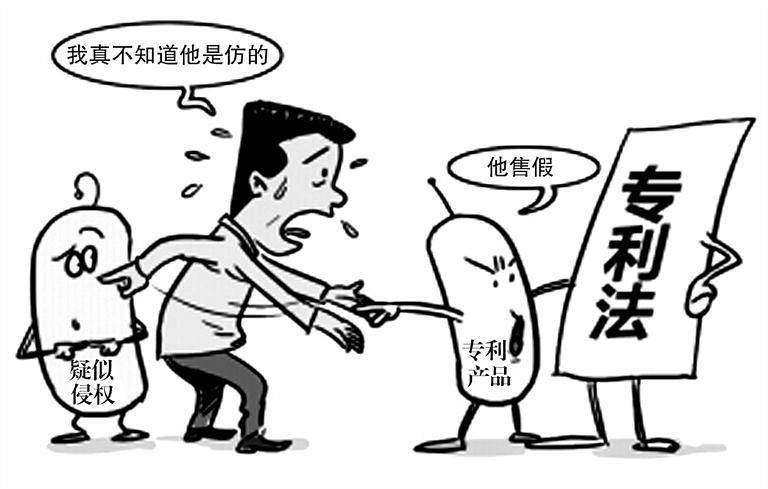
Article 70 of the patent act exempts users, promising sellers and sellers from liability if the legitimate source defence is established. The dispute is whether bona fide users should also cease to use if they prove their lawful origin and have paid a reasonable price. In practice, users of tort products often do not know and should not know that they have purchased tort products, and because they are at the end of the chain of torts, they are vulnerable to detection by rights holders, who often choose to prosecute users. Even if the manufacturer, the seller and the user are co-defendants, if the user is only exempt from damages under article 70 of the patent act, it is liable for tort of cessation of use. If the use is not discontinued, the royalties are payable as a substitute for the use that is not. In order to clarify the legal boundaries of patent rights and other civil rights, and in accordance with the principle of balance of interests, article 25 of interpretation 2 excludes by a proviso bona fide users。
In the drafting process, the view was expressed that the article exonerated bona fide users from the duty not to cease to use and was in conflict with article 70 of patent law, while another view was that, in the system itself, the legal source defence system was designed to combat the source of the tort, and the manufacturer was the main source of the tort. Nor does the trips agreement require that acts used in good faith be prohibited. The user is subjectively good-faith, objectively provides a legal source and pays a reasonable price to the seller at the time of acquisition of the tortized product, which ought to prevent the extension of the patent prohibition. Patents are highly exclusive, but do not amount to unlimited expansion. Patent law is not just a patentee's law, but it is not the intention of article 70 of the patent law, and it is also contrary to the legal fundamentals of the balance of interests, by focusing exclusively on the unilateral interests of the patentee, disregarding the legitimate interests of bona fide users, which would usurp the reasonable space of bona fide users and impede the security of transactions. On the basis of consultations with the relevant legislative authorities, explanatory ii finally adopted the second opinion。
With regard to the issue of ordering the cessation of the violation, article 26 of interpretation 2 provides that, as a rule, the wrongdoer, in the event of a violation, is liable for the cessation of the violation, but that the court may also not order the cessation of the violation in question, if the violation would be prejudicial to the interests of the state or the public interest, in lieu of payment of reasonable user fees. The manner in which tort liability is to be assumed is not explicitly provided for in patent law, but article 15 of tort liability law provides for the manner in which tort liability is to be incurred, either separately or in combination. Article 26 of the interpretation 2 falls within the context of the determination of civil liability in individual cases and is the proper meaning of the application of law such as tort liability law. While patent law provides for compulsory licensing of patents, article 26 of interpretation 2 goes hand in hand with compulsory licensing of patents. The adoption of compulsory permits by the executive as a pre-emptive procedure for civil tort proceedings would result in the suspension of civil proceedings, artificially complicating the relief procedure and preventing the timely settlement of disputes. It is important to note that only in exceptional circumstances, such as harm to the national interest and the public interest, does the court not order cessation of the action complained of, and cessation of the infringement remains the basic mode of patent tort liability。
In addition, interpretation ii provides for such issues as functional characteristics, standard required patents, estoppel rules, interim protection periods for invention patents, which have received much attention in recent years。
The introduction of interpretation ii, an important initiative of the supreme people's court to actively create an innovative rule of law environment, enriches and refines our patent legal system, will further curb the violation of patent rights, further strengthen the orientation of judicial decisions towards scientific and technological innovation, further effectively stimulate autonomous innovation and technological leapfrogging, and provide strong legal guarantees for mass innovation。
Thank you!