


Please provide a brief description of the characteristics of tropical desert climates and their main distribution areas, and an analysis of their causes。
Answer:
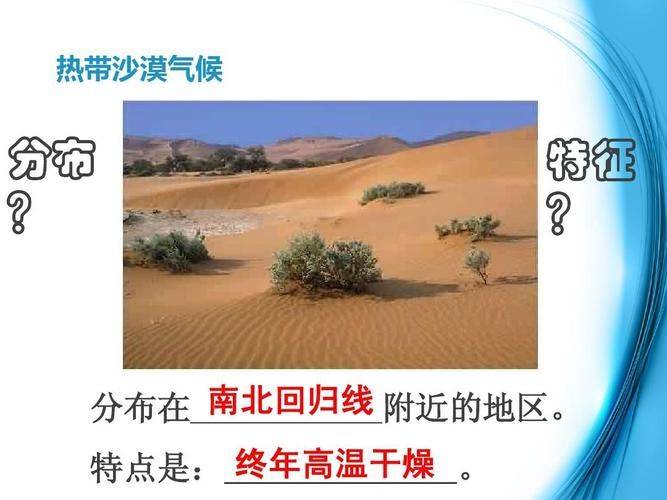
The tropical desert climate is characterized by high year-round temperatures, high temperatures and low precipitation, day and night. Mainly south
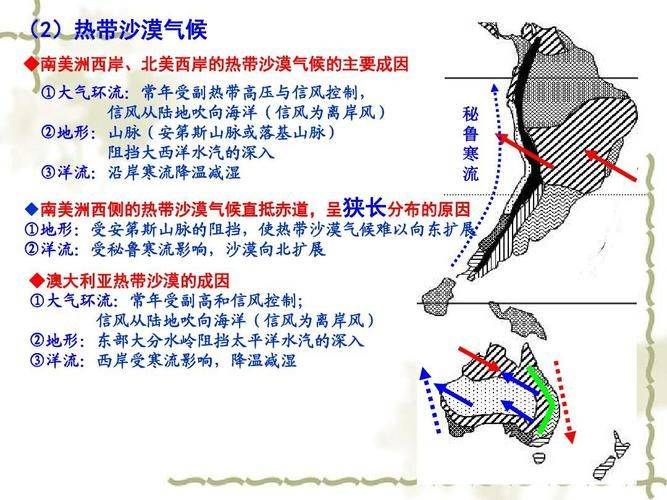
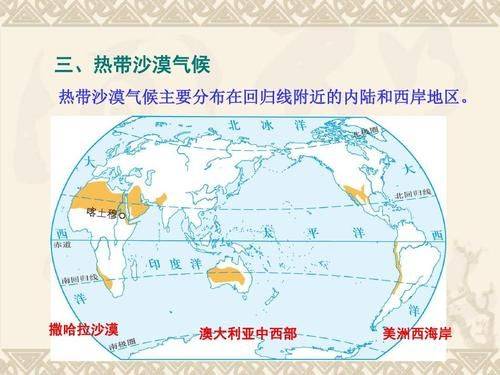
Intracontinental or continental west bank near the northern return line, such as northern africa, western asia, western and central australia
A narrow area on the western side of south america. There are three main reasons for this:
Production, which results in scarce precipitation as a result of the sinking of the air; two controlled by dry believer winds, with low rainfall; and three by cold flow
The effect is that air moisture is reduced, exacerbating drought。
Parsing:
The topic examines the characteristics, distribution and causes of tropical desert climates. First, tropical desert gas
The characteristics of the schedule are mainly in the areas of temperature and precipitation. Temperature, tropical desert weather, year round
The coldest average monthly temperature
10
More than a degree celsius, the hottest average monthly temperature
30
35
Do, go
It's almost as high as anywhere else
58
It's a degree celsius, and it's a poor day
35
40
Day
Night temperatures are very different. In terms of precipitation, the tropical desert climate is scarce and annual precipitation is widespread
250
Mm by
In many areas, there are dozens of millimeters, or even a few millimeters, with a high rate of precipitation, often constant for years
Rain. Second, the tropical desert climate is mainly in the interior of the continent or in the west bank, near the north-south regression line
Specific geographical locations include northern africa, western asia, western central australia and western south america
Area. Finally, there are three main reasons for the tropical desert climate: first, the vulnerability of the atmosphere to subtropical conditions
High-pressure belt control, with low precipitation due to atmospheric deposition; second, controlled by dry believer winds such as east of the northern hemisphere
The north and south-east of the southern hemisphere are offshore winds with low rainfall for the west bank; the third is cold
The effects of the currents, such as the colds in peru, the colds in western australia, the coastal areas through which they pass, the air



