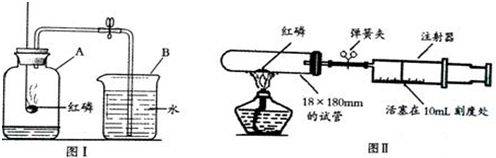
A chemical interest group has made bold improvements to the course's experiment on “quantification of oxygen content in air” (see figure i). Design (ii) (election of an 18 x 180 mm test tube as a reaction container with a volume of 45 ml) was conducted with good results. If you can compare figures i and ii below to answer the following questions:
(1) indicate the name of the instrument in the experiment: b
(2) the experimental phenomenon in figure i experiment is:
Red phosphorus burns, generating large amounts of white smoke
Red phosphorus burns, generating large amounts of white smoke
; after cooling, turn on the stopper
The amount of water that is inhaled in the cup is about the size of the original gas
The amount of water that is inhaled in the cup is about the size of the original gas
(3) the french chemist lavassi concluded from the experiment that oxygen is about the air mass
One of the classmates tested it with a chart i device and found that the volume of gas reduction was less than
Please help the student find two possible reasons for this:
Device leak
Device leak
2
Open the spring before cooling
Open the spring before cooling
(4) the operational steps of the figure ii experiment are as follows:
One for the alcohol
Two to remove the alcohol light, and release the spring when the test tube cools
3 set a small amount of red phosphorus in the test tube, place the 20 ml syringe piston at 10 ml tic, and fix the connection as shown in figure ii, and bind the spring to the rubber tube
4 reading syringe pistons
You think the correct sequence of the experiment is..
3124
3124
(serial number)
(5) in figure ii experiment, the syringe piston will be slowly moved from 10 ml to approximately ml to stop
(6) you think the advantage of figure ii is against figure i
Reduced laboratory error, fuel savings, environmental pollution, reading, etc
Reduced laboratory error, fuel savings, environmental pollution, reading, etc