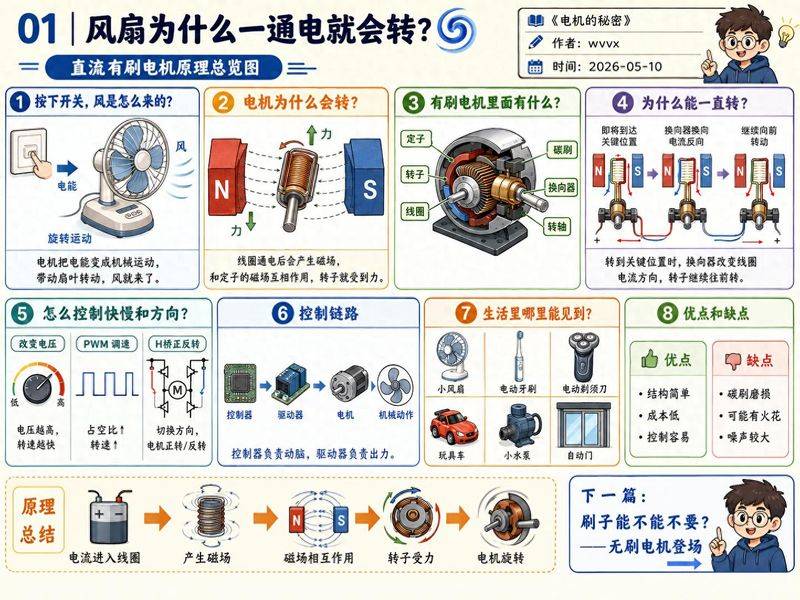
How does the wind come out of a switch
In the hottest summer, you press the fan switch, the leaves turn and the wind comes。
It's so ordinary that we rarely ask:
The electricity can't see, it can't feel, why can't it turn around a piece of iron, a round of copper wire, an axle
That's the most fascinating part of the electric power。
Light bulbs turn electricity into light. The wire turns electricity into heat. And the electric power, it turns it into action。
Fans, electric toothbrushes, electric screwdrivers, small pumps, toy cars, automatic doors, conveyor belts, all with similar things behind them. They look different, but they're doing the same thing:
Let electricity become mechanical。
This one, let's start with one of the most classic, easy-to-understand electric machines: the straight stream has a brush。
It is not necessarily the highest level, but it is well suited for the first stop. Because of understanding it, the no-brush, no-go, no-go, no-go, no-go。
The electrical story begins with "electron and magnetic"
A long time ago, people knew about electricity, and they knew about magnetism, but it was not clear what their relationship was。
Until the 19th century, scientists slowly discovered:
The current and magnetic fields are not completely separate, and they can interact with each other。
In 1821, an early electromagnetic rotation experiment was performed by british scientist michael faraday. He allowed an electric conductor to move in the magnetic field, proving that currents and magnetic fields could produce continuous rotational motion. Although far from today's power plant, this experiment has opened a door:
Electricity, really can turn into a spin。
Later, engineers began to think of a more practical question:
Can you make a really working power
In 1832, british scientist william stekin created an early transient straight current. In 1834, the blacksmith thomas davenport of vermont, united states, made a direct currenter closer to functional, and in 1837, he was patented for american electric appliances。
Interestingly, davenport is not a university professor or a big company engineer, but a blacksmith. He heard that electromagnets were very obsessed with iron smoking, and then studied their own magnets, batteries and electric machines. He even used electricity to drive small models and small machines。
It's just that the batteries were too expensive and too weak to be really commercial。
So, it's not just a scientific story, it's like an engineering story:
Scientists find patterns, and artisans turn them into machines。
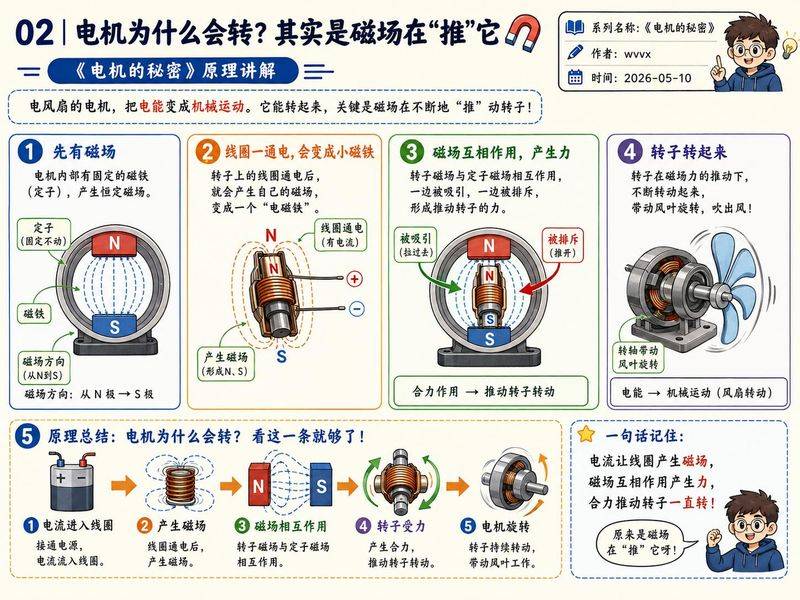
3. Why is the power turned? It's actually the magnetic field pushing it
It's not a mystery to have the core principle of a brush。
One sentence:
The wire that goes through, it becomes a little magnet。
The magnets have been seen. When the two magnets approach, they sometimes suck each other and push each other。
It's a similar thing in the electrics:
You can imagine it as a little theater:
Fixed magnet: set the stage
electro-circle: becoming an actor
magnetic force: turn the actors around. Electricity direction: deciding which side to push
So the fan's not "wired and magically turned," it's the current that gives the wire a magnetic field, and the magnetic field gives power and turns the rotor around。
4. What's inside the scrubber
A typical straight current has a brush, and there's basically these key players。
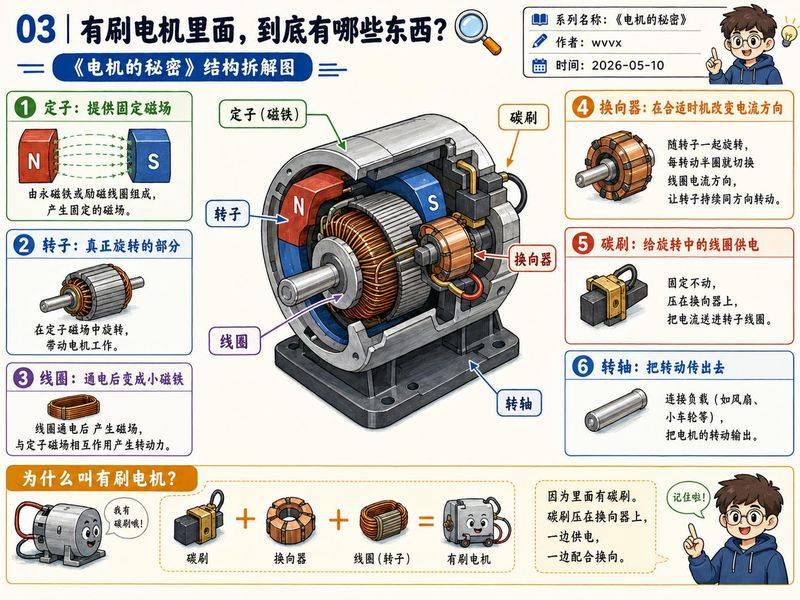
Sing: stand still on the magnetic field
The part that's not moving. It can be a permagnetic or an electromagnetic。
Its mandate is clear:
Provides a fixed magnetic field environment。
It's like the stage doesn't move, the actors move on the stage。
Rotation: the part that really rotates
The rotors are the spinning parts. It's usually connected to an electrical axis。
Fan blades, small gears and belt wheels are usually carried around by this axis。
Threads: electro-electrified into "small magnets"
The rotor's around the wire. The coil was supposed to be a circle of copper wires, but once it was powered, it created a magnetic field。
When this magnetic field works with the magnetic field of ting, the rotor has the power to move。
Carbon brushes and changers: "changers" in electricians
This is the most critical and characteristic place with a brush。
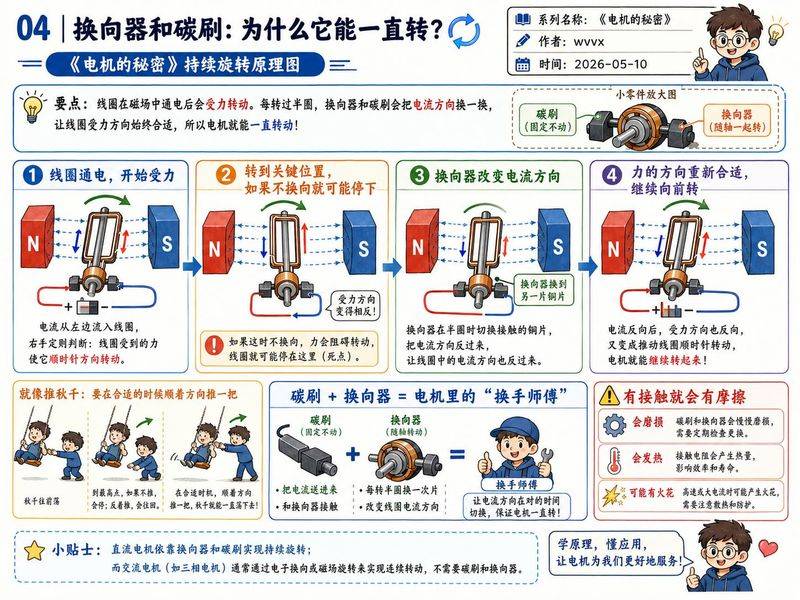
When the wiring turns around, there's a problem: if the current direction stays the same, when the wiring turns around, it's not right, it's probably not going to go forward, it'll even be pulled back。
So the electric power has to change the current direction of the wire at the right time。
This job is done by carbon brushes and transducers。
Circle rotation
okay, get to the key.
♪ turners change the current direction ♪
okay, let's move on
It can be understood by swinging。
No swinging. You have to push in the right direction at the right time before the swing gets higher. If it turns the other way, you'll stop the swing。
It's like the guy who knows the rhythm: it knows when to change the momentum。
Why is it called "brushed"? What is the brush
It's not a brush, not a brush, not a brush。
It means the carbon brush in the electric power。
The carbon brush will be pressured on the switch, and they will remain in contact as the electric power rotates. The current enters the rotor circle through this point of contact。
This design is very smart: it powers the loops in rotation, and it completes the current direction switch。
But it also has a natural disadvantage:
As long as there's contact, there's friction. If there's friction, there's wear。
So there's a scrubber that's been running for a long time, and the carbon brush will be short. During high-speed operations, sparks, noise and heat may also occur。
This was also an important reason for the subsequent absence of a brush。
However, it is important not to feel that there is a brush that is “defended and useless”. Its advantages are also clear:
It's not always the highest, but the right。
Enough + stability + cheap + good repairThese four words are more important than “high end” in many projects。
How do you control it
Turning the engine up is just the first step. In automation, we are more concerned about:
How do we get it to do what we want
For example:
For straight current brushes, there are a number of common controls。
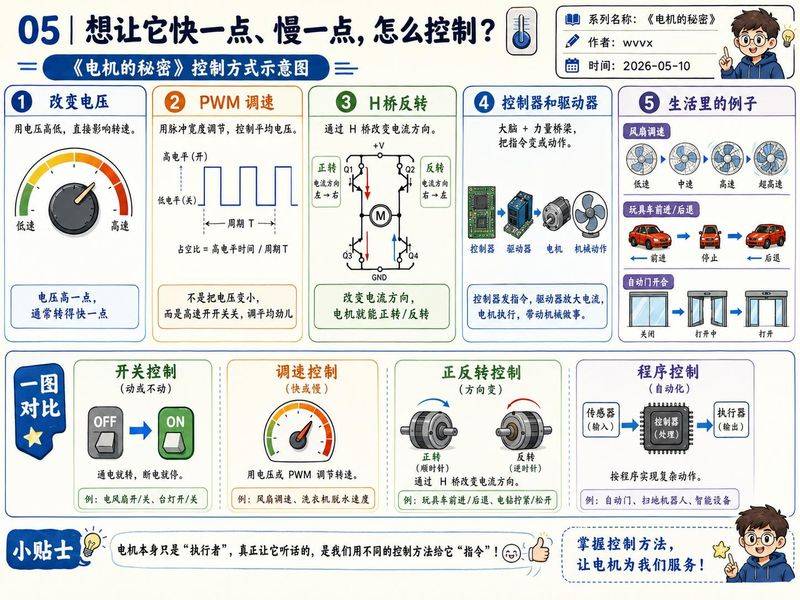
Changing voltage: the easiest way to adjust speed
Normally, the voltage is higher, the electrics turn faster, the voltage is lower, the electrics are slower。
It's quite understandable, like giving people a little more food when they're working, and maybe a little more energy。
But this is not unlimited. The voltage is too high and the power can heat up and burn. The load is too heavy and the electric power may not turn up。
Therefore, the conversion of the voltage, although intuitive, takes into account the rated voltage, current, heat and load of the electric power in the actual control。
Pwm speeding: looks like it's turning the switch, actually, on average
The pwm is a common speed-reducing method in industrial controls and single machines。
It sounds professional, but it's very understanding:
The pwm does not really reduce the voltage, but turns the power on, off, off, off, off。
For example:
Speed: turn on the switch, turn on the switch. Slow: switch off, switch offBecause of the speed of the switch, the electric power won't really stop. It feels an average effect。
It's like a tap:
So the pwm controls the power, essentially controls:
For some time, how much time did the electric power take。
H bridge: keep the power running and reverse
Many times, it's not just going to turn, it's going to turn backwards。
For example:
It's time to use h-bridge-driven circuits。
Its role is direct:
Redirect both ends of the electric power。
Power's turning from left to right. Power flow from right to leftBecause it's a little like the letter h。
You don't need to keep track details. Just remember:
The h bridge is to allow the direct power to turn, reverse, stop, and to speed with pwm。
The controller is brain-activated, the driver is active
Here is a very important idea of automation:
The controller doesn't have to work in person. It's more of an order。
One-piece machines, plcs, for example, are smart enough to judge logic and output signals, but their “handpower” is usually small and cannot directly drive larger power。
So in the actual system, it's often like this:
The controller, the drive, the electric, the mechanicalThe controller is responsible for determining:
The drive is responsible for actually sending the current to the electric power。
It's like the head of the workshop and the workers:
Common control combinations of brushes in direct currents include:
Control needs
Common ways
Just the switch
Switches, relays
We need to speed it up
Pwm speed module, pressure module
Need to reverse
H bridge drive
Need program control
Mono, plc + driver module
Cars/robots
Electric drive panel
Small auto equipment
Controller + power drive + limit switch
8. Where can i see it in life and industry
It's very common to have a brush。
In life:
Small equipment is also common:
Its characteristics are not “most advanced”, but rather:
Simple, direct, cheap, easy to control。
It's very valuable in engineering。
When a device requires only a small power-driven light load rotation, it is not necessary to use a complex server system as soon as it comes up. It's like there's no need to open a tank to buy food。
9. There are advantages and disadvantages to the scrubber, and one sentence is clear
The advantage of having a brush is real:
Its shortcomings are also evident:
So it's like an old worker:
Work is direct, inexpensive and experienced. But after a long time, brushes are tired and parts grind。
What does this article make clear
The current has a brush that turns because:
Power into the loop. The coil produces magnetic fields. Magnetic field interaction
♪ the rotor's being squeezed ♪
# the electrics rotate #
It keeps turning because:
Carbon brush + switcher
♪ keep changing the direction of the current ♪
keep the rotors moving forward
It's fast because:
Change voltage
or
use pwm to control the average power supply time
It can reverse because:
H bridge re-routing.
# the power rotates in the direction #
It's still in use because:
Simple structure, low cost, easy control, plenty of scenery