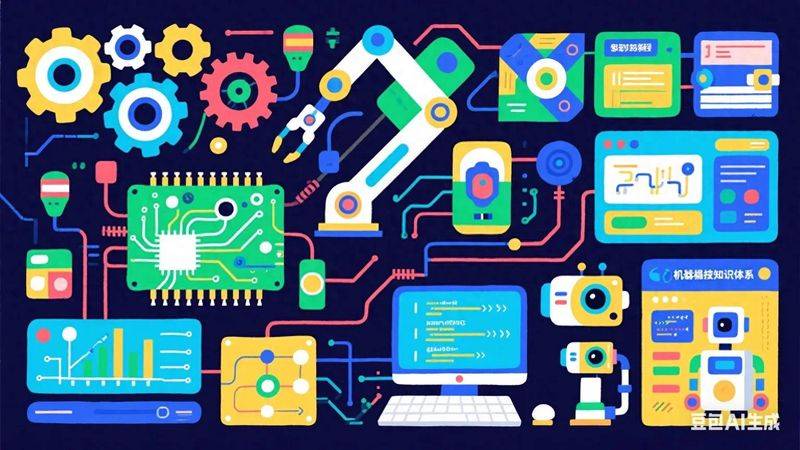
The production of robots requires the integration of knowledge in the four core areas of mechanical, electronic, software, sensory interaction, with varying degrees of knowledge required for different complex types of robots (e. G., entry-level vehicles, specialized industrial robots, intelligent service robots), as follows:
Core knowledge modules (by robotic hardware-control-software-interactive)
Mechanical design and structure (robots' “body skeleton”)
- basic theory: mechanical principles (motion agencies: gears, belts, silk bars; sports deputies: turn, move), material mechanics (choose weight/resistance materials such as aluminium alloy, abs plastics, yakli), mechanical mapping (understand/draw parts drawings)。
- practical skills: 3d modelling and printing (with solidworks, fusion 360 design components, 3d rapid production of spare parts), commonly used tools (drilling, thermo-melted glue guns, screwdrivers, assembled mechanical structures)。
- example scenario: design of wheeling structures for cars, joint connections for mechanical arms (driven by servers)。
Electronic circuits and hardware (robots' “neurological and power”)
- basic theory: circuit base (omm law, coupling of circuits, voltage/flow/power calculation), analogue circuit (sensor signal acquisition), digital circuits (high and low level, logical door, single machine control)。
- core element:
- controllers (introduction: arduino uno, esp32; progress: stm32, berry pie)
- executors (electrics: direct currents, step-ups, servers; rudders: control of mechanical arm joints)
- sensors (environmental perception: infrared protection sensor, ultrasound range sensor, photo-sensitive sensor; state detection: encoder, gyroscope mp6050)
- auxiliary components (power: lithium batteries, pressure-rigidation modules; connectors: du pont wire, enders; protective elements: fuses, diodes)。
- practical skills: pcb design and welding (drawing circuit boards with altium designer, kicad, hand welding devices), circuit debugging (one-size-fits-all instrument for voltage/blocking, short circuits/break-out)。
Software programming and control (robots' “brain”)
- programming languages:
- bottom control (c/c++: control of single-formula machines such as arduino, stm 32; micropython: simplified esp32/berries programming)
- upper logic (python: data processing, ai algorithms, visual recognition; c++: high performance control, e. G. Robotic operating system ros)。
- core technology:
- embedded programming (the preparation of code-driven sensors/engineers, such as "reading ultrasound data to control the switch of the motor to a shield")
- robotic operating systems (ros/ros 2: necessary for progress to achieve multi-modular communications, such as “radio-ray path planning implementation”
- movement control (pid algorithms: allowing robots to move at a velocity, to locate precisely, for example, to control the straightness of cars
- artificial intelligence (optional, necessary for intelligent robots: computer visual opencv/yolo (identifying objects), machine learning scikit-learn (classification mission), in-depth learning of tensorflow/pytorch (complex scene, e. G. Autonomous navigation))。
Perception and interaction (robots “perception of the world, connecting human beings”)
- environmental perception: signal processing (noise filtering of sensor data such as calman filtering to optimize gyroscope data), multi-sensor integration (with laser radar+ cameras to improve environmental judgement accuracy)。
- hmi:
- foundation: keys, touch screens, led indicators
- progress: voice interaction (calling 100-degree ai, science majors flying api for voice command robotic response), app/web-page control (remote manipulation using bluetooth, wifi, 4g modules)。
Ii. Recommendations for learning paths (from entry to action)
1. Introduction phase (manufacturing simple robots, such as follow-up cars, shelter cars)
Precinct: mechanical assembly (with an existing package pack) circuit base (arduino+sensor/engine connection) basic programming (c/c++ controls the trail/divide)。
Tools: arduino package, breadboard, du pont line, without complex mechanical design。
2. Progress phase (manufacturing functional robotics, such as mechanical arms, autonomous navigation minivans)
Re-learning: 3d modelling and printing (designing self-defined components) → ros operating system (to achieve multi-module synergy) →pid control+ path planning (to allow cars to bypass barriers autonomously)。
Tools: berry/stm32, laser radar/deep camera, fusion 360, ros。
3. Professional stage (smart/industrial robots)
In-depth: ai algorithm (computer vision, deep learning) industrial control (plc programming) robotic dynamics (complex motion control, such as precision capture of industrial mechanical arm)。
Summary
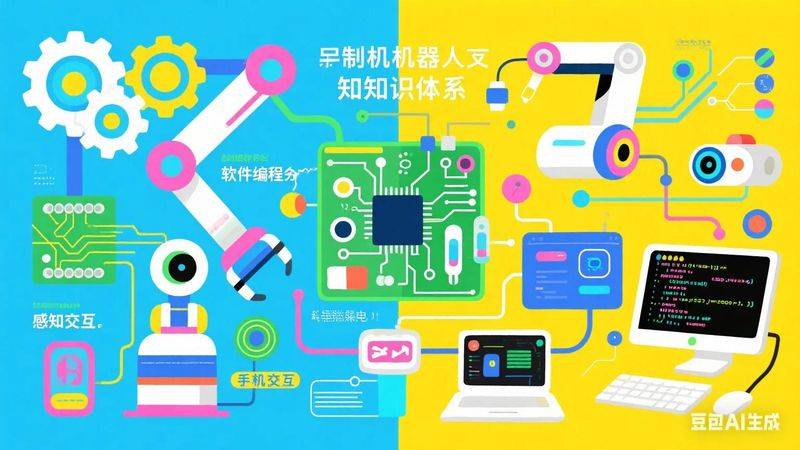
The core logic for robotics is: “mechanical skeletal electrons for neural software for brain sensory interaction”. Newers do not need to complete all their knowledge at once and suggest starting with small projects such as the “simply hardware + basic programming” (e. G. The arduino absorption cars) to learn by doing and gradually develop into complex technologies。