After the summer, the southern region ran at 40°c, and the market price of vegetables rose slowly, with a single carbs sold to 78 cents, and the red potato leaf was not cheap. A lot of people are impressed. It's more painful to buy food in summer than to eat meat. But you know what? Many urban dwellers are secretly planting “landnuts” on the roof, with emptied cabbage and red potato leaves, with 40°c sunburning, which is so long that they can eat from the beginning of summer to the end of autumn, and spend most of the year away from the market, saving money and fresh。
This is nothing new, and the roof is no longer fresh in the southern areas of guangdong, guangxi and fujian. It has been three years since my aunt lee, who lives in guangzhou, planted cabbage and sweet potatoes on the roof of her building, and she said, “in the summer, the surface temperature of the roof can reach 40°c, and the other food can be tanned for two days
Why would cabbage and red potato leaves be "cross the street" at 40°c? The core is heat-resilient, sun-resilient and life-sustaining, known as the “heating special forces” in the vegetable industry。
First of all, emptiness, which is inherently hot and wet, is best suited to grow at 25-35 °c, even if the temperature reaches 40 °c, so long as the moisture is sufficient, it can grow quickly. Unlike little cabbage and lettuce, the troughs of hollow cabbage are empty, they store moisture, and the foliage is thick, and they are not afraid of light. It is all the more sobering that emptied cabbage does not have to buy seeds, that the market for vegetables buys a fresh groceries, leaves behind the old incisors at the bottom, cuts into small sections of about 15 centimetres, each with two to three nodes, pours water into the soil, and has roots in three to five days, with new leaves in a week。
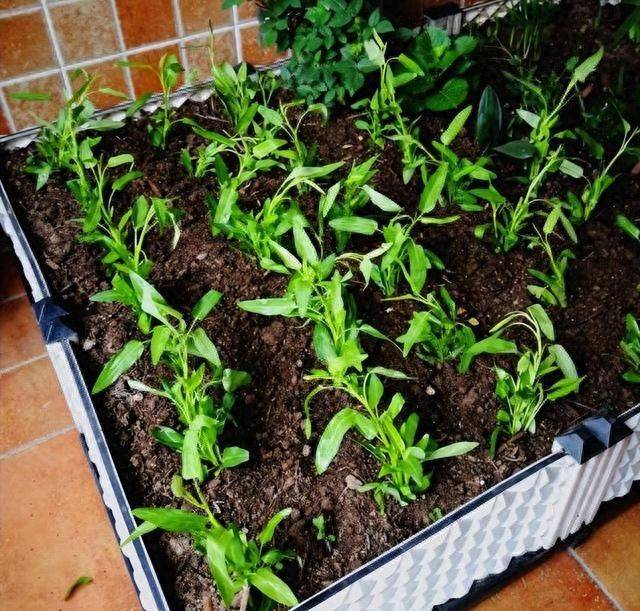
The red potato leaves, which used to feed pigs more often in the countryside, are now the “long-life food” popular in the cities and are more resistant to drought than to empty cabbage. Even a week of high temperatures of 40°c is not easy to die without water, and there are very few diseases and insects, almost without medication, and leaves are grown clean and healthy. It is easier to grow, with sprouted potatoes in the family, which can grow in the soil directly; failing that, the market buys a few cassavas, cut into smaller parts about 20 cm, tilts into the soil, shows 1-2 knots, water is poured out, and the rate of survival is over 90 per cent。
Many are concerned that the roof is hot and tan, that the soil is adhesive, that water is scarce and that the vegetables are not ready. In fact, with three simple skills, the new guy can grow a success. He doesn't have to deal with it every day。
I. Selection of containers and soil is the only way to grow
No special flower pots are needed for roof-planting, and used foam boxes, plastic drums, and cash boxes are available, with the emphasis on perforation at the bottom, otherwise the water will rot. Foam boxes are the most suitable for depths above 20 cm. They are too big to move and too small to stretch。
The soil is free of the need to buy nutrients, with small gardens, out-of-the-urban areas digging up some of the land, mixing some of the decaying leaves or dry straw, soaking and venturing. When the soil is packed, a layer of bricks or stones is laid on the base to prevent water from being accumulated, which is then filled with soil, approximately 5 cm from the mouth of the box, and not overfilled。
Ii. High-temperature conservation know-how and the hotter, the more lazy it becomes
It's important to water the top of the 40°c building. Don't do it at noon! At noon, the soil was hot, cold water was pouring down, the temperature was too different and the root was prone to “floating” and quickly fell. The correct course is to water it before 8 a. M. And after 7 p. M., once and for all until the water comes out of the bottom hole。
There is also a small insulation of two to three centimetres of dry straw, leaves or old sheeting on the soil surface, which can insulate cooling, lock water, reduce the number of waters poured, and prevent soil sheeting. High temperatures do not require frequent pine soil, and occasionally light-spread the topsoil with small shovels。
Iii. The more the harvest takes, the more it takes
Vacant vegetables grow to about 20 centimetres and can be strangled at the top, with two to three leaves of the root, without being uprooted. When it is finished, more branches will appear in the armpits, which will be harvested a week later, and the more the branches will grow。
The red potato leaves are more resistant, with vines growing to 15 centimetres or more, and they strangle directly to the point, and each time they are finished, the vines will sprout from the side, and a single one will grow several vines, crawling with the whole foam box. They grow fast in the summer and can choke almost every day. They're good at cooking, making soup, mixing cold, and having sweet mouths。
Many people are addicted to it once, because not only are the two dishes good, but they are also very productive and cannot be eaten. A 1-metre-long foam box with an empty cabbage picks five to six strokes and a single picks two to three pounds; a red potato leaf is more condensed, with more than 10 vines long, and can hardly be eaten. From may to the end of october, they were able to eat for more than half a year, without having to buy green leaves, and a family of three would be enough to save thousands of dollars a year。
More than anything else, these two types of dishes are almost non-pregnant, non-pharmaceutical and non-fruitful. The water is usually watered with rice water, which is diluted by fermented rice water, which is fertilized in the soil, leaves that are oily, free of fertilizer, and cheap and environmentally friendly. The roof of the building is so windy that, occasionally, the corner of the foam box is pressed with bricks to prevent it from blowing over, and the rest of the time it is left unattended and allowed to grow freely。
More and more urban people are now starting to grow on roofs and balconys, not to save money, but to eat non-pesticide-free, fresh and fresh food. In summer, many of the vegetables in the market are grown in large sheds, and pesticide residues are a concern; their own empty cabbage, red potato leaves, which are not used for the entire journey, are taken off and washed and can be fired, and tasted sweeter than those bought in the market。
Moreover, growing vegetables is a depressive method, and after work, the roof is watered and choked, and the mood has changed. It does not take much time, 10 minutes a day, to exercise and harvest fresh vegetables。
Someone might say i don't have a roof. Of course, the balcony, the window stand, the small yard, with a small foam box or a flower pot, the empty cabbage, which guarantees a six-hour-a-day light, can last half a day, and can continue to grow madly and eat. Without buying too many tools, waste containers + plain soil + vegetables can grow at zero cost and starters can succeed once。
In the summer, you don't have to worry about buying groceries and vegetables, with cabbage and potato leaves, and the roof at 40°c is so long, you don't have to go to the market for six months, save money, be fresh, be assured。
Have you grown any vegetables on the roof or on the balcony? Welcome to the comment section to share your experiences of growing food and share your little skills in high-temperature dishes