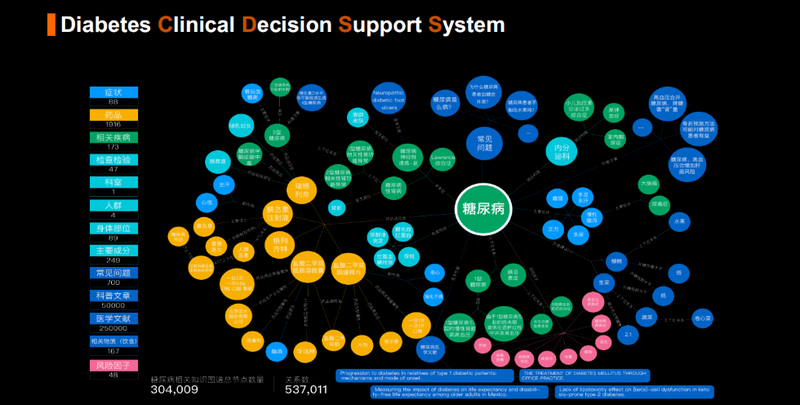
The application provides a methodology, device, equipment and medium for the projection of the risk of diabetes based on a knowledge map, which includes: updating the knowledge profile of diabetes with the first patient profile data of the subject to be projected and obtaining the target knowledge map; determining the second point vector of the predicted year node based on the first point vector of the node around the node of the year to be projected in the target knowledge map; obtaining the first collage vector based on the first correlation vector between the point vector and the node of the target and the year to be forecast; targeting node of the disease node and/or the uninfected node; establishing the first relationship vector based on the second correlation vector between the node of the year to be predicted and the surrounding node; entering the first yield and the target node of the target node in the diabetes risk prediction model; and determining the disease probability of diabetes based on the first confluence. This approach has improved the accuracy of diabetes risk predictions. Accuracy of disease risk projections. Accuracy of disease risk projections。
Download all detailed technical information
[summary of technical realization steps]
Diabetes risk prediction methods, devices, equipment and media based on knowledge mapping
This application concerns computers
In particular, it involves a knowledge-based approach to diabetic risk prediction, devices, equipment and media。
Technical presentation
Diabetes is a metabolic disease characterized by high blood sugar, and in existing technology, the risk projection for diabetes is usually based only on patient history data (e. G., medical data) to develop a diabetes prediction model and use it to predict the risk of diabetes in patients. This method does not make full use of a priori medical knowledge, resulting in poor accuracy of projections。
Technical realization thinking
In view of this, the purpose of this application is to provide a knowledge-based methods, devices, equipment and media for diabetic risk prediction to improve the accuracy of the diabetes risk prediction。
First, the application implementation example provides a methodology for diabetic risk prediction based on a knowledge map, including:
The pre-established diabetes knowledge map is updated using the first patient profile data of the subject to be projected, and the target knowledge profile is updated; the first patient profile data described includes data on the medical indicators related to diabetes in the year to be predicted
Determines on the basis of the first point vector of the surrounding node in the target knowledge map associated with the nodes of the year to be projected
Technical protection points
Technical profile summary
1. A method for predicting the risk of diabetes based on a knowledge map is characterized by: updating the pre-established knowledge profile of diabetes using the first patient profile data of the target subject to be projected, and the updated target profile; the stated first patient profile includes data on medical indicators related to diabetes in the year to be projected for the intended target; determining the second-point vector of the stated year node based on the first node of the stated target map associated with the predicted year node; identifying the target node of section ii and the target node of the stated target node of the stated target node in relation to the stated target year; aligning the stated target node to the target node of the stated target node and receiving the target node of the stated target node with the medical indicator of diabetes; and/or determining the comparable yield of the comparable maturation of the reported diabetes node in the first dose of the stated endpoint of the stated target node; 2. The characteristic of the method described in claim 1 is that when the target node in question is the disease node in question, the first cosine similarity in question is considered to be the probabilities of the subject in question to suffer diabetes in the year in question; when the target node in question is the probabilities of the disease node in question, the first cosine similarity in question is considered to be the probabilities of the object in question not to suffer from diabetes in the year in question, calculated on the basis of the probabilities of the non-diabetes in question; when the target node in question includes the disease node in question and the node in question, the size of the relationship between the second cosine similarity and the third cosine similarity in question is determined as the magnitude of the disease in the year in question to be predicted. 3. According to the methodology described in claim 1, the characteristics of the diabetes knowledge mapping described are the following: the acquisition of data on the medical characteristics associated with diabetes, the relationship between the level of each of the medical characteristics described and the data on the medical characteristics described; and the secondary medical history data of the patients who obtained the samples; the second medical history data described include data on the various medical indicators relevant to diabetes in the various historical years of the sample and on the incidence of diabetes in relation to each of the historical years described; the construction of the conceptual layers of the diabetes profiles described on the basis of the medical characteristics data described, the level of data on each of the medical characteristics described and the correlation of the data on the medical characteristics described; and the building of the illustrative layers of the diabetes profiles described on the basis of the secondary history data described; the illustration layers of the various historical yearnodes of the patients with the samples in question in relation to the various medical indicator nodes and the target nodes described; and the construction of the diabetes profiles on the basis of the conceptual and case studies described. 4. The characteristic of the methodology described in claim 1 is that the risk prediction model for diabetes described is trained by:
(a) for each of the objectives in the described diabetes knowledge map, convert the first node of the objective into a head node vector, convert the first node of the first end node of the said three-track set, and convert the first node of the said first node and the relationship between the first node and the said end point into a third association vector; for each of the three-track set of the stated objectives, align the stated head node vector vector corresponding to the three-track set of the said three-track set of objectives to a second joint node of the stated node; divide all of the stated objective node of the said endpoint of the said diabetic knowledge set into a third set of the stated node of the said node and the first node of the said node of the three-point set of the same set of three-point set of three.
[property technical properties]
Technical researcher: wang lok, xu yi, zhang lin, xu zheng, sven zheng
Application (patent) by shinzhou medical technology inc.
Type: invention
Country and city:
I'm the owner of this patent