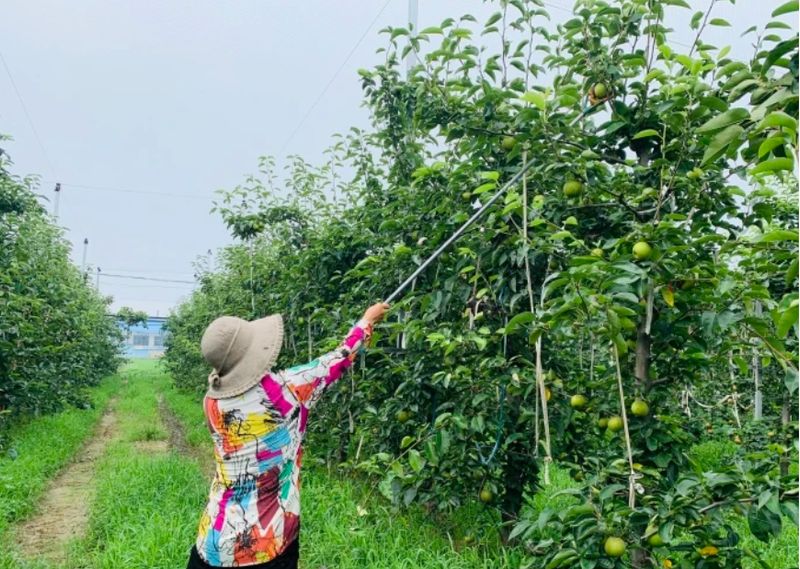
Three volts, the hottest season of the year, is the time of harvest in the pear garden of nantung city. The pear gardens of hayan city are very productive, with pear noodles coming from the heart of the pear, and staff travelling through the pear trees to pick. In recent years, the institute of scientific research and research in the province of hai anito and the modern agricultural (pear) industrial technology system in jiangsu province have been developing pear industries, introducing new varieties, promoting new technologies and models, and effectively promoting fruit-farming. The government has spent more than 3 million yuan to support the development of pear production。
Saved by cultivation: two people manage 40 acres of pear garden
Summer july, the sun is burning. A line of pear pens under a high-strength bird-proof net, located in the town of ha'an, the home of the founding family farm, whose fields are very wide and where machinery such as a ditcher and a chalk machine travel without hindrance。
“it's a dry main cultivation method of pear, the greatest benefit of which is the ease of mechanization, which was the first pear garden in the province to adopt this conservation model.” according to the farmer zhou's state-building presentation, the most lacking of the pear cultivation is labour, and with the introduction of stem pear cultivation, other key farming links, apart from picking, pollinating, and pulling, require more labour, have been replaced by machines. “at the time when more than a dozen people were needed to manage, now two people are enough.”
Zhou zhou detailed the account: it used to take up to one day to open a ditch of 100 metres long, 0. 6 metres deep and 0. 4 metres wide, which could now be completed in five minutes; increased the number of per acre plantings from 110 to 138, which would effectively increase the area of the sheave; used to drug 18 acres for five workers for two days, now a half a day for one person in 40 acres; used to transport only pear by hand-picking, shoulder-picking and hand-picking, with a maximum of 500 pounds per person per day, and now at least 1,000 a day through the platform. "i planted pears for more than 30 years, which i couldn't even think about." it is worth mentioning that the basic data collection of local standards (protocols) for dry farming techniques in jiangsu province comes from the pear garden of zhou。
Unlike the main dry-form farming method of pear farming, journalists at the family farm in xiashan, yacho town, hayan city, saw an alternative model of low-strength cultivation — the pear tree y-shaped planting model — which grows on both sides through a towed rope。
“these are steel racks, which are costly to input in the prior period, but have the advantage of being more resistant to wind, especially in the case of frequent typhoons in july and august each year.” the farm argued that the tree crown of the y-shaped shelf was largely at a reach level, making it easier to manage production and less energy; better ventilation; a more even distribution of branches and more manageable angles; and a more integrated head and quality of fruit。
“modern machinery enters orchards, significantly increasing operational efficiency and reducing production costs.” the director of the regional agricultural service centre of the seaan development area, senior agriculturalist sun yaura, said that agricultural mechanization was a necessary trend in development, and that the new equipment for special agricultural machines, which covered areas such as pear gardening, fertilization, plant protection, weeding, cutting, harvesting and transportation, was a good indicator of the level of mechanized production in the hayandey industry。
Eco-planting: special plants in orchards to treat grass
"you have no idea that not only do we keep some raw weed in the pear garden, but we'll grow some more." zhou zhou ziang points to a line of moist grass between pear trees and says that it is an orchard weeding technique that protects water and regulates the temperature by using natural weeds on the face, or seeds such as weeds and weeds。
What is orchard grass? It is described as an orchard management method for planting multi-year grass plants to cover the soil in the middle of fruit trees or in the garden as a green, ecological and healthy soil management technical measure with the advantages of improving soil quality, curbing weed growth, reducing soil erosion, improving soil organicity, improving the microclimate environment of orchards and improving the quality of fruit products。
Just two days ago, zhang dongshan, driving a chaff machine, shredded the weeds in the middle of the pear tree, and then ploughed the grass on the fields, returning to the fields and supplementing the roots of the pear。
The surface temperature can reach 40°c after mid-summer, but only about 30°c in the orchard. “this is the credit for the grasses, which, like natural air conditioners, regulate the small climate in orchards, so that the roots of pear trees grow at the right temperature.” zhang dongshan described the heavy rains in the summer, the high growth of weeds, the absence of herbicides in orchards and the growing of weeds of single leaves. “since it is shallow, it does not grab water and fertilizer from pear trees, it also prevents the growth of grass from deep roots, and it also increases the organic quality of the soil and thus the quality of the fruit.”
Eco-safety, green controls are key. In order to significantly promote green control techniques for crop pests and pests, reduce pesticide use and reduce pollution from agricultural sources, the hyan pear garden also uses green control techniques such as physical control. The installation of frequency-fibration headlights, stickers, etc., which use pest lighting, wavering and colouring properties to trap pests, reduce production costs and glorify the environment。
Quality output double up, generating more than 3,000 jobs
A pear full of pears is filled with branches, and workers are busy picking up the premature pear “sutri 1”。
“this is the kind of gold prize that you won this year throughout the province. Tang yong peng, the family farmer, introduced him with a few green pears and greeted all of us. A soft bite, with the fruit like snow, a sweet juice with a mouth full of mouths, and a fine chewing with its consequences, and a very thin mouth。
This year was the first year of pear-laying in a pear farm in tai peng family, and the selection of the “sutri 1” pear was awarded a gold prize at the fifth high-quality pre-ciplinary pear recognition event in jiangsu province, which was particularly exciting for the farmer, don yong peng, born in 1994. “i had no skills, no experience, thanks to the agricultural and rural sectors, which allowed me to study throughout the province, and thanks to the skill and patience with which the country was built, helping me to solve many of the problems of growing.” after graduating in 2018, tang yong peng worked on a two-year completion test, and the country's strong implementation of the rural renewal strategy has led him to decide to start a business back home. He told reporters that the 30 acres of pear garden had been planted in 2021, and that it was for the first time this year, with a special hot market, currently yielding 3,000 pounds of pear trees. “let me be more committed to the roots of the countryside and move towards standardized cultivation and improved confidence in quality.”
The pear industry is a maritime feature industry. At present, nearly 5,000 acres are grown in pear gardens throughout the city, mainly in sutrid 1, jade, crown, new gao and autumn, leading to more than 3,000 jobs. Since 2020, haian city has received 15 prizes and 25 silver prizes for high-quality pear nuts in the provincial and municipal scales. In 2021, at the world horticulture fair in yangzhou, the "sun moon" card selected for the family farm in the state of hai-an was awarded as "chang yin yin."。
“in the next step, we will continue to introduce the promotion of pear-saving farming models, promote agro-agriculture, guide old orchards through interfacing, shifting branches, remodelling orchards, working on the fine management of pear gardens, and continuously raising the potential of pear gardens for increased production, called the sea-angle pear brand.” according to cai guangzhou, an agriculturalist at the hai ango plant。