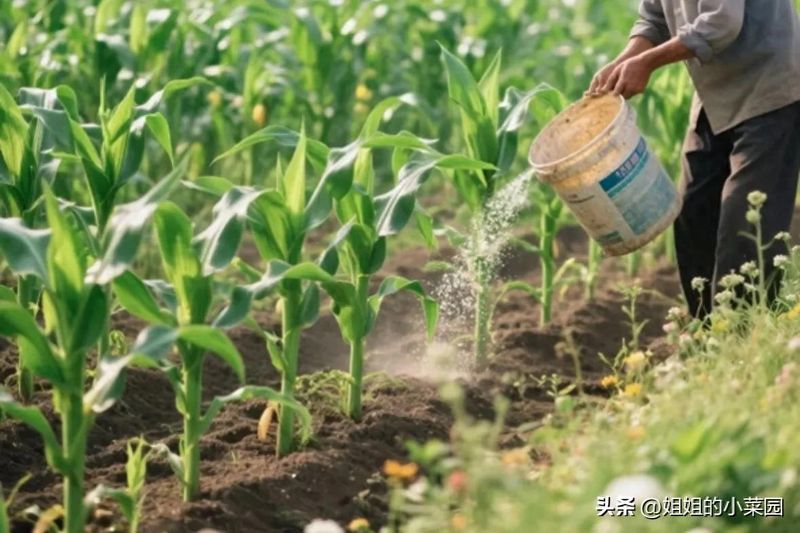
After the harvest, the land was clean, and a number of farmers had taken the grain and were immediately busy preparing their fields for either paddy or summer corn. We all hope that for the rest of the year, the land will feed and earn more. If you want to grow high-yield corn, don't cut it off today
Why is it so big, so full of seed, so high-yielding plots that can hit 2,000 pounds while their corn is always bald and seedy? Most of the problem is with fertilizer. Many people use urea on their own every year, and the money is spent, but the results are normal. There are now a number of land-based, old farmers who have been using a simple and practical method: a common urea-based farming, with little money, and a significant increase in maize strength and production, which has long spread in the countryside。
Let's be honest: corn acres don't make two kilos of crap, but they're not just as easy as normal fields can get. In recent years, hebei, xinjiang and the north-east have high-yield demonstration fields and large-scale growers, which have been measured in the field and have resulted in acre production of up to 2,000 kilograms or more. These plots, however, are either good species + good practices + fine management, or soil and water fertilization are particularly good. The average farmer does not have to be up to 2,000 pounds, but an increase of 200 or 300 pounds in acre production, a more balanced stick and less baldness is perfectly possible。
In rural areas, urea is the basic fertilizer for all households. It has high nitrogen, high efficiency and cheap prices, and is commonly used to catch up and produce long-term supplementation. But urea is only applied all the time, and the problem becomes more obvious:
• light-composed nitrogen fats, corn is easily fertilized in the early stages, and the straw is thin and tall, and it looks warm, but it doesn't fight the wind and it blows down
• at the critical stage of flowering, slurry, the lack of potassium for phosphorus, the premature decay of the leaves, the baldness of the rods, the insufficiency of seed grains and the natural failure of production
• the low utilization of urea, which is scattered into the ground, partly volatilized and partly washed away by rain, is equivalent to half of the fertilizer money spent on drifting
• long periods of monolithic use, with easily compacted soil, reduced ground strength and thinner ground。
The old farmer's urea is not a secret recipe, it's the low-priced potassium phosphate that is visible in the farm shop。
The combination of urea + potassium dihydrogen phosphate is just complementary:
• urea: nitrogen supplementation, promotion of leaf growth, strong and green leaves
• potassium dihydrophosphate: high potassium phosphorus, contributing to root ligation, strangulation, voltage, disease resistance, slurry promotion, prevention of premature decay。
Corn is the fastest growing and most fattening from the alpine to the loud horn, at which time it is reasonably combined with the application, with potassium nitrogen and phosphorus, and with a strong and impotent plant, a post-supplied foot, a large stick and full seed grains, the effects of which are evident。
It's simple to use, and ordinary people look at it:
1. Following water: when water is being poured, the proportionately urea and potassium phosphate are being ploughed to the ground with water flow, absorbing fast and suitable for large areas of land
Root cavity/ditching: opening shallow ditches or small caves by maize roots, burying mixed fats in the ground and pouring water, with less nutrient loss and longer fertility。
Use must be flexible according to the fertility of the home and the strength of the maize: average large field, urea per acre, with a small combination of potassium dihydrophosphate, should not be greedy. Much of the fertilizer is not only expensive, it is easy to burn a seed, but it reduces production。
Visits to nearby villages have revealed that the mix has taken several years for many old farmers. At first, someone was suspicious and compared an acre or two:
• potassium urea + phosphate: thick straw, thick leaves, flat rods, low bald
• urea alone: high and low, small and empty。
The real effect is that a lot of farmers in the neighborhood are beginning to follow it, and it is slowly becoming a good fertilization technique in the countryside。
It's not a good job to grow land, it's a good job not to use it as much as possible, but to use it right. These earthly methods, summarised by the older generation, look simple and in fact correspond to scientific field farming. The urea with potassium dihydrophosphate, with no additional input, can make maize more stable and more productive by means of fertilizing. For average farmers, it is expensive and practical。
Finally, an objective statement: a perfect method of fertilization is only part of field management. Every step must be taken to ensure that maize production is stable, high-yielding, good seeds, rational planting, pest control and drainage. Fertilizer alone cannot ignore other management. Each step will be solid, accompanied by appropriate fertilization techniques, and the land will naturally yield more food and more revenue。
The fertilization methods shared here are the conventional farming techniques summarized in the farmers ' practices, and there are differences in soil fertility, climatic conditions, crop varieties, which can be tested on a small scale in the context of the actual situation in the field. The choice of farming is made by going to a regular store and not being greedy about buying poor products cheaply。