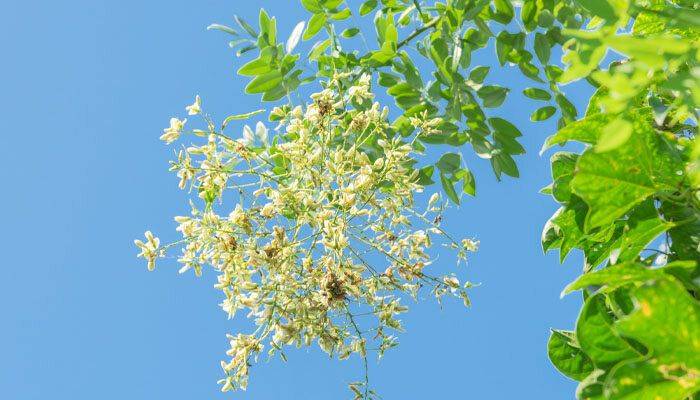
Styphnolobium japoNicum (l.) schott, a soybeans-owned tree. The bark of the tree is dark and the tree canopy is dark, and the old are flatballed or egged. Leaf is born, feathered. A cone of roses, butterflies, yellow and white in the summer, a little aroma. Graffiti, radiant beads, yellow and green, often prowled, winter-sooned, with seeds. Seed kidneys, brown and black。
The northern part of china is home to high-temperature, high-humid, south-west china, the northern plains of the yellow river basin and the yangtze region, with cultivation in viet nam, japan, north korea and the united states of america. The light, with a mild shade, adapts to the colder climate, is deep and developed; the soil is not so demanding that it can grow normally under acidic to limey and light saline soil; and it is resistant to wind and drought, infertile, and adapts to adverse environmental conditions such as urban soil sheeting. More seeding。
Regional distribution
The northern part of china is home to high-temperature, high-humid, south-west china, the northern plains of the yellow river basin and the yangtze region, with cultivation in viet nam, japan, north korea and the united states of america。
Growing habits
The light, with a mild shade, adapts to the colder climate, is deep and developed; the soil is not so demanding that it can grow normally under acidic to limey and light saline soil; and it is resistant to wind and drought, infertile, and adapts to adverse environmental conditions such as urban soil sheeting。
Reproduction methods
Sowing breeding
Selection of nursery grounds
The country's seedlings should choose whether the land is flat, well drained and drained, the soil is fertile and the deep, deep, or sandy, soil is appropriate. It adapts to neutral, limey and micro-acid soil and grows normally on light salted soil (about 0. 15 per cent salt), but poorly in arid, arid and low-lying nurseries。
Seed processing
Preplanting should be treated using either leaching or sandy methods。
Absorption method: vaccination with 80°c and continuous mixing until water temperatures are reduced to below 45°c, placed for 24 hours, and swollen seeds are removed. Uninflated seeds were subject to the above-mentioned two to three repetitions, resulting in their expansion. The swollen seeds are covered with wet cloths or grass curtains and seeded after 1. 5-2 days, around 20 per cent of the seeds are seeded。
Shashifa: seeds are usually hidden 10-15 days before seed is planted. Before the sand hides, the seeds are immersed in water for 24 hours, bringing the sand to 60 per cent, i. E., holding hands in groups and breaking them up. Seed sand is evenly mixed by size ratio 1:3 and placed in an earlier dug pit and then covered with plastic sheeting. During the sands, one turn per day and remain wet, with 50 per cent of the seeds being seeded。
Seeding
The planting time is usually spring-spring, and in mid-april the planting is generally desirable in wuzhou. The seeding rate is 10-12 kg per acre. It can be broadcast or done in two ways. It's 70-80cm wide, 40-50cm deep, about 30 cm wide, 15-20 cm tall, 10 cm broadcast, and 1. 5-2 cm champion. You can do it. You can do it. Post-sown repression allows seeds to be closely associated with the soil and can be repeated when necessary。
Root breeding
(b) plantation: roots may be introduced after the fall of the leaves, buried and preserved with sand before planting, and the moisture of the sand is controlled, neither dehydrating the roots from the water, nor becoming too heavy and decaying。
(b) land-building: the best soil is sandy, thick, flat, easy to drain and free from disease. 2500 kg of animal manure per 667 m2 or 50 kg of phosphorus and ammonium as base manure; insecticides such as furan dan to kill ground pests. It's about 1 metre wide。
Nursery: mid-march in the south and late march to early april in the north. Select a smooth root section 5-10 mm in diameter with no traces of disease or pests for 1-2 years, with a 5-7 cm long backup. The ditch is 50 cm wide and 5 cm deep, and then the root section is levelled in the ditch at a 30 cm range, covering the fine sand, pouring through the root water, covering the membrane and producing seed in about a month。
I don't know
The length of the injection is the same as the time in which the seedlings are planted。
Select the 8-20 mm diameter wood-composed hard branch, cut into 15 cm long plugs, cut the upper cut, 1 - 2 cm from the bud, cut the lower cut to 45 cm, cut the lower cut to a 45° angle, 5 mm from the sprouts, with 50 bundles at the top and lower end, and extract the backup after immersion of 3 - 4 hours with 50 mg/kg raw root powder。
The whole ground requires that the branch be inserted into the soil by an inclination of 45 degrees at a line distance of 20 cm x 40 cm, and that the membrane be covered in a coherent manner。
Plantation techniques
Sapling migration
Saplings: in general, seedlings begin to grow from 7 to 10 days after broadcast, and 10 to 15 days are available. The membrane plot needs to be removed when two or three leaves grow in the seedlings. At 15 cm, two to three times, the seedling plant is 10 to 15 cm, and the acre stock is around 8,000。
(a) deplantation: for greening trees, it usually takes 3-4 years to get out of the bed. Because of the denseness of the branches on the top of the tree and the short distance between them, the trunks are extremely convoluted. The following spring, a year's seedling will be grown at a distance of 40-50 cm and a distance of 70-80 cm, after which the main stem will be cut off from the ground by 3-5 cm. When the budding branch grows to around 20 cm, it is likely that there will be a large number of budding after stem, and a strong branch will be left standing up to take over the rest of the branch. At any time in the future, care will be taken to remove the sides and temporarily retain the small and weak branches on the main, middle and lower branches, in the interest of preventing the bending of the backbone. In this way, the following year may be higher than 3 m。
Fertilizer water management
The amount of water to be poured in seedlings is determined by climatic conditions, soil quality, etc. In general, seedlings are given up two to three times before the rainy season, and a freeze is applied once before the garden is frozen, with timely discharge in the event of a flood; before seeding, the acreage is applied around 3,000 kg of base fertilizer (mainly organic or ring fat), by early june, in combination with the acres of water for fast-effect nitrogen fertilizer (e. G. Urea) 8 to 10 kgg, and urea (preferably mixed with a suitable compound fertilizer) 2 to 3 times in july/august, at around 30 kg. No more water fertilizing after september to promote woody forestation。
Integrative trim
The three tree shapes of natural happy, cup-form and natural-style condensed backbone can be trimmed as required. Naturally happy, when the backbone grows to more than 3m, with three or four strong, scalable branches. The main branch, which removes the branches below the main branch and the buds in time for the mid-term cut of the branches in winter, leaving 50-60 cm and the sidekicking of the branches in order to form a small tree crown; the cup shape, i. E., three main branches, as happy as nature, and two short branches on each of the branches in winter. In the summer, six small branches are formed, heart-cooked, growth-controlled, and two short branches are chosen for each branch the following winter, forming a cup of “3 shares, 6 weights, 12”; the natural axle-form means that after holding the main branch, the tree canopy continues to grow。
Pest control
The main pests are powder, ulcer disease and decomposition, which can be treated with 70 per cent of the methyl tobuzin humid powder 800-1,000 times more liquid or 50 per cent of the degenerative particularly humid powder 600-800 times liquid spray; the main pests are gills, gills, moths, moths, etc., and 10 per cent of the amphibians humid n2000 and 4. 5 per cent of the high-efficiency chlorocypermethrin emulsifiable concentrate 1,500 times liquid or 2. 0 per cent of the n-mactrin emulsifiable concentrate 3,000-4,000 times liquid combinations; grass removal in the hysteria is mainly within the seedland of the year, where manual removal or chemical herbicide protection is possible and where chemical herbicide is used, care must be taken not to spray herbicides into the trunk of the tree。
Main value
Garden value
Zirconium is a distinctive tree of the courtyard, which is thick in its leaves, covered in shades, suitable for shades, and used as a sidewalk in northern china. It is also very appropriate to be planted in parks, around buildings, neighborhoods and lawns. The dragon claws are either planted or planted in front of the door, or stand alone by the rocks of mount trinta. It can also be used for the greening of working mines. The summer and autumn are spectacular flowers and good honey plants. Flower buds can be dyed, fruit and meat can be drugged, seeds can be forage, etc. It is also wind-proof sand, wood- and economic-forest-based tree species that are good shade trees and sidewalk trees in both urban and rural areas and are more resistant to toxic gases such as sulphur dioxide and chlorine gas. It is also a tree that can be chosen as a mixed forest。
Economic value
Wood is flexible and wet. It contains starch, which can be used to brew wine or to make paste or feed. Seed oils are used for industrial purposes; extrafruits of the accelerator can be sugared. The crowns are beautiful, the fragrances of flowers, the sidewalk trees and the fine honey-bearing plants。
For example, co-existing with zeng zeng zeng can make full use of space and nutritional space, can make better use of protection benefits, can enhance resilience to natural disasters, improve land conditions, and can make full use of land and light resources to increase the quantity and quality of forest products and maximize economic benefits。
Value of medicines
Functional governance
Hair leaves: hepatic venom; haemolysis; dry wet pests. Eclamps of the main child; heat; intestines; urine blood; hemorrhoids; rashes; euphemisms; swollen acne。
Breaths: bruising to stop the bleeding; hot and wet; windworming. The main drop; the white belt; the hemorrhoids; the cystic itching; the heart pain; the naked eye; and the plume。
Roots: bruising and swollen; pesticide. Main hemorrhoids; larynx; worm disease。
Angular horns (fruit): circulatory bleeding; clean liver. Hemorrhage of the main hemorrhage; haemorrhage under the gut; dysentery; leak; haemorrhagic gonorrhea; hemorrhaging; hemorrhaging of the liver; and dizziness。
Value
The route from qinhan to qin has been marked as one of china's special tree species. Zirconium is a specialty species commonly used in courtyards, with thick leaves, shades and shades, which are often used as side trees in northern china. It is also very appropriate to be planted in parks, around buildings, neighborhoods and lawns. The dragon claws are either planted or planted in front of the door, or stand alone by the rocks of mount trinta. It can also be used for the greening of working mines. The summer and autumn are spectacular flowers and good honey plants. Flower buds can be dyed, fruit and meat can be drugged, seeds can be forage, etc. It is also wind-proof sand, wood- and economic-forest-based tree species that are good shade trees and sidewalk trees in both urban and rural areas and are more resistant to toxic gases such as sulphur dioxide and chlorine gas。