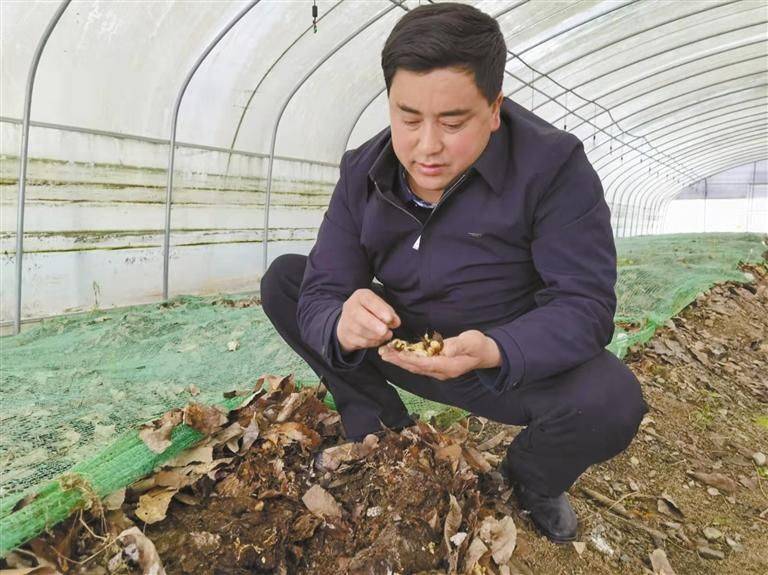
Zhang yunhong, head of the ning jiu tianma seed breeding base, briefed journalists on seed cultivation. I'm a journalist
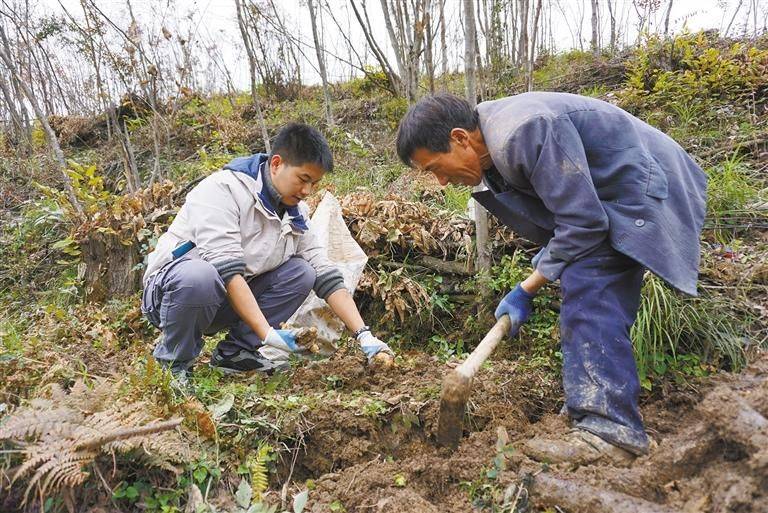
In the village of tianmingshan, the town of hu jia dam in ningjian county, villagers li yongyung (right) are digging for tianmima. I'm a journalist
Qin ling has nothing to do with herb, basando。
Ningqiang county, located at the source of the han river and in the qinba hinterland, is the origin of china's tianmima plantations and is the largest qingnan area of zhongnan. As the dominant local industry, forest gestation, with its high returns, has set the population on the path to increased income and prosperity。
In the 1970s, professor xu jindong of the chinese academy of medical sciences and his team promoted the technique of co-planting bacteria and the sexual reproduction of leaf-breeding beds, the first outbreak of which was separated, making wild mit species “unculted” increasingly successful. Today, in the development of the qin industry, local cultivation models are constantly being developed, with the selection of good qin molybdenum and fungi, and the development of high-quality qin varieties。
I'll be the first to solve the problem
The mid-west han, yunnan, and sichuan ba hills are the three main production areas of the country。
There is one person who must remember — china's “father of tianima” seo jin hall — who has changed his family。
“despite the success of the first artificial planting experiment in lichuan district, hubei province, and the actual introduction of the fungus plant technology into large areas of production, tien ma is still in the east wind team of the tipping water community of ningchang county. It was also the birth here of the method of planting a sexless breeding bed, and the method of planting new materials, which was then extended to 11 districts in the hanchian region, ending the three-year-old lack of supply of food in the country.” in the autobiography of professor seo jin tsai, he wrote such a statement。
On 23 may this year, professor seo jin tong died in beijing. He has developed his whole life for the fertilized industry without waiting for the season to mature。
In 1973, professor seo jintao led his research team to ningchang county for research into the biological variants of tianmu. The then ningqiang district drilling community east windsor team had nearly 100 miles to travel to the county city, which was difficult to transport, but where natural and soil conditions were suitable for the growth of the sis。
At the time, professor seo's family had not been able to offer any good food to the guests, but at the time of the meal, the crowd had always been able to get professor seo some dense meals。
The seed is small as dust and it is very difficult to germinate. "ten-ma's a treasure, and she's going to run; she's a ogre and she's gone." this statement, which is passed on among local farmers, can prove that the cultivation of sterma is much more complex than the normal crop。
At that time, most scholars argued that the growth of cynics (including seed growth) could not be avoided, and professor seo and his scientific team later proved that cynics could not provide nutrients for cynic seed growth, but rather significantly inhibit seed growth。
In order to solve the problem of nutritional supply, in 1976 they observed lumbering plumes from three seeds planted on leaves, two of which were harvested to tima, and then expanded the range of production experiments according to a successful method of seeding the leaves at the first test, after which a successful study was made of the method of sembling leaves. The extension of this method in the hanchong region has not only prevented the multigenerational degradation of sterility, but has also been effective in stabilizing and increasing production。
In the course of the promotion of the sexual reproduction of leaves, professor seo and his scientific team found that the fertilization rate of seeds and the yield of cymbals varied considerably from region to region, thus questioning the direct absorption of leaves by the seed. They looked under the anatomical lens at the plume and the leaves, and found that there was a strain linking the leaves to the plume。
In order to explore the relationship between mycelium and the seed sprouts, they remove yellow leaves from the trees in the autumn, dry them up to the following summer, soak them up and sow the seeds, and sow the seeds after the high voltage of the leaves collected from the forest floor. This proves that the seed is not directly assimilated to the nutrients of leaves, but is associated with the infection of another bacteria。
Living conditions were poor at the time, with scientific staff releasing half a dormitory, disinfecting it indoors, moving into a home-made inoculation cabinet and transforming a small bacterial separation room. Professor tsui jin tsai takes samples from a base ten kilometres away every day and rides into the city to separate the bacteria. Later, in this poor nursery, they succeeded in separating the home and abroad of the famous co-generation of tima seeds。
At that time, the ningqiang district institute recruited more than 30 farmers throughout the county to specialize in tienima technology and, after training by prof. Seo jin tong, to direct production throughout the county, among them wang jianzhong, age 25。
In wang jianzhong's memory, professor xu is a follower and a follower." he was patient with us, he experimented with us, let us do it together, and he often said he would do better than us.” wang jianzhong said that the experience had laid the groundwork for his subsequent development of the pharmaceutical industry, and that in the 1990s he had taken the initiative to study advanced cymber cultivation techniques in ningxia and henan。
Professor tsui jin tsai has made a significant contribution to the development of the local fertilized industry, after decades of taking root. In the 1970s and 1980s, ningqiang and veng county became the main area of han and the national zimma production and commodity supply district, all of which have the highest production and quality in the country. Later on, the tianming industry in luiyang county grew and became the country's main area of production and the first to be certified through the gpa。
The industry is busy
This year's harvest began to be somewhat later than in previous years, following the heavy rains that affected the harvest in november。
The town of hu jia dam is located in the easternmost part of ningjian county. On 11 november, the day after the excavation of more than 140 acres of the village of qingmingshan in hu's dam town, a large iron pot was erected in front of the storage room of tianmima base. The villagers saw that the water in the pot was almost burned, pouring into the bucket the good rice. This pot of rice is lunch for more than 20 scavengers in the village. During the 50-day harvest season, workers come home early and late and eat lunch in the mountains every day。
Wang jing jing and his husband lee ying rong go to the mountain every morning at 7 a. M. On a motorcycle and return home in the dark, earning about $200 a day. Li was a good local excavator, and on an unstable forest slope he could tear apart a layer of mud mixed with rotten leaves and excavate the earth。
The trick of digging is that when digging, it cannot be too heavy, otherwise it is easy to dig apart. "i dig the place, i dig the head, but you see how big it is, i can dig dozens more or even hundreds more every day." lee yong-young said it's all about digging up qingma。
The tingming species of the village of aqingmingyama, which are owned by the cooperative of collective economic organizations of the village at an altitude of approximately 1,200 metres, are expected to produce more than 120 tons this year, with a cumulative increase of more than 600,000 yuan for the villagers entering the garden。
The town of swallow, more than 100 kilometres west of hu jia dam, is the largest shopping and distribution site in the south. This is where tianmima came out and sold it all over the country, some of which were also exported to korea。
During the harvest season, almost all of the women who were left at home in swallow town were admitted to the large and small synthetic processing co-operatives, cleaning, steaming, slices and drying, and were the main forces in the processing line. In contrast to the strict rules governing working hours, the head of the cooperative has drawn up a more humane system for working year after year, in which the worker is able to work full-time or to return to school and cook at a fixed time。
A tianmama processing co-operative in swallow town now employs more than 10 women, and by march next year it will aggregate nearly 40 tons. Looking at his own tianmou store, wang jian, the head of the cooperative, who had some regrets that he had not built the store a little more, frankly said: “the largest investment in the whole process was in the storehouse and drying room, together with the slicer and some other equipment, which had invested more than $5 million in unobserved factories.”
The village of shen dam in swallow town and the rural ex-poor village of kang xiaohuai were able to avoid the risks of working outside the country during the epidemic by relying on the tianmima industry, thereby providing stable security for the lives of the five members of the family。
Kang shunhuai is now a worker of the yan yin tianma cooperative in yanzhong town, while he has grown two acres of tianma himself. “i haven't been out to work since 2019. It's good to grow sis at home. This year's two acres of sis are estimated to be worth $30,000, plus the income of my work at the cooperative. Kang shunhuai said that her family's tianma had been able to harvest and had not been able to benefit from the technical assistance of the winnie tianma cooperative。
The yin ying tianming cooperative combines sterilisation, fungi production and processing in one form, bringing the villagers of the surrounding area together in order to grow tima. The chairman of the cooperative, shen qiang, has for many years been running the tianming industry, and has accumulated a wealth of technology and experience, and is currently leading the surrounding villagers together in order to grow the tianmima. Co-operatives provide bacterial and technical support, and villagers are responsible for planting, caring for and distributing the proceeds equally, so as to ensure both the production and quality of sis and reduce the risks of industrial development for all。
“ning qiang is an aerobic zone and a traditional planting area, and it is a deep memory of the stronger people engraved in the bone marrow. Since 2016, ningqiang county has established a series of demonstration bases for seedlings and commodities, such as swallow, yangping and dae an towns, forming a whole-industry chain that combines a combination of tungsten development, planting, production, processing and marketing. This year, ningqiang county's new development commodity, 28,000 acres and more than 4,500 acres, is expected to produce more than 50,000 tons per year。
We need to develop and follow up
The study by prof. Xu jin tsai resolved the technical difficulties associated with the use of fungi, honey circulus and sexual reproduction of foliage beds, paving the way for the development of the industry. After almost half a century of accumulation, people continue to explore the growing possibilities of development on this path。
In order to learn and develop the field mahjong techniques developed by professor seo jin tung, the ning dynamite zhang huai rong founded the ning dynamism institute in 1993。
Unlike crops in general, the growth of sterumes involves fungi and honey circulus, which are not technically directed by “hand hands”, a process that is difficult for farmers to understand. Zhang huai rong has been training local farmers in tima technology, detailing the market prospects for tima and life habits. Over the years, more than 13,000 people have been trained in edible bacteria and tima cultivation。
Zhang huai-ryung has also been working technically to reverse the severe degradation of the honey cyclic fungus, with the successful and autonomous selection of m. D-1 bacteria, based on the resource advantage of the shannan qinba mountain region, which indirectly or directly accounts for 80 per cent of the national fertilized areas; and the autonomous selection of honey #5-1, honey #31, honey # honey cyclic strains, which reverses the serious degradation of the meringue fungus and spread it to large areas of the national fertilized areas。
Unlike zhang huai-wing, who is studying the two strains, zhang zhang was currently the head of one of the largest urban seed breeding bases in the south. His cynic memory echoes songs and smells of medicine. Compared to the local traditional cultivation of red and luminous plasters, the utopian ephedrine content is much higher than that of red and the pharmaceutical value is high, and the market price can be five or six times higher。
In 2015, zhang dong-hung, who had returned to entrepreneurship, began to develop forest cover in high-altitude areas with policy support. Later, he returned to his home town, the village of baekgoko, where he fully exploited the local resource advantages, and began to scale up and plant the charades, turning into “gold jobs” for the people of his hometowns who often went into mountains to dig. Zhang dong-hung said: “at the beginning of last year, we invested more than $3. 5 million, built 8,000 square metres of sheds, built the largest utsima breeding base in the south, and nurtured utsumi-zero and one generation of `utsumi'
The natural environment, which is unique in nature, breeds a rich resource of chinese medicine and is one of the country's largest producers of chinese medicine, of which such medicines as tima are well known. “in the next step, we will be able to make a good selection of fertilizers and a good selection of bacterial seedlings, culture of fungi forest, build a high-quality fertilized fertilizer base and a commercial fertilized fertilizer base, relying on a model park for the development of fertilizers' integration as an entry point, and achieve the integrated development of the fertilizer industry. We plan to spend about five years in order to produce more than 100,000 tons per year and more than 3 billion yuan per year.” ningqiang county director of agricultural and rural affairs said something。