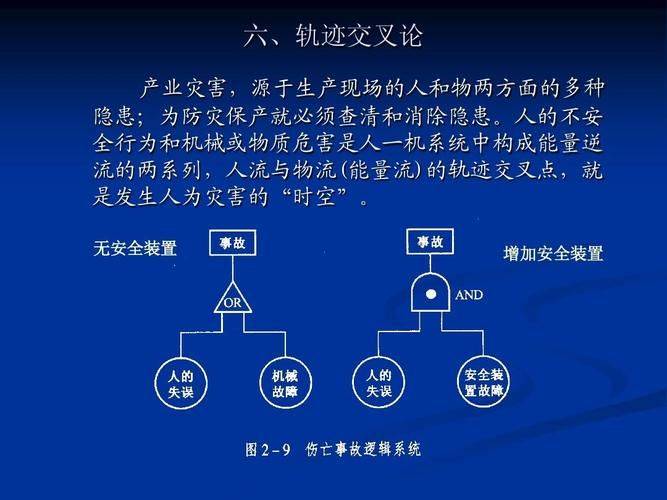
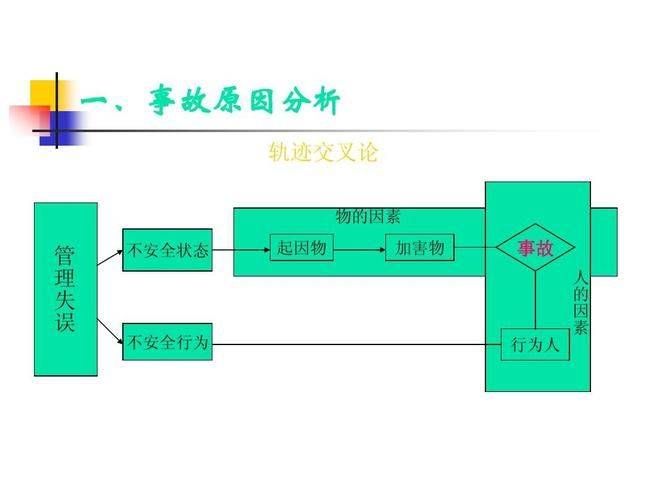
Trace interspecting theory, also known as the cause of the accident, was co-sponsored by many scholars like w. G. Johnson and skiba. The underlying idea of the doctrine is that injuries are the result of many interrelated sequences of events, which can be summarized as the two main development series of “people” and “matters, including the environment”. In the process of accident development, human unsafe behaviour (human motor trajectory) and the insecurities of objects (physical kinetic trajectory) occur (cross-crossing) at a certain time and space during their development, leading to the transfer of energy to the human body and thus accidents. The intersection of trajectories emphasizes that the human and physical factors are equally important in the cause and cause of the accident, and that the two are interrelated and causal. The theory describes the course of development of the accident as: the underlying cause is the direct cause of accident injury. For this reason, the key to accident prevention lies in avoiding the intersection of human and physical dynamics in time and space, while the theory is an effective tool for analysing the causes of accidents。
Background and presentation
The understanding of the position of both human and physical factors in the cause of accidents has changed considerably as production techniques have improved and the theory of the cause of accidents has developed. On the one hand, the problems of insecurity in production facilities and conditions have gained increasing attention as a result of technological progress in production, and on the other hand, the in-depth study of the human factor has correctly distinguished between human and material insecurity。
Johnson (w. G. Jonson) argues that the determination of whether or not an act or state of insecurity is influenced by the subjective factors of the researcher depends on the depth of his understanding of the problem. Many people perceive insecurity as a result of human error because of a lack of knowledge about failures. In addition to human insecurity, there must be a certain level of insecurity and insecurity has a greater impact on accidents。
Skiba argued that both the production operator and the mechanical equipment had an impact on the occurrence of the accident and that the dangerous state of the mechanical equipment had a greater impact on the occurrence of the accident, which could occur only if both factors were present。
The main point of the theory referred to above is that, in the course of the accident development process, the physical trajectory of the human factor and the physical element is the time and space at which the accident occurred, when the insecurities of the human element and the insecurities of the human element occurred at the same time, in the same space or in the same space, or in the same space。
The intersection of trajectories, as an accident cause theory, emphasizes that human and physical factors are equally important in the cause of accidents. According to the theory, accidents can be prevented by avoiding the intersection of human and physical factors, i. E. The simultaneous and simultaneous occurrence of human and physical insecurity。
Activation principles
The development of the accident is described in the intersection of trajectory theory as: the underlying cause is the direct cause of the injury. From the point of view of the development of the accident movement, such a process is described as a motor trajectory of accidents caused by the cause factors, including, in particular, human factors and objects。
Human factor motion trajectory
Human insecurity arises from physical, psychological, environmental and behavioural factors:
(1) physical, congenital and mental impairment
(2) deficiencies in the social environment, management of enterprises
(3) mental defects of the day after the day
(4) differences in the distribution of sensory energy such as vision, hearing, smell, taste and touch
An object's factor trajectory
Unsafe conditions may arise at all stages of the production process in the physical kinetic trajectory:
(1) design defects, such as inappropriate materials, miscalculation of strength, poor structural integrity, unsuited mining methods, etc.
(2) manufacturing, process defects
(3) deficiencies in maintenance, reducing reliability
(4) deficiencies in use
(5) environmental defects in the workplace。
In the course of production, the human factor track follows its direction of (1) (2) (3) (4) (5) and the physical element track follows its direction of (1) (2) (3) (4) (5). The time and location of the intersection of human and physical trajectories is “time and space” where casualties occur, which also leads to accidents。
It is worth noting that in many cases people and things are causal. For example, insecurity sometimes leads to human insecurity, which in turn contributes to the development of material insecurity or leads to the emergence of new ones. As a result, the actual accident was not simply carried out along the lines of the above-mentioned human and material tracks, but presented a very complex causal link。
If the chain of events is disrupted by efforts to remove the pitfalls of mechanical equipment or the handling of hazardous substances, or to eliminate human error and unsafe behaviour, the two series of motor tracks cannot intersect, the danger cannot occur, and accidents can be avoided。
For the human factor, the emphasis on job evaluation, enhanced safety education and technical training, scientific safety management and the generation of unsafe behaviour that controls people physically, psychologically and operationally is tantamount to cutting off the path of human factors resulting from accidents. However, it is difficult to control people who are very free and have great differences in physical and mental characteristics, and it is difficult to avoid accidental failures。
In most cases, the poor management of enterprises, the lack of education and training of workers or the lack of maintenance and overhaul of mechanical equipment, as well as inadequate safety devices, have led to a state of human or material insecurity。
The cross-orbit theory highlights the incident chain of cutters, promotes the use of reliable and structurally sound systems and equipment, and promotes insurance systems, protection systems and signal systems, as well as high automation and remote control devices. In this way, even if an artificial error is made, the human element (1) (5) series would be the result of a reliable security system, such as a security lock, and the development of the containment factor (1) (5) series would completely avoid casualties。
Some leaders and managers have wrongly attributed all casualties to “violations” by operators; indeed, human insecurity is also due to managerial deficiencies such as inadequate education and training. The focus of management should be on the unsafe state of the control material, i. E. The elimination of the “causes”, and certainly there would be no “polls”, and the “cut off” material would have a dynamic trajectory that kept people from the trajectory of the object, so that accidents could be avoided。
The elimination of insecurity in production operations has proven to be a significant reduction in casualties。
Applications
The intersection of trajectories, as an accident cause theory, emphasizes that human and physical factors are equally important in the cause of accidents. According to the theory, accidents can be prevented by avoiding the intersection of human and physical factors. At the same time, the doctrine is a good tool for investigating the causes of accidents。
In manufacturing production safety, the doctrine is used to study how to avoid accidents, emphasizing the intersection of control over people and physical trajectory. In the area of air operations maintenance, the cross-trajector theory is also applied to security management, with the same emphasis placed on controlling the insecurity of humans and objects in order to prevent their intersection。
In building safety accident prevention, the doctrine has been applied to control unsafe behaviour of construction operators and unsafe condition of mechanical equipment. The aim is to avoid cross-trajectories between people and objects in the construction process, through, inter alia, the adoption of risk-control techniques for mechanical equipment, the enhancement of training for operators and the establishment of safety incentives。
The doctrine has also been used in the analysis of dangerous chemical transport accidents. For example, when analysing the 2020 zhejiang wingling tank explosion, researchers explored the dynamic logic and causes of the development of the accident on the basis of the cross-track theory and suggested preventive measures accordingly。
In addition, the cross-trajector theory has been applied as a foundation theory in the analysis of logistics security management in higher schools, to explore the causes of security problems and to develop appropriate preventive methods。
Impact and meaning coverage
The cross-trajector theory, as an important theory of cause of accidents, emphasizes that human and physical factors occupy an equally important place in the cause of an accident. Its value lies not only in explaining the cause of an accident, but also in providing a clear and practical theoretical framework for accident prevention and investigation。
In an accident cause theory system, the trajectories are considered to be as profound and practical as adams's theory of causal chain and serley's accident decision-making model. This theory reflects the reality of the vast majority of accidents, such as the finding by the ministry of labour of japan that only about 4 per cent of the 500,000 work-related accidents were unrelated to human insecurity, while only about 9 per cent were related to physical insecurity, highlighting its universal and interpretative emphasis on the interaction of human and material factors。
The doctrine has had a positive impact on security management practices and promotes management strategies that give equal importance to human and material factors. Its core preventive philosophy avoids the intersection of human and physical trajectories from time to time. In practice, the doctrine emphasizes the prevention of accidents through a “trigger of cutters”, promotes the use of systems and equipment with high reliability and structural integrity, and promotes insurance systems, protection systems and signal systems, as well as highly automated and remote control devices. At the same time, the doctrine is an effective tool for systematically investigating the causes of accidents。
For example, in port material plants, the use of the “trajectoric intersection” theory to control accidents and eliminate hazards has yielded tangible results。
Moreover, the impact of the cross-trajectory theory, which goes beyond traditional industrial production safety areas, has been introduced into a broader field of applied research, such as studies to evaluate the state of occupational health, such as glass plants, and studies to analyse the logistics security management of universities based on the theory, which reflects its strong interpretation and broad applicability。