Material requirements
From the process of crowding out, it is known that the screws work under high temperatures, certain corrosiveness, severe wear and tear, and therefore must:
1) high temperature tolerance, high temperature constants; 2) wear resistance, long life expectancy; 3) corrosive resistance, materials are corrosive; 4) high intensity, capable of bearing large twists, high rotation speeds; 5) good cutting processing performance; 6) low stress after heat treatment, small heat transformation, etc。
Common materials
The screwdrivers used in our country are steel 45, 40cr, ammonia steel, 38crmoal, high temperature alloy, etc. 1) steel 45 is cheap and processed well, but resistant to corrosion. Thermal treatment: modified hb220-270, high frequency gillfire hrc45-48. 2) 40cr is better performing than steel 45, but is often coated with a layer of chromium to increase its ability to withstand corrosion and wear and tear. However, the requirements for chromium plating are high, the plating is too thin to be worn, too thick to be skinned, and the erosion is accelerated and less applied. Thermal treatment: nox steel, 38crmoal integrated, with a modulated hb220-270, hard chromium plating hrc>553) is more excellent and widely applied. The general nitrogen layer is 0. 4-0. 6 mm. However, the resistance of this material to the erosion of hydrogen chloride is low and expensive. 4) high-temperature alloy material is better than other materials, which are not coated and are mainly used for plastics with halogen-free screws, which are highly resistant to oxidation and corrosive properties, and for thermal treatment hra55`604.
Thermal treatment
Moderation hb220-270 and the use of titanium carbide coating in foreign countries has increased the corrosive resistance of the screw surface, but it has reportedly not been sufficiently resistant to wear and tear。
A number of measures have been taken abroad to improve the corrosive resistance of the screws. One approach is to use highly resistant to corrosion-resistant alloy steel. This is the case of 34cralni, 31crmo12 etc. There is also a way to spray xaloy alloy on the screw surface. This xaloy alloy has high tolerance for corrosion。
When the screw is matched by a longer cylindrical surface on the main axis of the gearing box, the screw can be used as a fixed arm beam. The stress of the screw during the squeeze can simplify the situation as shown in the figure:4
Spiral stress
1) self-heavy g; 2) rectangular m required to overcome material resistance; 3) axis p generated by material pressure。
The screws are generally scrapped because of long wear and tear, the gap between the screws and the drums is too large to be properly squeezed out, but there are examples of disruptions due to inappropriate design or operation of work stress exceeding the strength limit. The screws should therefore also meet certain intensity requirements. 4) the dangerous fractures of the screws are generally at the smallest root length of the screws in the feed segments. Based on material mechanics, composite stress for plastic materials is calculated using a 3rd strength theory with the following strength conditions:
Other information
1) in the case of a floating link between the tail of the screw and the main axis of the gear-reducing box, the bending effect caused by the self-heaviness of the screw is equal to zero, so it is calculated only by the pressure and shear stress of the screw. 2) the two methods are practically the same because of the small bending effect caused by the self-heaviness of the screw (the screw is surrounded by material), which can be omitted even in the former case. 3) there are also fours of the spiral diameter estimated by twist。
The use of the screw
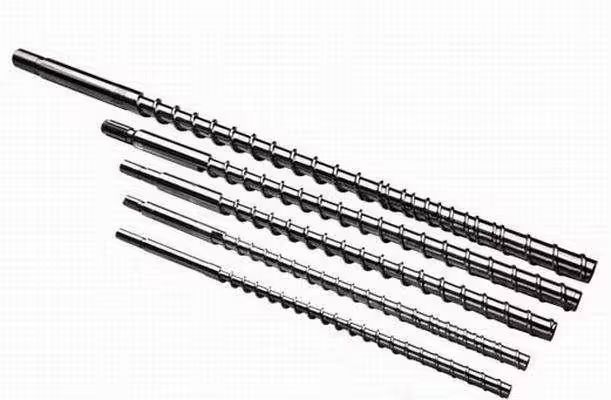
Most are used in plastic-forming equipment, such as plastic-type extruders, retrofitters, etc. The screws and cylinders are the core components of plastics-forming equipment. It's heating out the plastic part. It's the core of plastic machinery. The screws are widely used in processing centres, cnc machines, numerically controlled beds, aggregators, line cutting, grinding beds, shrouding wires, moving wires, pcb drillers, sculptors, sculptors, sparks, teething machines, scratch beds, large standing doors and so on. 4
Design principles