


In the a stock market, the most painful thing is to lose the real bull stock, to sell it at the rise point or to chase it at the top of the mountain. Many people are staring up the stopboard every day without seeing the core signal behind it — change of hands. The new generation, chen zheng qiang, is telling the truth: the first rise and halt in the bottom area, with a change of hand rate of less than 5 per cent on the same day, is evidence of a high level of control by the dealer and a sign signal for the start-up of the bull stock. It's not an empty word. It's a dry product that he's been working for years, sharpened from data on the big dragon list, and today he's tearing the logic apart, making it clear that you can use this signal in the future, precisely capturing the bottom-started bull stock。
First, the most basic concepts should be explained in such a way as not to be understood by new hands. What's the change rate? It's a stock that sells and sells for a certain period of time, which, in plain words, is the liquidity of chips. When we look at the disk, the change rate is active, the change rate is fast, the change rate is low and nobody wants to move. But there's a huge mistake in many of the caravans: feeling that the change rate is just nobody's attention, that the stock ratio is not alive, that it's a “mortem stock”, that it's only 3%, 4% in the end, and that it's simply ignored, that it goes after 20%, 30% of the change-of-hands, and then it goes back in, and the change doesn't even work with a few boards。

Why? Because you don't understand the meaning of the change of hands. Chen has repeatedly stressed that the central premise of this signal must be a “first rise at the bottom” and that it is completely different, even a trap, from the bottom. Let's set the bottom standard and not half the hill. At the bottom: first, there must be a significant drop in stock prices in the front period, with a drop of at least 30 per cent, which would have largely destroyed the upper pallet; second, the decline would have to be followed by a long-term cross-blank shock of two or three weeks and months, during which the turnover has been weak, with a long-term turnover of less than 3 per cent, which is typical of a “ground grinding floor”; and third, the small volatility of stock prices during the cross-blank period, with no more than 15 per cent up and down, without a significant rise or fall, indicates that the leverage has stabilized. Meeting these three points is the real bottom, not the short-term rebound, or the high-level return。
Then at the bottom, the first stop and change rate was less than 5%. What was the dealer's secret? The core logic is, in one sentence, that the chips are locked up by the dealer, that there is so little in the field that the dealer can pull up and stop with little money and no one can sell them。
Think about it. The first step is sucking. In the few months on the bottom, the dealer buys it quietly, hastily, has cut meat in the open, has not patiently received it in his hand. The process is like a farmer collecting food, the dealer collecting the “food” in the field, and the rest of the land is either firmly held, dead and unsold, or the dealer's own basement, with a poor chance of trading. At this point in time, the dealer simply does not need to spend a lot of money to raise, to carry the pressure, to pull up a little bit, and no one sells it, and the stock price goes up and down, and the change rate is naturally low, roughly between 2 and 5 per cent, or even lower。
The low-handedness is not “no one buys”, but “no one sells”. How high does the dealer control it? At least 50 per cent, or even 70 per cent, of the disks were acquired, with full ownership of the equity discourse. He wants to pull, he wants to smash, he wants to smash, he wants to push, he wants to push, he doesn't push, he goes up fast and steady, and he has a very high probability of a plate, which is the standard bovine。
Let's compare it again. What's it like in the top? Stock prices have doubled and doubled to high areas, and suddenly contractions have stopped, with exchange rates below 5 per cent. This is definitely not a control, but rather a trap for the dealer. The dealer had too much chips in his hand and had to lock the warehouse up and pull it up, create the illusion that the chips were stable and had to go up, tricking the loosers in order to pick up the plates, and he quietly split the goods behind his back. When it was almost ready, the dealer went straight to the plate, the stock price went down, and the high-speed switch went straight to death. So chen xiaoquan specifically reminds us that the low-handed, low-handed, bottom-only, high-level, straight-out。
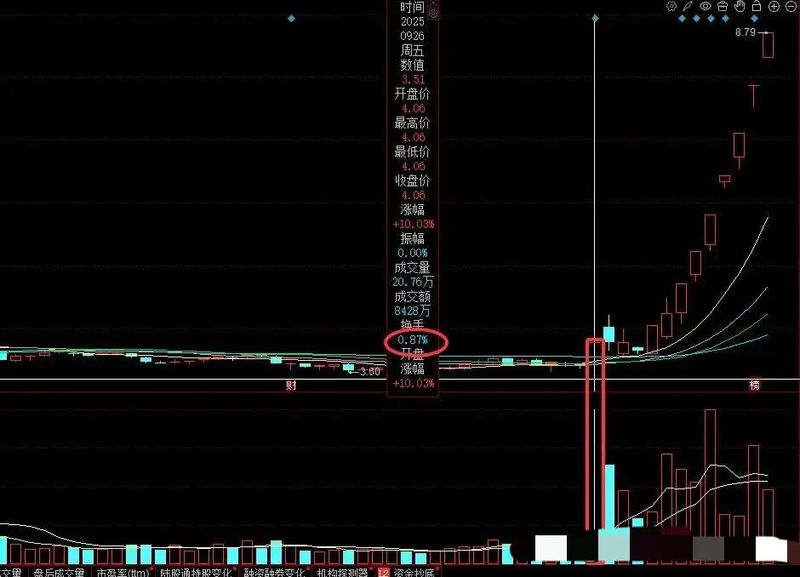
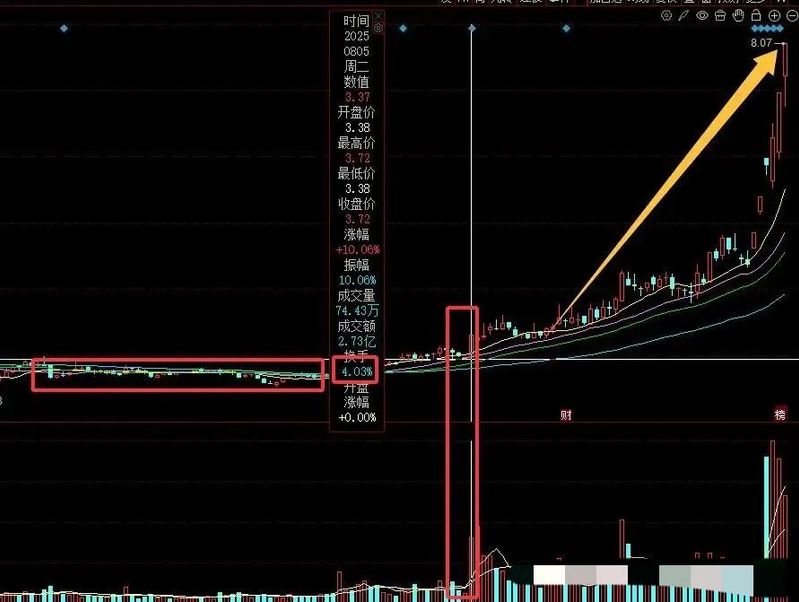
It is not enough to know logic, to be precise in the field, to be stuck in a few details, or to be deceived by false signals. Chen xiaocheng summarized four core points, none less:
First, it must be the first rise at the bottom, not the second and third. The first increase was the first shot by the dealer to break the balance of the disc, which was officially activated, and the most direct manifestation of the high disc. In the case of a later boom, even a change of hands would be less than 5 per cent, which could be a stretching locking block, with a significant loss of signal reliability and no certainty that it was a high-controlled disk from the outset。
Secondly, the exchange rate is strictly below 5 per cent and cannot be vague. In some cases, the stock increases and stops at 5. 2 per cent, 5. 5 per cent, or nothing at all, which means that there is still a certain amount of pressure going on in the field and the dealer's control is not that high. It would be preferable to have between 2 and 4 per cent, with less than 2 per cent as low as possible, with a higher subsequent outbreak。
Thirdly, it should be of high quality. It would be better to have fast seals before 10 o'clock, large and stable, full-time, non-defeating, and instantaneous if open. In the case of an upswing in tail-painting, or repeated flaming boards, with weak seals, even if less than 5 per cent is changed, it means that the dealer is weak and unwilling to do so。
Fourth, the turnover needs to be mildly amplified. The volume of the trade on the day of the first plate, if it were 1. 5-3 times the amount of the cross-discs of the previous day, could not have been a daily explosion. Moderate quantities suggest that the dealer has taken the initiative to climb, while the naturalities may be either the dealer’s downfall or the large funds to flee and the chips unstable。
In order to be more intuitive, we would like to give two examples of real-time a's recent trends that we can see at once。
First, in february 2026, a small capitalization fell from 12 to 5 in the preceding period, with a drop of more than 60 per cent, followed by a three-month crossover between 4. 8 and 5. 5, with a daily average turnover of less than 2 per cent and a condensed trade to the extreme, fully meeting the true bottom standard. On 18 february, the stock was blocked 20 minutes earlier, with a turnover rate of 3. 1 per cent the same day, twice as high as the previous day, and the seals were stable and open. That's the standard "lower than 5% change of the bottom panel." what about the back? Five direct increases and stops, with stock prices rising from $5 to $9, increasing by more than 80 per cent in just one week, with typical large cattle stock movements. A lot of people in the diaspora were looking down, and they didn't feel alive, they didn't come in, and they didn't regret it until it got up。
The second, in march 2026, was a high-rise stock, which rose from $6 to $14 in the previous period, with an increase of over 130 per cent, followed by a halt in march 15, with only 3. 8 per cent turnover, which also appeared to be low. But it was high, not bottom, and the next day it went straight down, the closing was down by 7 per cent, the back was down, the stock price fell back from $14 to $9, and the whole of it was covered. This is the trap of high- and low- and bottom-to-bottom-to-hand。
So, how does it work? Chen xiaocheng also offers a simple and practical three-step strategy that can be used directly by new players:
First step, the day of the headboard, don't rush up. At the bottom, there's a change of hands, the dealer's control is strong, and the odds are even, but in a few cases, the dishes are washed. If the front board opens the second panel on the same day, it cannot be bought; if the board is slowly sealed, the hand change is controlled at 3-5% and can be tested in a small manner, not exceeding 20%。
Step two, look at the next day, confirm the signal. If the contraction continues, the change rate is still below 5 per cent the next day, which means that the dealer continues to lock the warehouse and lifts it directly to 4-50 per cent; if the change rate does not exceed 8 per cent on the second day, the stock price does not break the plate, which increases the price, which means that the dishing is not going out, and then the stifling is going down; and if the next day goes down directly, drops the price of the floor, means that the signal is not working, leaves the field and does not fall。
Step three, holding phase, focus on turnover and turnover. As long as the exchange rate remains below 5 per cent and the turnover remains moderate, it will be held firmly, without fear of shock. Until one day, the stock price was high and the change rate suddenly exceeded 10 per cent, or even 15 per cent, indicating that the dealer began to deliver the goods, the chips were loose, the lines were closed directly in batches and the bags were settled。
There are two common error zones, many of which have stepped on the pit:
The first is to use the second new unit as a low-handed stop signal. The next time the new stock is on the market, the leverage structure is unstable, the bottom floor is low, most of which are ad hoc controls by the dealer, without a long-term inhaling process, and it is easy to rush back and down, and this logic cannot be used。
The second is ignoring the plate effect. The bottom-to-floor, low-to-floor stocks are best placed in the current market hotbeds, or have good policy and good industry interests, so that they can be connected and grow even more steadily. In the case of cold door blocks, there is limited follow-up space, even if the signal is right。
In fact, the skills in the stock market are never as sophisticated as they are useful, but rather are the simple, direct, core logical signals that are best suited to the bulk. Chen xiaoquan's “lower than 5 per cent bottom switch” method, which essentially captures the dealer's inhaled, high-controlled start-up point, avoids the high-end docking, false break-through trap, and is much more successful than blindly catching up。

Let's not try to catch demons and soar, let's start with this high-precedented basic strategy. Then look at the stock on the bottom, look at the change of hand rate, which is below 5 per cent, and don't ignore it as a “dead stock”, and spend a few more minutes looking at the position, looking at the trade, or maybe the next big cow stock。
When there is no 100 per cent success at war in the stock market, and when the signal fails, the key is strict discipline, the signal goes right, the signal goes right, the signal goes wrong, it goes down, and it is not greedy. Have you ever met a stock like this before? What was the verdict? Did you miss the bull stock? Let's talk in the comment area, share experience in the field, and avoid each other。



