



In short-term transactions, the rise is the most direct expression of the financial attitude, while the time and intensity of the seal is the central basis for judging the strength of a stock, the probability of a board, the intent of the main force。
Many investors look only at whether the boom or not has stopped, while ignoring the inherent logic of time and intensity, leading to frequent purchases of slabs, panels, and weak increases and stops when the next day is low。
A truly mature trader is able to quickly identify a strong and weak ranking through the block time, thereby increasing the chances of winning。
First, the sooner the board is closed, the better the willingness to raise funds, the sooner the time comes, the more assertive the aggressive attitude of the representative, the greater the strength of the stock。
The early-disk phase, in particular the stock sealing board within 30 minutes of opening, is often the main market line, the plate tap or the good driver. The fact that the pool bid went up and up quickly showed that the main funding plan was clear and the leverage was well locked, and that it was reluctant to give the bulk a low level of access to the car。
Such shares are low-pressure, consistent in mood, with low probability of a panel being behind the seal and higher price next day. On the contrary, the shares of the tailboards are mostly passive, self-help, lack of active offensive, and the next-day premium tends to be very poor or even directly low。
To put it simply: the early plate is strong, the midday board is weak, and the tailboard is full of holes. The timing, which directly reflects the urgency of the financial offensive, also determines the amount of gold to increase。
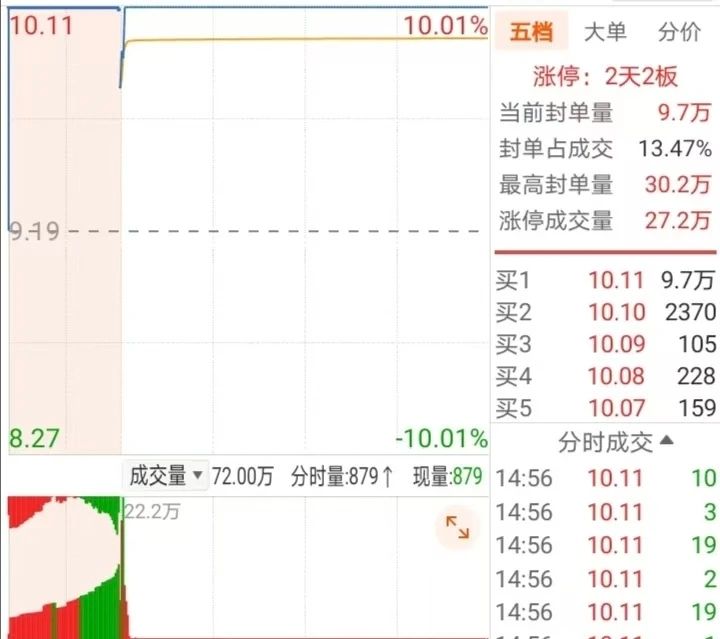
The speed of the panel determines the stability of the chips, the speed of the panel, the shallower the medium of the disc, which means the smaller the pressure, the healthier the chip structure. Strong stock rises and stops are usually straight-line lifts, a wave of panels, with little backsliding or deep concussion。
This trend is indicative of the high level of off-site financing, which has been sold by shareholders and left empty. The stock that has been pushed up over and over and over again, and has been dazzled, means that it is heavy, divided and underfunded. In terms of intensity, a wave of seals is back。
For short-line players, preference is given to one wave of boom-and-bust targets, where the stakes are stable and the probability of a board is high, while stocks that have been closed repeatedly are vulnerable to failure the next day, and when emotions deteriorate, they are highly exposed。
Three, the size of the seal, which directly reflects the intensity of the increase, is the most visible data to measure the intensity of the increase, the larger the seal, the greater the financial attitude, the safer the stock。
At the acceleration stage, the billings tend to be 5-10 per cent or more of the pallets, or even larger, and this huge monotonous sealing indicates that the funds have been hoarded, that the off-site funds have not been bought at all, and that the in-field chips have remained intact. On the other hand, the low level of recognition of funds, as evidenced by the small and reluctant increase in the number of seals, would blow up the tablets。
It also depends on the continuity of the seals: the size of the early seals and their continued stability are strong; the smaller the early seals, the weaker they are. The seal also prejudges the next day premium: the larger the bill, the higher the next day; the smaller the bill, the greater the probability of opening the next day。
The real strength is up and down, and it's early + one-size-fits-all + three-way resonance。
Four, the number of openings and the quality of the repossessing, reflecting changes in power and power, not all increases and stops can be blocked at once, the number of openings and the strength of the repossessing, are also important signals of the intensity of the judgement。
The openings of powerful stocks, often short-lived, fast-activated, low-pressure and strong-strength, are an adequate expression of the master's power to wash and change hands, commonly referred to as “dry without weakness”。
The rise in vulnerability, on the other hand, is repeated, unencumbered, smaller and smaller seals, with the tailings even reluctantly closed, which are “bad and weak” and extremely risky the next day。
Normal: do not open the tablets. The opening of the board is not necessarily a bad thing, but the speed of the sealing and the quality of the seal directly determine whether the stock is going through the board or rushing back。
V. Fall time and practice of the next purpose
(b) 9:45-10:30:30:30:30:30:10:30:30:30:30:30:30:10:30:50:50:30:50:50:30:50:50:50:50:50:30:30:30:30:30:10:30:30:30:30:30:45:50:50:50:50:50:50:50:50:30:50:50:50:50:30:50:50:50:50:50:50;50:50:30:30:30:30:30:30:30:30:50:50:50:50:50:50:50:50;50:50:50
Post-14:00 seal: super-vulnerable, mostly induced, and probably low rate the next day. The real high-tension scale is almost always from the early-discretioned wall, accompanied by large-scale seals and fewer boards. The tailings appear to be safe and the least funded option。
Summary: the sooner the time comes, the greater the intensity, the more stable the premium. The most powerful form is that of fast boards, large seals and very few open boards; the weakest form is that of thin tailboards, few seals and repeated panels. Shortlines can only be used to make the strongest increase and stop to stabilize the premium。
Not to guess the main power, not to gamble, but to look at the time and intensity of the seal, it can filter out most of the vulnerable rise and stop, avoiding the large side of the blast. Remember the core principles: time up, time up, seal up. The prep is an opportunity. By adhering to this standard, it is possible to gain an advantage in the upswing in the game and increase the success and return rates。



