


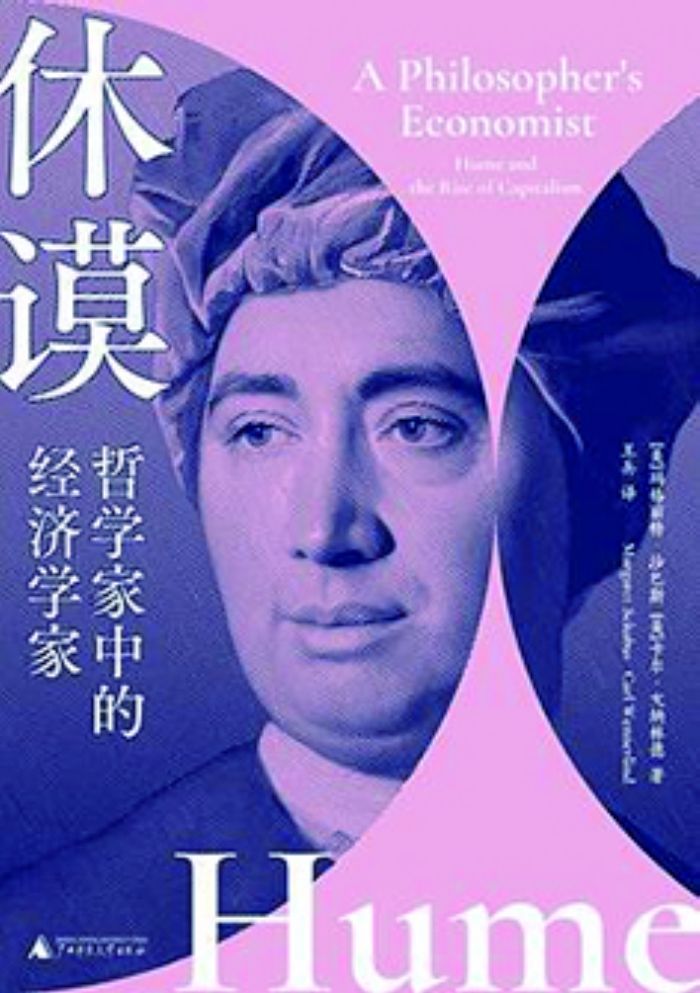
Humu: the economist of philosophy
Marguerite schabascar wennard
The king is a soldier
Guangxi teacher training university press
Published in april 2026
Feng yi
In the history of western thinking, david humud has long been remembered as a philosopher and historian. His skepticism has shaken the traditional form and roots of schooling, and the theory of humanity has reshaped the paradigm of humanism, while british history was more famous in the 18th century in european history. But its economic thinking has long been overshadowed by philosophical halo. This inherent cognitive bias was broken by the american scholar margaret schabas and carl wennnerind, the economist of the philosophy family, who, with an interdisciplinary perspective, restored the whole spectrum of the ideology of the economy, arguing that economics is by no means a “paranoia”, but rather a central thread that runs through its life-long thinking, positioning it more as a central theorist in the era of the rise of capitalism. This book not only fills the gaps in the study of jammu, but also prompts a rethinking of the intrinsic links between philosophy and economics, as well as the ideological underpinnings of the business civilization of the enlightened age。
The author directs the long-standing perception bias in the academic world: the economic discourse of humud has been used as an accessory to philosophical writings and even as a fragmented reflection of the shift of interest in later years. But by combing the whole text from youth to old age, from the exploration of property and justice in the theory of humanity, to the analysis of business growth and decline in the british history, to the systematic economic discourse in the political series, the authors have clearly demonstrated that economic issues are at the heart of the idea of peace, and that philosophical and historical research provides solid support for economic thinking。
The economic thinking of the humud was not born out of empty space, but rooted in the transformational context of the scottish business community in the eighteenth century. At that time, societies were transitioning from traditional agricultural civilization to commercial capitalism, and the mercantilist theory was dominated by economic policy, which generally equated wealth with silver and silver, considering the maintenance of a sustained trade surplus as the only path to national prosperity. By using empirical philosophy as a weapon, he systematically criticized these traditional ideas, not simply theoretically, but on the basis of keen observation of the economic realities of the time. He was personally involved in commercial activities and was familiar with the movement of money and the actual operation of trade. The quality of this “terrestrial gas” makes its economic thinking both philosophical and realistic. The author stressed that he was the first thinker to base economics on human sciences. Rather than viewing economic activity as an isolated game of interests, he embedded it within the overall framework of humanism, morality and social order, a holistic perspective that is key to transcending simultaneous generations of economic scholars and providing a source of thought for future generations of economists such as keynes and hayek。
The core system of the ideology of the muslim economy has been dismantled in half a page of the book, consolidating its scattered papers into a logical theoretical framework. Among them, monetary theory, free trade theory and business social ethics theory constitute three pillars, each of which is both theoretically pioneering and realistic。
Prior to humu, mercantilists equated money (gold and silver) with wealth itself, advocating that the state accumulates gold and silver through trade surpluses and severely restrict currency outflows. The classic monetary numeric argument put forward by the shumu had completely subverted that perception. In his view, money was only the medium of commodity exchanges, not the wealth itself; commodity prices were determined by the volume of money in circulation, and the increase in the number of currencies would only lead to price increases that would not substantially increase the real wealth of the country. More groundbreaking is the introduction of a “price-castle flow mechanism”: a country’s trade surplus would lead to an inflow of gold and silver, an increase in the money supply, and an increase in prices, thereby weakening export competitiveness and increasing imports, and eventually automatically reducing the trade surplus; on the other hand, the trade deficit would automatically restore the trade balance through a decline in gold and silver outflows and prices. This theory demonstrates the ability of the market to automatically regulate the trade balance by declaring the policy of trade protection ineffective, and directly inspires adam smith's state richness, one of the central propositions of classical economics。
One of the first systematic thinkers in recent times to justify free trade is that commerce not only promotes national prosperity, but also social civilization and the maintenance of international peace. He argued that the trade protection policy of mercantilistism was essentially a zero-sum game, and that one country's profits were bound to be at the expense of others, which could trigger trade conflicts and even wars; while free trade was a positive game, where countries produced and exchanged goods based on comparative advantage and achieved mutual benefits through commercial trade。
In the view of the middle east, the value of business goes far beyond the economic dimension, and its development promotes the emergence of cities, the concentration of populations and the interaction between people, thus fostering the moral qualities of civility and rational tolerance. In a commercial society, the desire of people to pursue wealth translates into a motivation for hard work, thus promoting technological progress and social development. More importantly, commercial interests could become a bond of peace between states, and the closer trade relations between states, the higher the cost of waging war, and the greater the tendency among states to settle disputes by negotiation. This idea has broken the traditional bias between business and morality and has provided the theoretical underpinnings for the transformation of the original era of business civilization to replace noble civilization。
Unlike some of the blind liberals in the future, there is no absolute supporter of capitalism. He was soberingly aware of the two sides of the business community, and had analysed the advances and inherent contradictions of capitalism. He fully recognized the civilized values of the business community. Compared to the low productivity, poverty and ignorance of traditional agricultural societies, commercial societies not only improve the standard of living of the population, but also promote the spread of education and the mobility of social classes, so that “civilization, diligence and knowledge” become the dominant values of society. At the same time, the potential crisis in the business community has also been acutely observed: the expansion of commerce fosters a wind of greed and luxury and exacerbates the division between rich and poor, while excessive accumulation of capital can trigger a concentration of power that poses a potential threat to individual freedom and social order. He therefore made it clear that capitalism was not a perfect system and that its development could only be guided by law, morality and policy, if it was to pursue economic progress while taking into account social justice. Such a dialectical perspective has enabled the endurance to go beyond mere economic liberals to become one of the first thinkers to reflect on the contradictions inherent in capitalism。
The value of this book goes far beyond “returning a true hindsight” and, above all, prompts us to rethink the wholeness and relevance of our thinking. Philosophy, economics, history and ethics were never isolated disciplines, but rather human beings knew the world and understood the different dimensions of their own, supported and permeated each other, and together formed the whole picture of human thought。
In this age of highly fragmented disciplines and increasingly fragmented perceptions, the prevailing ideology reminds us that economic issues are never purely economic, but complex issues closely intertwined with humanity, morality, culture and politics. Only by breaking down the barriers to discipline and thinking from a multidimensional and multi-dimensional perspective can we truly see the essence of the functioning of the economy and society and thus find an effective path to solving the problem. Thus, the re-reading of hugh is not only a reflection on the history of ideas, but also a profound reflection on the path of contemporary social development, the direction of academic research and the pursuit of human values, which is at the heart of the ability of classical ideas to transcend time and space and to live forever。



