


Global marine methane leakage distribution and ocean current regulation mechanisms revealed
In recent days, the guangzhou bureau of marine geological survey is working with the senior engineer, leung yong team, in collaboration with partners, and with the support of projects such as the national natural science fund, research has revealed a mechanism for managing the temporal and spatial distribution and ocean current of global marine methane leakage. The results were published in marine geogeology。
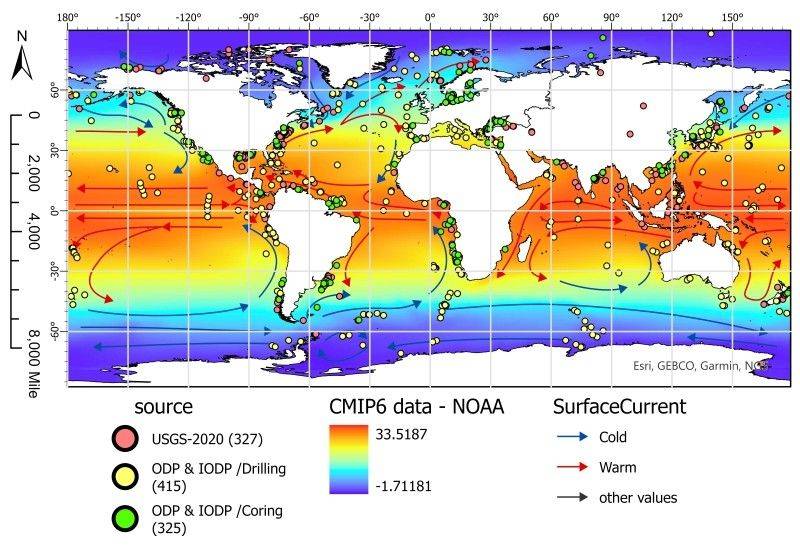
Map of the global spatial distribution of marine methane seepage and warm current activity. Research team to map
Large amounts of methane reservoirs are present in marine sediments and, as a key component of the global carbon cycle and climate system, dynamic changes have far-reaching implications for the earth's environment. Among them, methane seepage is significantly regulated by ocean dynamics, and research teams have undertaken systematic studies to explore in depth the spatial and temporal patterns of methane seepage and the mechanisms in which ocean currents play a role。
The research team has collected extensive methane leakage coordinates and flux data from multiple marine regions around the world, using many advanced data analysis methods for in-depth excavation. Quantified spatial characteristics of methane leakage using recent neighbourly analysis and nuclear density estimates techniques; using the moran index to assess fully the local and global correlation between leakage activity, current conditions and sea surface temperature. At the same time, the synergy between the temperature gradient and current irradiation areas is explored in depth through multi-scale and stratification, using spatial concentration algorithms for noise applications of spatial density and sequencing points algorithms to identify cluster structures。
Research results indicate a significant positive correlation between methane leakage from the seabed and currents. On a large scale, the team was successful in identifying leakage clusters closely associated with ocean power processes, and methane leakages exhibit significant spatial cluster characteristics. Several high-density centres for methane seepage have been observed, particularly on the near-shore continental shelf, the pacific rim and the atlantic rim。
Further studies have found that currents have significant effects on methane leakage through a variety of methods, such as temperature gradient changes, pressure changes and water fusion exchanges. The data show that about 42 per cent of marine methane leakage occurs within the zone of warm currents and cold currents, which are typically represented by the convection of gulf currents and north atlantic currents。
The study not only provides a fresh perspective on the process of the global ocean methane cycle, but also provides a solid scientific basis for an accurate assessment of the impact of methane leakage on global climate change and provides important guidance for future marine ecological protection and climate change response strategies。
Relevant paper information: https://doi. Org/10. 1016/j. Margeo. 2025. 107589



