Why do you say that the bernoulian doctrine is not an upward principle
The so-called benuli doctrine was developed by daniel bernouli in 1726 on a set of hydrodynamics. In short, while fluid flows change the speed of fluid flows as a result of environmental changes, fluids change simultaneously with pressure. The faster the flow, the smaller the pressure; the slower the flow, the greater the pressure。
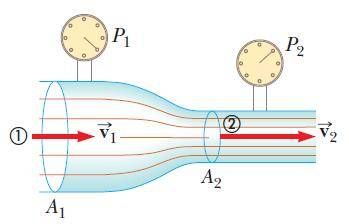
The current speeds up when the pipes contract, but the pressure drops
So there's a wide-spread theory of why aircraft wings can generate lifts:
When we open the wing, we find that the wing is a shape of a high and flat surface, and when the current passes through the wing, the upper surface is fast and the lower surface is slow, so the pressure below the wing is higher than the upper surface, according to the bernoulian doctrine。
When we open the wing, we find that the wing is a shape of a high and flat surface, and when the current passes through the wing, the upper surface is fast and the lower surface is slow, so the pressure below the wing is higher than the upper surface, according to the bernoulian doctrine。
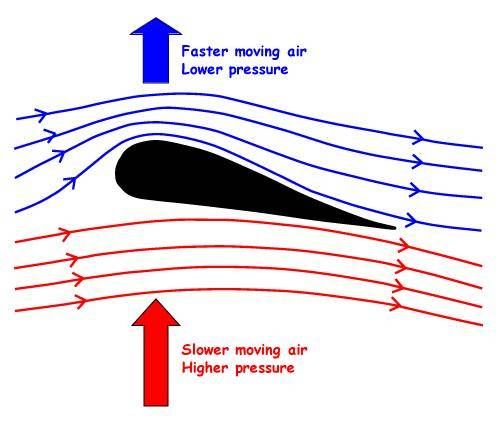
The upper and lower surfaces are slow
There is some reason to say that even though it is confusing, there are several fatal problems。
1. The benoli doctrine is essentially a constant and constant force of pressure and fluid dynamics, whereas in practice the gas is adhesive, so it is not valid at all
2 this interpretation, based on the “benueli doctrine”, presupposes that the air flow passes through the upper and lower surfaces at the same time, but actual studies indicate that the air flow passes through the upper and lower surfaces of the wings at different times and that the time is not directly related to the length of the upper and lower surfaces of the wings。
So the bernouli doctrine is not the correct answer to the reasons for the wing lift。
So what's the rationale for wing lift
We need to divide the wings into two parts of the upper and lower surfaces。
When the air flows through the surface, it is “stopped” by the wings, and is forced to bend, which was previously backward, and is now moving below the slope; when the air flows through the surface, the air is still “directed” by the upper surface of the wings, so naturally, it is directed below the slope。
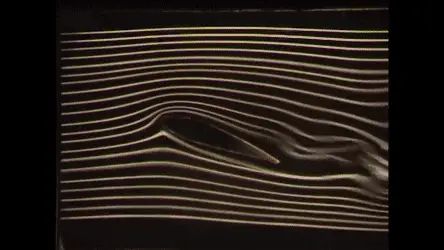
Relative effects between air and wings
According to the constant law of kinetics, the gas that had been properly flowing backwards created a downward trend in the function of the wing, so the gas in turn gave the wing an upward force, which was the lift on the wing。
Of course, the constant law of momentum between the gas and the solid is ultimately reflected in the pressure pressure, and the following is the distribution of pressure on the wing surface. As can be seen, the distribution of pressure on the surface of the wing is very complex and far from being explained by a “benueli principle”。
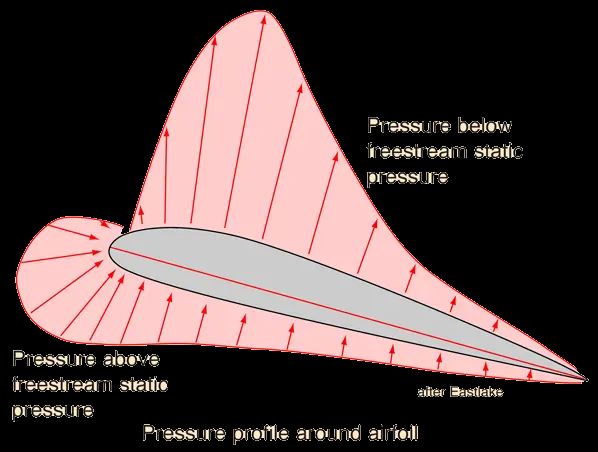
Pressure distribution on wing surface
Of course, the conclusion that the surface air flow on the wing is fast and the lower surface flow is slow is correct, as is the conclusion that the upper surface pressure on the wing is low and the lower surface pressure is high, but this does not mean that the aircraft wing lift can be explained by the bernoulian principle, which simply does not explain the distribution of the surface air flow on the wing, which requires a more sophisticated n-s equation。
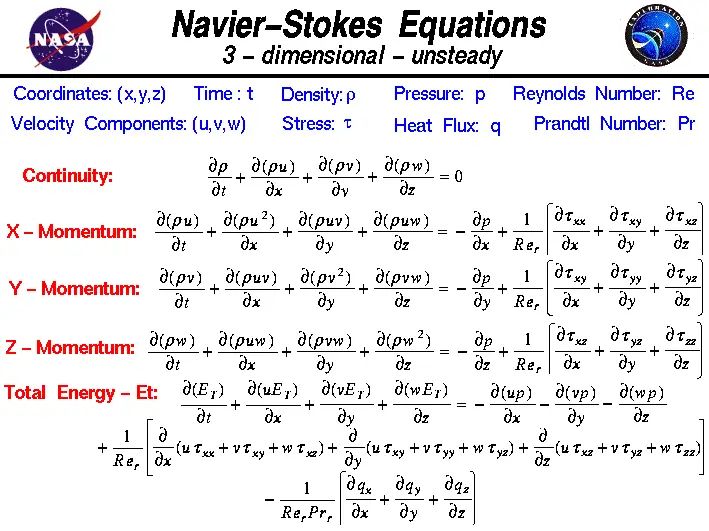
A complete n-s equation
Clearly, for ordinary people, the reason why wing lifts are derived from the constant theorem of kinetic strength is more appropriate than the n-s equation。
Let's wrap this up
The complex physical nature of the air and the complex shape of the wings determine the complex flow of the air near the wing, which requires a complex n-s equation to calculate the exact pattern (see how many “complexes” are in it), so it is not an explanation for the “bernoli doctrine”。
But no matter how complex the flow, it is easy to understand why the wings are able to produce lifts from the point of view of constant momentum. In short, the wings force the air to move downwards in the process of generating relative movement to the air, so the air in turn gives the wings an upward lift and lifts the entire aircraft — the simplest explanation for the ability of the wings to generate lifts。