It's 10 miles from spring wind. From ancient times to this day, peach blossoms have been the most impressive spring symbol in the country's paintings, carrying all the chinese images of spring, life and romance. Many people find it difficult to get a picture of the country, especially the peach blossoms, and are afraid that they will not be able to draw the fragrances. Today, i'm taking this super-detailed peach troupe, and i'm going from threads to colored filaments, from flowers to flowers, to disassembly one step by step, and the zero base is going to be able to do it easily, and i'm going to paint the first softness of spring day in the paper room。
First, learn the peach blossoms, then write: the "bones" code in the national painting
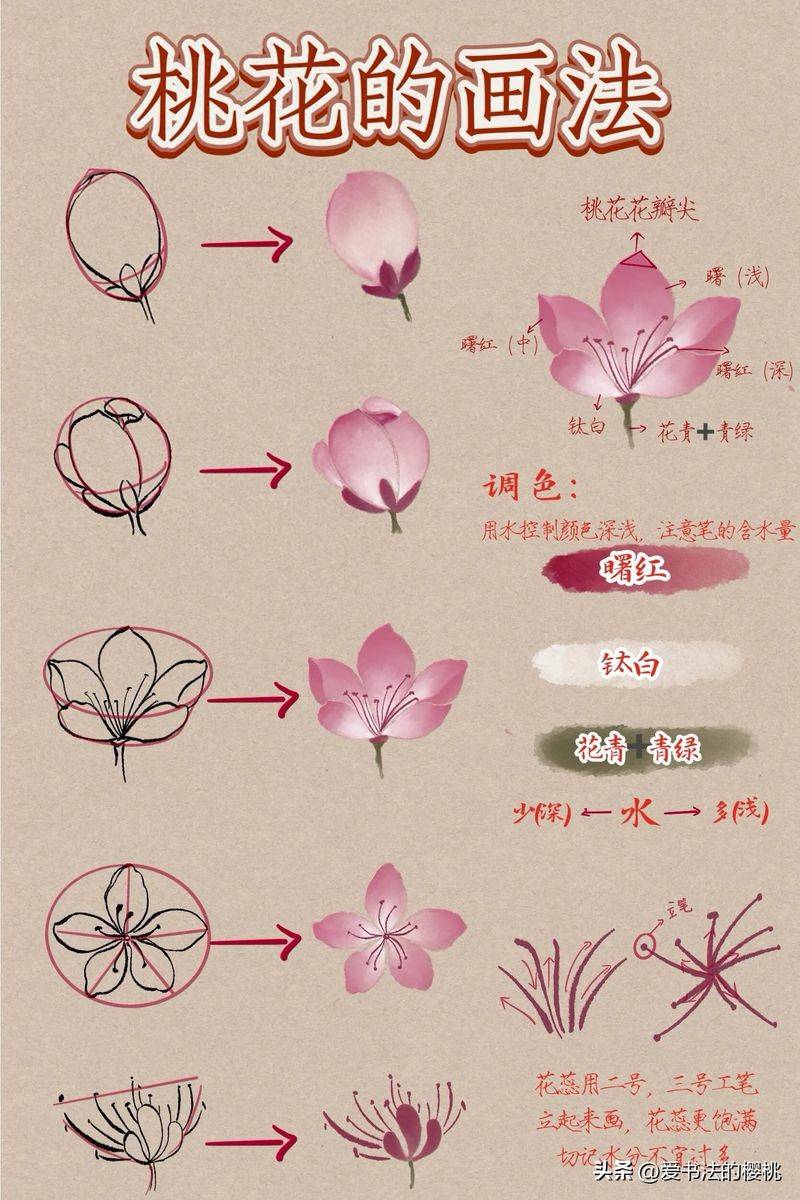
If you want to paint peach blossoms, first you have to read its form language. The petals of peach blossoms are made of five petals, and the petals have a tiny tipping point, which is not as round as a plum, which is the key detail in the national painting to distinguish peaches from clubs. And the flower shape of peaches is very different, ranging from cluttered flowers to half-open buds, to full-stabilized flowers, with different stages of attitude, with different pens and ink。
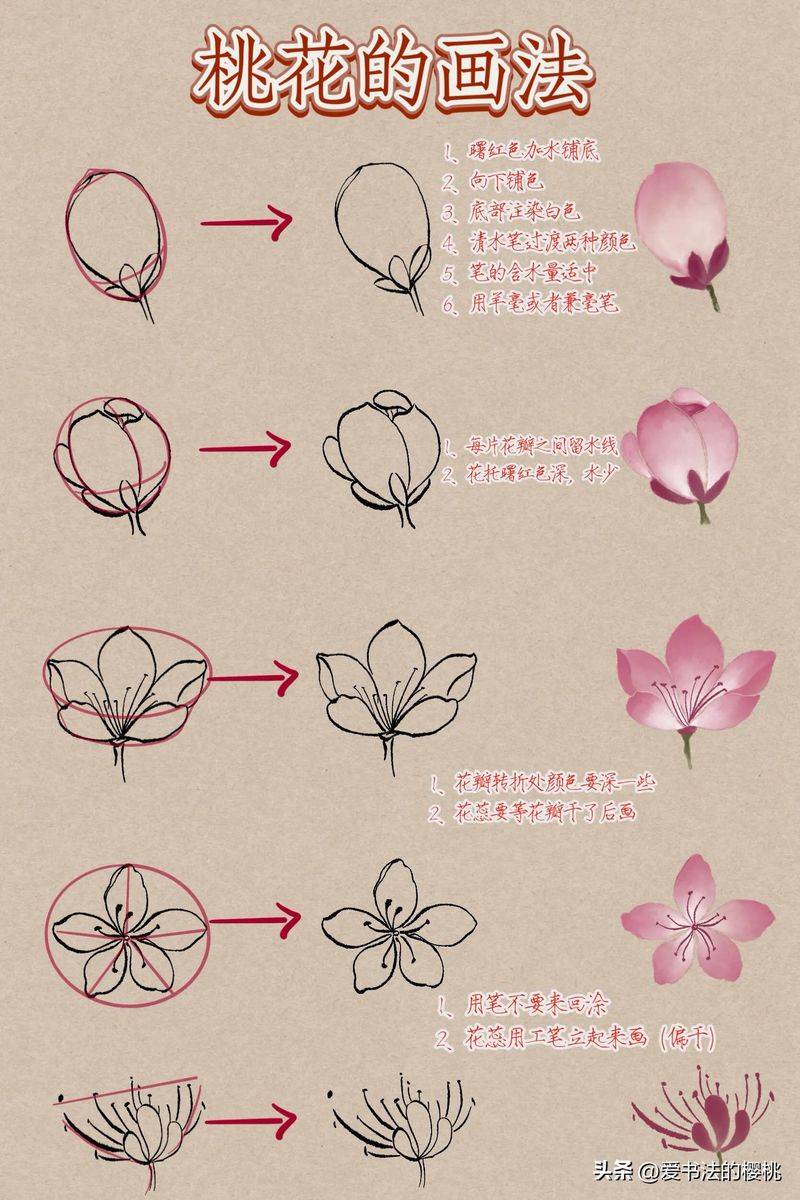
The first step in the curriculum is to use simple geometric graphics to give peach blossoms "still bone." when painting a flower, you draw the whole contours with an ellipse, then you separate the petals with a simple line, and you don't want the line to be perfect, you just have to grasp the closeness of the flower. Half-breathed buds, positioned with round and cross-lines, draw the radians of the petals slightly stretching outwards; and flowering, with rounded and radioactive lines, spread evenly among the five petals, so that the peaches that are painted do not turn upside down and carry their own natural aura。
A lot of rookies can't draw peach blossoms, but they skip this step, and they draw them straight out of the pen, and the petals wrinkle, and there's no way. It's like building a house with a foundation, and it's the same as a national painting, where the liner's “bones” is fixed, and the color behind it is not turned over. And the way these drafts are located, not only for peach blossoms, but also for plumes and almonds to be painted in the future, which is the bottom logic of what is really going on in the country。
Dinosaurs: the ink of peaching's "smugness"
The soul of the country paints peach blossoms, all in colour. Many people paint peach blossoms that are either dead-coloured or shallow or poorly balanced. The coloring method in the curriculum makes it clear that the colour of peach blossoms is “water-controlled, pen-specific”。
The most basic color for painting peach blossoms is dawn red. The water is abundant and light, which is used to draw the edges of the petals and the light surface; it is small and dark, and it is used to draw the roots, turning points and bouquets of the petals. Plus the high light of the titanium with the petals, the colour of the flower with the green and the green, these three colours combine to paint the natural transition of peach blossoms from light powder to deep powder, without complex modulation techniques, and the new hands can bring out soft and natural pink。
When you draw a single petal flower, you wet the paper with a pen, then you paint it with a flashlight, you get dizzy from the point of the petals to the root, you light a little titanium on the bottom, you make a smooth transition with a water pen, the two colours naturally merge, and the petal's tenderness comes out. There's a key detail here: there's a water line between petals, i. E., the edges of each petal are not connected, so that they can distinguish between petals and avoid a tumble of colours, and many new hands paint peaches, or fail to notice this little technique。
Half-opened buds have a slightly deeper color than the flowers, and the turning point of the petals is reinforced by a little bit of bright red, showing the petals in size. The colour of flowers, which focuses on the petals: the outermost petals are the lightest, and the closer the petals are, the deeper the petals are, the deeper they turn and the root, so that the five petals are not flat like paper, but rather have a sense of space that goes back and forth. And we have to wait for the petals to dry up, and then we'll paint the flowers. Otherwise, the colours will fade and the whole flower will be destroyed。
Iii. Dragon: "live" with details
A lot of people paint peach blossoms, paint petals, but lose on flowers. Either it's too rough or it's too messy, and it destroys the beauty of the whole flower. In fact, flowers are the eyes of peach blossoms, and they're painted, and the whole flower has its wonders。
The curriculum focuses specifically on the fragrance of the drawings: drawings with a pen number two or three, so that the fragrances are strong and not too much water, otherwise the lines will faint and appear soft. When drawing, the line is drawn from the radiance of the heart, and the line is different in length and error, rather than being as neat as a comb, it is rather stylish. Fadron lines need to flow thin, thick roots, sharp edges, and a thicker radiance on the edges of the flower, with both strength and detail。
Moreover, the number of flowers must be kept in mind, with more flowering, less flowering, and less flowering, with only a fraction of the flowers on the side, so that the peaches that are drawn are consistent with nature's growth patterns and do not appear to be the same. Many newcomers paint radiance, either in the middle, or in the middle, bearing in mind the three main points of “the pen, the rays, the length of the line,” so they can draw beautiful radiance。
Iv. Guidelines for placing those places: the five obligable complications of news, enough
Many people learn to paint peach blossoms, the less confident they are, rather than being clumsy, stepping on a pit common to new hands. Taking into account the points in the curriculum, i've sorted out a few of the easiest places to roll over, and i'm helping you to avoid the pit:
The first pit, the paint. Many newcomers draw petals, and when the color is deep, they change it repeatedly with a water pen, and the more dirty it becomes, the more hair on the paper. The colour of the country's painting is “one-size-fits-all” and it is much better to set the colours before the next one, to think about the path of the penthouse, to be painted at once, even with a small flaw, than to be painted repeatedly。
The second pit, the moisture is not well controlled. It's too much water, and it's dizziness beyond the petal contours, and it's turned into a blurry piece of color; it's less water, it's dry, it's thick, it's not perplexing. Here's a little trick: to test a pen on paper before painting, to feel the amount of water in a pen, the amount of water in a pen and a pen, the amount of water in a pen, the amount of water in a pen, the amount of water in a pen, the amount of water in a pen, the amount of water in a pen, the amount of water in a pen, the amount of water in a pen, and the amount of water in a pen。
The third pit, the petal level, doesn't matter. A lot of people draw five petals, the same color, and look like a pink piece of paper, without a sense of space. Remember, the petals that are closer to you are slightly darker than your petals, the lighted petals are light, the back-lighted petals are dark, and the peaches that are drawn have a 3d feeling。
The fourth pit, the draught too early. The flower petals are dry, the colours are disillusioned, the lines of the flower are wiped out and the whole flower is dirty. It's important to wait for the petals to be completely dry and then use a dry pen to make the lines clear。
The fifth pit, the petals are not in the right shape. Many newcomers paint peach blossoms, too round the petals, too hard to distinguish from plums, or too sharp, unlike peach blossoms. The petals of peach blossoms are micro-tips, not round arcs, and can be painted with a light indication of the position of the petals, followed by a pen to avoid drawing the wrong shape。
From a flower to a chronology: a small idea of evolution
When you can draw a single peach flower, you can try a little peach flower. And when they are painted, the flower shall have its place, and a flower shall bloom with one or two buds and one or two bouquets, and shall be added to it with a few branches, which shall be fine and curvature, and shall not be drawn too straight, so as to be stylish。
The direction of the petals will also change, with some faces towards you, some sides, some backs, some plumbs, and others rising, so that the peach branches will appear to be wrong and alive. A few green new leaves can also be added to the branch, with light green and a little bit of platinum, the shape of the blade on the side, and a thick ink for the veins, and the spring-day vibe will be full。
The glamour of the country's drawings is never instantaneous. Many people feel that they are clumsy and bad at painting their country, but if they know the right way, one step at a time, the zero base can also draw a moving peach. As shown in the curriculum, every step of the way, from a simple liner to a fainted petal to a dazzling wreath, hides the tenderness and wisdom of national paintings。
Haruhi is just about to pick up the brush and follow the curriculum and draw a peach blossom of his own. There's no need to be perfect, but it's important to feel the tenderness of the spring and the charm of the country. When the first powder falls on the paper, you'll find that it's really not that hard。