The principles of traditional ignition systems
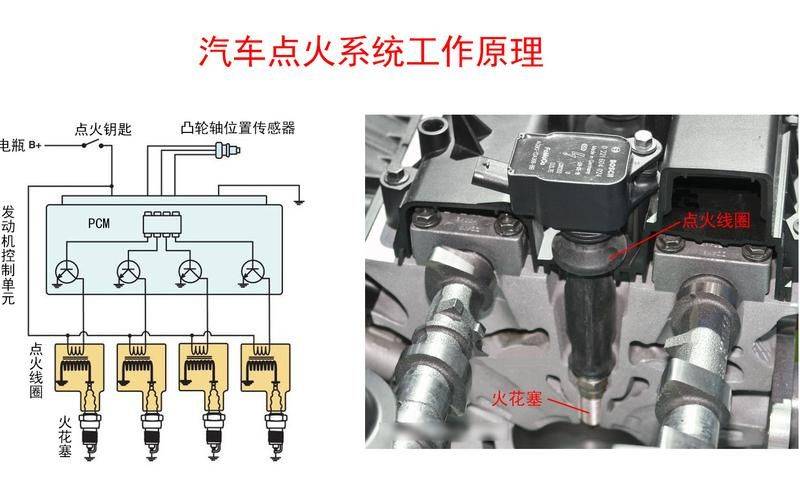
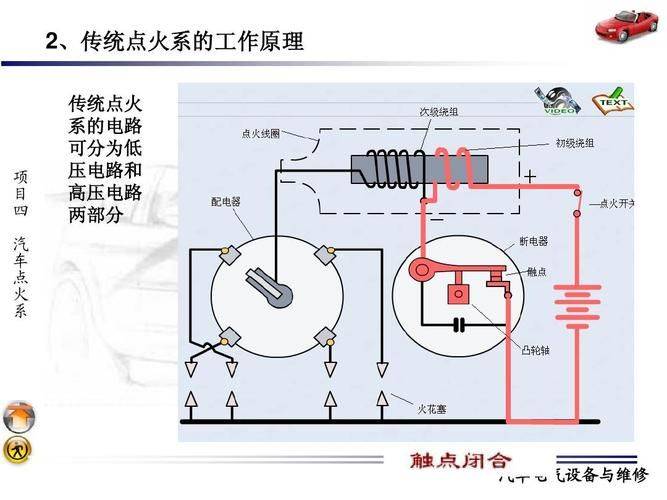
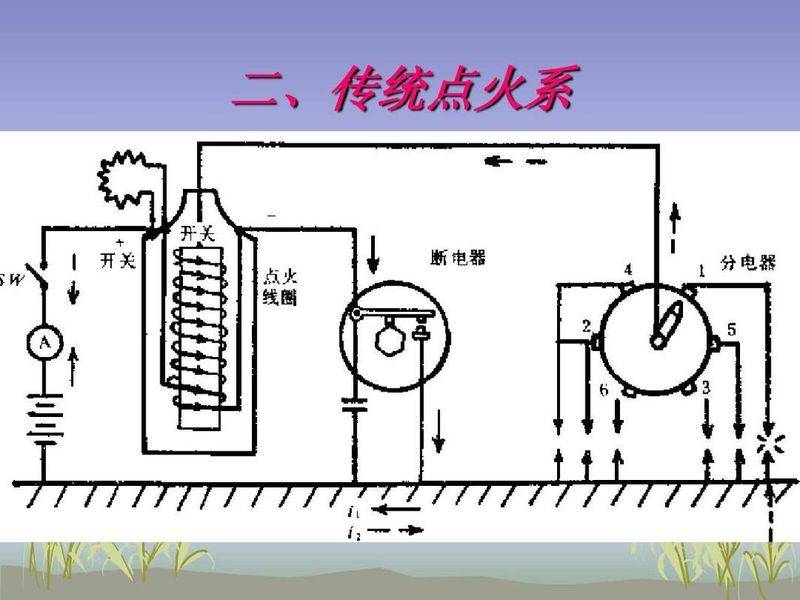
In traditional ignition systems, batteries or generators supply 12v low voltage, nodes
Wires and broken appliances are converted to high voltage, then distributed to the cylinders by distribution. Fire. Hana
Plugs, so that electrodes produce electric sparks。
When the engine was working, the broken electrical axis was in the engine's cam axis with the cam
Drives down the rotation. When the electrical cam turns off, the electrical contact closes alternately and
It's open, so the working principles of the traditional ignition system can be divided into contact closed, primary
Electricity current growth; contact opening, sub-rotation generating high pressure; spark plug interpolation fire
The three phases of the discharge were analysed. The work of the traditional ignition system is as follows:
4-3。
1. Process of contact closed, primary current growth
The primary circuits of the ignition system include batteries, ignition switches, additional electrical resistance
(b) primary circuits of the ignition ring, electrical break-ups and capacitors. Primary circuits
Equivalent circuits are shown in figures 4-4。
When the contact points are closed, primary currents pass through the ignition ring with additional resistance from the battery
Primary rounding n1, primary currents are increasing exponentially and gradually reaching their limit
Value ub/r, primary current waveform as shown in figure 4-5(a). Fire on the car
In the coil, about 20 ms after contact closes, primary currents close to their limits
Value。
Primary current growth not only generates self-sensitization in primary circuits, but also
It's a sub-circle, about 1. 5 to 2 kv
Plugs, secondary voltage wave shape as shown in figure 4-5(b)。
2. Process of contact opening, secondary circuits generating high pressure
Primary currents grow exponentially after contact closes and closes at tb
When i1 grew to ip, the contact point was turned on by the cam, which ip called the primary power outage。
Once the contacts are open, primary current ip drops rapidly to zero, and the magnetics drop rapidly
Less, as shown in figures 4-5(a). At this point, both primary and secondary bypass groups are produced
Visible electric motion, low number of primary bypass groups, generating 200 to 300 v of self-awareness
There's a lot of sub-circles, so they're generating an intersensitization of up to 15-20 kv
U2, as shown in figures 4-5(b)。
When the contact points are open, primary circuits form an oscillation circuit of l, r, c, causing decay
Reduce oscillation. Corresponding changes in the induction electric dynamics in sub-circles. Like
The secondary voltage value of the fruit cannot pierce the spark plug, so u2 will follow figure 4-5(b)
The middle line changes and disappears after several oscillations. If u2 goes to uj and sparks
When the plug is punctured, the voltage changes as shown in figure 4-5(b) line, uj states
To blow through the voltage。
In sub-circles, between high-pressure guidance lines and engine body, sub-circles
There's a certain amount of electricity between the spark plug and the side pole
Called distributed capacitor, expressed in c2。
In fact, there are heat losses and magnetic losses。
3. Firing process between spark plugs
Usually spark plugs blow through uj under u2max, in which case
When sub-voltage u2 reaches uj, the sparks break through
At that time, i2 appeared in secondary circuits, with subflow waves as shown in figures 4-5(c)。
At the same time, secondary voltage fell suddenly, as shown in figures 4-5 (b). The spark discharge is usually by
Employment and inspection. It's called a spark room
The process by which the electric field stored in c2 can be released quickly when the gap is punctured
The point is that the discharge time is extremely short (about 1 metres), but the discharge is very large and can reach dozens of places
Peasant; reduced electrical resistance in the spark gap and remaining energy in the magnetic field of the coil
It will be slowly discharged along the ionising spark gap, creating a sensor discharge, known as spark
The end, characterized by longer discharge times of several milliseconds, is more frequent
Small, about a few dozen milliang, low discharge voltage, about 600 v. Experimental proof, electricity
The longer the discharge lasts, the better the ignition。
Every week during engine work, the broken electrical cams (two-week curves)
The cask is set on fire in the order in which it is lit. If you want to stop the engine, just..
Break the ignition switch and cut the primary circuit。