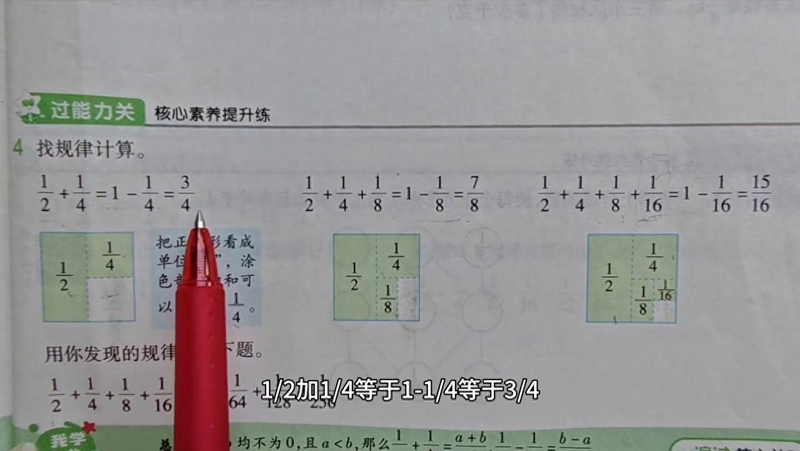
The question of finding a rule is based on these questions. This is a question that you can see in graphics how these questions are calculated。
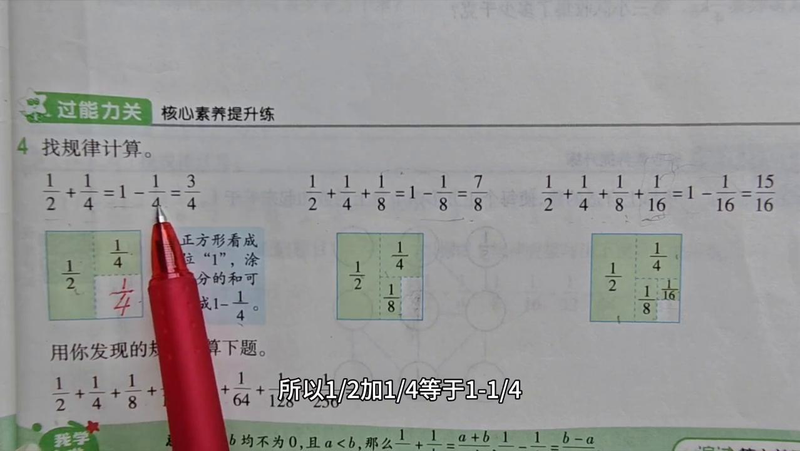
1/2 plus 1/4 equals 1-1/4 equals 3/4. Treating squares as unit "1" is divided into two parts on average, one in two, one in two, one in four, and one in four without colour, and one in two plus one in four。
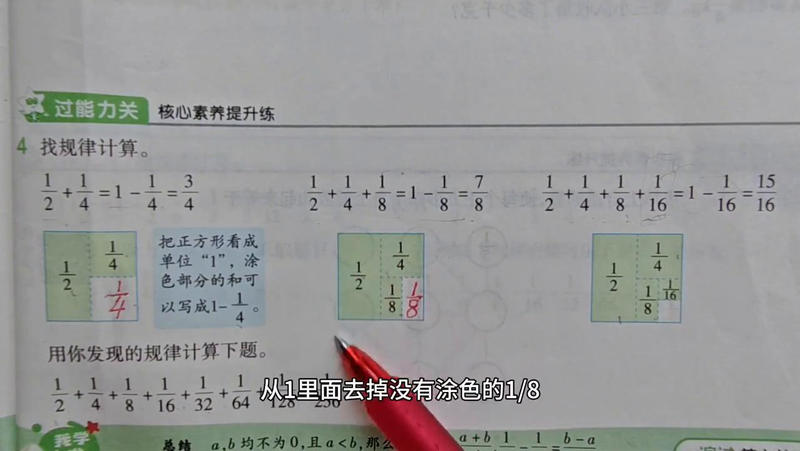
As can be seen from the figure, one fourth of the coloured one is removed from the one, i. E. The one-one-fourth difference, i. E. The sum of one half plus one quarter. So 1/2 plus 1/4 equals 1-1/4 and 3/4. 1/2 plus 1/4 plus 1/8 equals 1-1/8 and 7/8。
• the division of unit "1" into two averages, one coloured one in one, one in two, one in four, one in two, one in eight, and one in eight without colour, and one in two. 1/4 and 1/8 were removed from one of the coloured 1/8s, i. E. 1/2 plus 1/4 plus 1/8。
Thus, 1/2 plus 1/4 plus 1/8 equals 1-1/8 and 7/8. See also 1/2 plus 1/4 plus 1/8 plus 1/16 equals 1-1/16, equal to 15/16. This square colour is 1/2, 1/4, 1/8, 1/16 and 1/16 without colour. 1 less uncolored is equal to coloured。
It is therefore clear that 1/2 plus 1/4 plus 1/8 plus 1/16 equals 1-1/16 and 15/16. The common denominator for observing these algorithms is that the first number is 1/2 and the second number is 1/2 above, and they can be written down by 1 less the last plus, which is the pattern of this type of calculation。
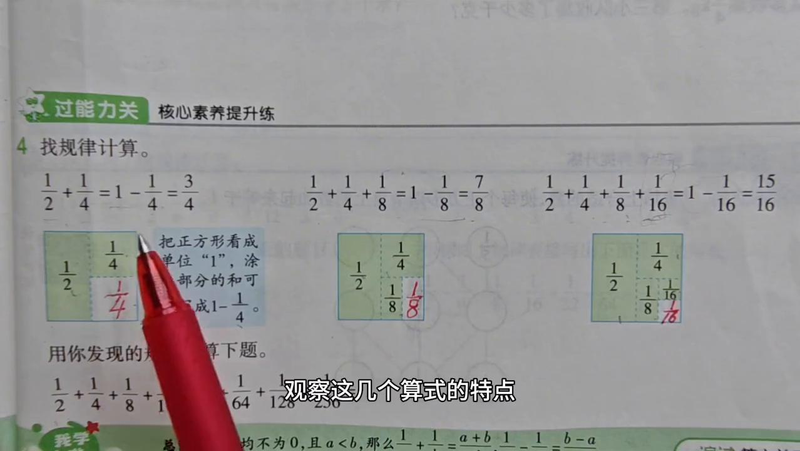
Look at this question, the first number is 1/2 and the following additions are 1/2 of the above plus and the same pattern as above. These add-ons and can be written in one minus the last plus 1/256 difference, one minus one quarter of 256, equal to 255 points of 256. As you can see, these numbers add up to one-to-one points, and they are the result. You think it's easy