I. What are the functional titles
The title is the main indicator of the academic skill level and professional competence of professional technical staff。

The job title evaluation is based on a peer-reviewed expert review, based on evaluation criteria and procedures, as well as a review and determination of the integrity, competence and performance of the professional skills. The results of the job evaluation are an important basis for the recruitment, appraisal and promotion of technical expertise。
Ii. Current system of functional titles
The functional titles are divided into three broad levels and five detailed levels:
Primary title
(1) level. For example, technicians, medical doctors, paralegals, economists, third-level teachers, etc。
(2) assistant level. For example, assistant engineers, assistant economists, physicians, level iv lawyers, assistant teachers, level ii teachers, etc。
Secondary title
Examples include engineers, lecturers, attending physicians, third-level lawyers, economists, first-level teachers, etc。
3. Senior title
(1) deputy senior. For example: senior engineers, associate professors, associate fellows, deputy medical doctors, second class attorneys, senior economists, senior teachers, etc。
(2) positive. For example: senior engineers, professors, research fellows, chief doctors, first class attorneys, official senior teachers, etc。
Iii. Is the evaluation title useful?
Many would ask that question, although it was often heard, but it was not really easy to answer it with simple yes or no。
Those who truly know the job title evaluation are aware that it is assessed on the basis of the relevant state policy and on the basis of the needs of society for employment. We cannot say arbitrarily that it is good and bad and that, as with academic qualifications, it is natural where it is used。
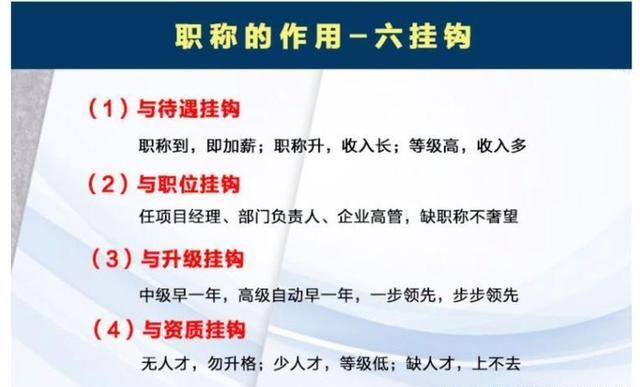
In some trades people really don't value their titles, and most of the people who take the job evaluation are not actually useful for later jobs, and you, like the computer industry, have much lower usage than the construction and engineering industries。
In our working life, different industries, different companies, different jobs, the requirements and importance attached to job titles and work experience may differ。
In terms of medical records, we usually call on the chief physician or above, the chief physician. Do you know what the functional title corresponds to
In the medical category (health technical posts), medical, preventive and health personnel have the following functional titles: doctor, physician, attending physician, deputy medical practitioner and chief medical practitioner。
The functional titles of “deputy director” and “director” are senior, the former being deputy senior and the latter being senior. The director and deputy director of the general hospital are equivalent to a professor and associate professor, while the subordinate hospital at the medical university is rated as professor and associate professor because of its teaching role。
Thus, the title is also important for practitioners of the medical profession, without a certain number of years of work experience, academic qualifications, qualifications and clinical workload requirements, and professional competence, which are difficult to evaluate。
It is important for the engineers to know that the title is yours and that in the construction industry, as long as it is not grass-roots, and as long as it is not a new graduate, it is basically everyone's。
This is due to the nature of the industries, unless they are not intended to develop. The title of the construction industry represents a person's level of knowledge and performance and is widely accepted and accepted by society。
The title of the construction industry is a requirement for promotion to a qualified enterprise and, for a qualified enterprise in the construction industry, a requirement for the establishment, qualification rating, qualification upgrading, and annual qualification。
The most useful job titles are directly linked to wages in the enterprise, and in the past few years, the private sector has also begun to attach greater importance to it. In the enterprise, however, it has always been the highest priority, without which promotions are not possible and without which salary increases are not possible。
Without a middle-level job title, the job title is considered, and in state enterprises, the job title is everything. He is the criterion for the qualification of talent and, above all, the decision maker of talent wages, no matter how many years you have worked, no matter how capable you may not have a job。
At the bottom of the trade, the title is also a symbol of identity, for example, an expert in the profession or the association, at least a senior engineer, who may be embarrassed if he does not have a title。
Many people are given titles not simply for the use of the company and its title, but for higher local development within the industry, and once they become industry leaders, there is a risk that they will no longer be a worker, and you will have a say and a place。
In addition, in many cases employers and companies employ highly qualified personnel according to their job titles and qualifications。
The promotion of talent in enterprises is based on job titles and personal ability to work. You have the corresponding title, which, in part, represents the level of knowledge and working ability of you and the type of professional and technical qualification that you possess, which is an indication of the academic level or the type of job you are able to perform。
If you're a manager or a cadred employee, your career plan always depends on your title, and eventually you'll be a senior engineer, a full-fledged engineer。
But if you didn't have your title evaluated, how could you have an engineer's title? In the case of promotions to the total skilled worker, there is a need for a high-level job title, an opportunity for promotion to the post, a corresponding allowance for skilled personnel, etc。
In short, from a practical point of view, the title is to be planned in advance, not in the form of a cloud, which is not useful, so you don't have to wait until the title is used to hate。
Iv. Presentation process

Step 1: information preparation period
Those who have been given the title are aware of the fact that the most burdensome is the preparation of information. Because of the amount of information involved, there is also a need to fill out forms, stamping and making people busy. So here's a little trick for you, you can sort it out。
The material prepared for the evaluation of the title is in fact a human being, i. E. A person's academic qualifications, identity cards, photographs, personal history, further education hours, etc. The other is the academic category, which is the title paper。
Academic blocks may also be patents, or topics, or books (monographs), technical reports, etc。
Step two: the evaluation phase
This stage is essentially in conjunction with a review of the commission's own documents, which essentially involves both evaluation and defence. If the conditions are not met, they will be painted by the jury. In the end, it is the jac that points out whether you can pass。
Step 3: publicity phase
This solution is a publicity of the results of the evaluation, and if there is no objection to this result, then the issue of certification can be determined directly after the publicity period。
Step four: lower evidence phase
In fact, the last two stages are relatively easy, and once publicity has been completed, certificates can be produced directly。