


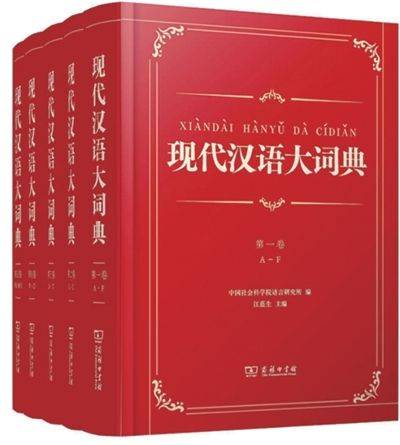
The great dictionary of modern chinese: editor-in-chief, jiang lansheng, institute of linguistic studies, chinese academy of social sciences; published in the commercial printing library。
After 20 years of codification, the modern mandarin dictionary (hereinafter referred to as " the mandarin " ) was finally officially published. This was the first large original speech in the century and one of the most important studies in the field of linguistics and literature. The “first” and “most important” evaluations are affordable. There are 157,000 word counts and 12 million words, more than twice and more than three times respectively of the modern chinese dictionary. However, it is not only an expanded version of the modern mandarin dictionary, but it is original and goes beyond the concept and method of codification。
The term “modern chinese” begins with the introduction of white language in chinese. For more than 100 years, chinese dialects have presented a complex state of “dispersional multilines”, while modern chinese writings, recorded in chinese, are only theoretically defined, what the actual face is, and are not depicted in a comprehensive and systematic manner. The new china was founded without a new large-scale speech, which was subsequently revised in its " deed sea " . Since its establishment, the new china has compiled the chinese-language dictionary and the chinese-language dictionary, all of which have been written in both historical and linguistic terms. The mandarin is the only “normative and descriptive” combination of modern chinese words, which have reached a certain scale and give a more comprehensive picture of the real face of modern chinese in use and development. It is even more rare that it integrates the perspective of time into the symbiography, allowing us to extract from the dictionary the micromemories of social change that have prevailed for over 100 years. It is fair to say that the man in the great is not only an increase in the number of words received, but also a groundbreaking one; it not only provides a pronunciation of individual words, but also helps us to gain a comprehensive understanding of the modern chinese language, which is an age-sensitive dictionary。
In a model of meaning + syntax + semantics, the man in the great present systematically combusts the modern chinese language's own construction rules, refines the modern chinese vocabulary, perfects the vocabulary system of monophonic coexistence, and discovers a collection of high-frequency linguistics derived from modern language life, which has nothing to do with words, and demonstrates modern chinese maturity and independence. The results of the great face have been remarkable in modern language discovery. For example, the term “squealing” during the civil period was combined with the term “squealing for money” and “challenging for trouble”, and the term “crowding” was added to the current edition, with the word “crowding” being added to the term “squealing” to clarify the synonym of “drawing, cashing” and, as in the case of “star”, no longer limited to the meaning of “star”, after the proliferation of the words “single star” and “child star” “stalking”. The back-to-back search function of the great face provides an important support for the aggregation of such monosonics and is a major highlight in its codification。
In the use of chinese, new words often appear and quickly disappear, and normative statements can be omitted, but as long as they have to be checked, sexual statements should be recorded. For example, in the works of the country of well-known literaryists, such as chu, there are often synthetic words that have not been passed on, such as “deepness” “conservation”. Following the entry of the hampshire, an explanation is given and a reference is made to the original origin, along with the text。



