I have a lot of japanese students around me, and i am one of them, and many of my classmates have attended a variety of training courses in order to take part in japanese-language intermediate interpreters. I am one of the others, because of family conditions, i have never attended any kind of extracurricular study. I have just seized every minute of the classroom to catch up with the rest of the study. I have my own learning methodology, which has helped me to successfully pass the japanese-language intermediate interpretation. I will share my experience and hope to help more friends。
In june, a written test was signed up for the teaching materials (also known as the set of meals bought at zhongjiang's internet store) and a written test was completed for october 13th。
Preparation of the written examination phase
(pedagogical material: hearing curriculum, reading curriculum, translation curriculum. The total score for the written examination was 200 and 120 for the completed examination)
Hearing (80 minutes)
Class 16 ab exercises must be done carefully. It's the words of birth, the words of the book. There will be a part of it in the book。
Special attention is given to two points:
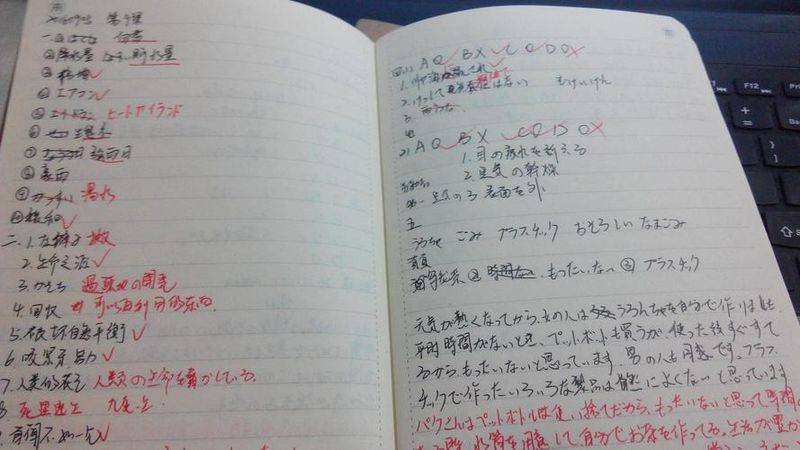
Strengthening the capacity of "hand-written" japanese, in particular japanese. (the chinese written examination is not the full choice of the competency test, but is largely “written”, especially in the first subject of hearing, and must react quickly. For example, it is important for students who spend their time typing computers to be able to do so. I'm not sure
Training to “integrate” capacity. The last question in the hearing section is to summarize the conversations heard. It was therefore important to make good use of such topics in the hearing books and to strengthen the capacity to take stock. The required number of words is met. It is not necessarily difficult to use words, but it is important to capture the centre, not to make mistakes, to break words。
Reading (40 minutes)
Reading does not necessarily come in the original language of the book. At least i was all extracurricular。
The 11 lectures on reading basics and techniques in the last session of the reading curriculum need to be studied. The reading techniques described are useful not only for this examination but also for reading in other examinations, such as the competency test. After these 11 lectures, the theoretical knowledge can be applied in practice by reading the next 16 lessons. Attention should also be paid to general issues. The book contains a summary technique。
Translation (80 minutes)
It's a big translation, but i went through it all. There's no need to carry every one of the examples. It's about learning skills based on understanding and translation methods。
The question of translation in the last exam was not difficult, nor was it very professional or difficult to say. But there are a few long sentences. More written and written language skills are built. Words that are not possible can be replaced by some known words or synonyms. Attention should also be paid to the differences in the translation of chinese from one language to another and cultural differences。
(ps: watch your handwriting, scroll clean! This is important. I'm not sure
Preparation and oral examination process
(pedagogical material: oral course, interpretation course, total of 100 points for oral examination, 60 points for qualification)
I'm sure a lot of students care about oral tests. The lead time is still tight, as i'm a reporter of the written test. Only two months and less。
Speech (40 minutes)
I'm just going over the text in "speaker academy." after each class, the "speaker" did not read, but the "speaker's chair" of each class should be used to describe a lot of ways and how you can express it. Because of time constraints, i can't prepare much for the spoken part. With the usual bottom line plus two pre-test drafts??? If you have time, you can prepare some more articles, which can be a "workout problem" behind your speech book, but i suggest that we prepare some hot topics. For example, in this test, i'm talking about the "scrambling back" so i'm more concerned about the events around me. The speaking time for the real exam is three minutes. Be careful when you're ready。
Interpretation (60 minutes)
It is a huge project, not to read only 8 lessons. The examination proved to be the subject of several questions in the book. When i read the book, the words that were prepared in front of each class were retraced, and the post-interpretation pages were retraced with the recorder, and the translations provided in the book were only referenced and refined, if i felt that i had done better than the translation. Please be careful not to rely too heavily on a reference translation after the book. This is also mentioned by the curriculum authors themselves: “it is hoped that the learners will try to be as sure as they can of their own understanding to try and translate. If there is a better translation than this reference, that has served the purpose of the book.” after all, interpretation is about immediacy, not recitation. It is generally not possible for a true interpretation to know the content except in advance。
With regard to notes, the japanese-speaking interpretation is still the word "subordinate." the sentence is not very long and some keywords can be remembered. Including drawing some symbols, but only if you want to see. The pen should be quick. The notes vary from one person to another, with some having a large brain memory and a good short-term memory, to the other. It's important to find a way to take your notes. And that's how you do it in your usual practice. Other people's methods don't necessarily suit you。
Oral examination process
The examination took place at the gubei school of foreign trade, shanghai, and i signed up early, as if the examination time had been allocated very early. November 9th will arrive at 7:30 a. M. Then everyone was in a classroom, and there were plenty of people taking exams. The phone was closed and placed in an envelope from the teacher and sealed. And then we'll wait for the call。
Called about 10 at a time. Called to the preparatory room after arrival. Then the teacher will send you a speech, a note, a title, no hint. I'm going to have to take a look at this. There is also a white paper to be used in writing speeches and in taking notes for interpretation. About 10 minutes. Hold on!
Then we're going to the exam. One ordinary classroom, two examiners, one male and one female, all middle-aged. The guy in japanese made me sit down, ready to start, etc. Then the tape is recorded. That's when the teacher won't talk to you. There's two old horns standing in front of me. The tape recording will require you to give your name in japanese. I was basically reading what i just wrote. We're done in two minutes. So the last minute is waiting, waiting, boring, teachers don't talk to you. Feel the air stagnating? It would be better to be an examiner if he didn't exist. I'm not sure
The three-minute speech was followed immediately by the interpretation examination, five medium translation days and five medium translation days. The tape recorder is not waiting, so the process must be highly focused. After a sentence, you've got about 30 seconds to translate. Hold on. If there is an omission at this time, remember to say what is central and what can be said. Remember not to say nothing. It's not usually too hard to read. During the translation, although i did not go to the look of the examiner, i could still hear the examiner in the circle。
The whole oral test will be 15 minutes, soon。