Many people have experienced confusion: it takes a lot of time to study, to read books, to brush books, to learn videos, to study deep, to seem to be disciplined, to learn, not to write, not to do anything, not to score exams, not to do anything。
It's not that you're not smart enough, you're not hard enough, but you've been caught in the trap of hearing and learning. You think deep-tilled learning is just passive information, and the brain has never really been involved in thinking and absorbing。
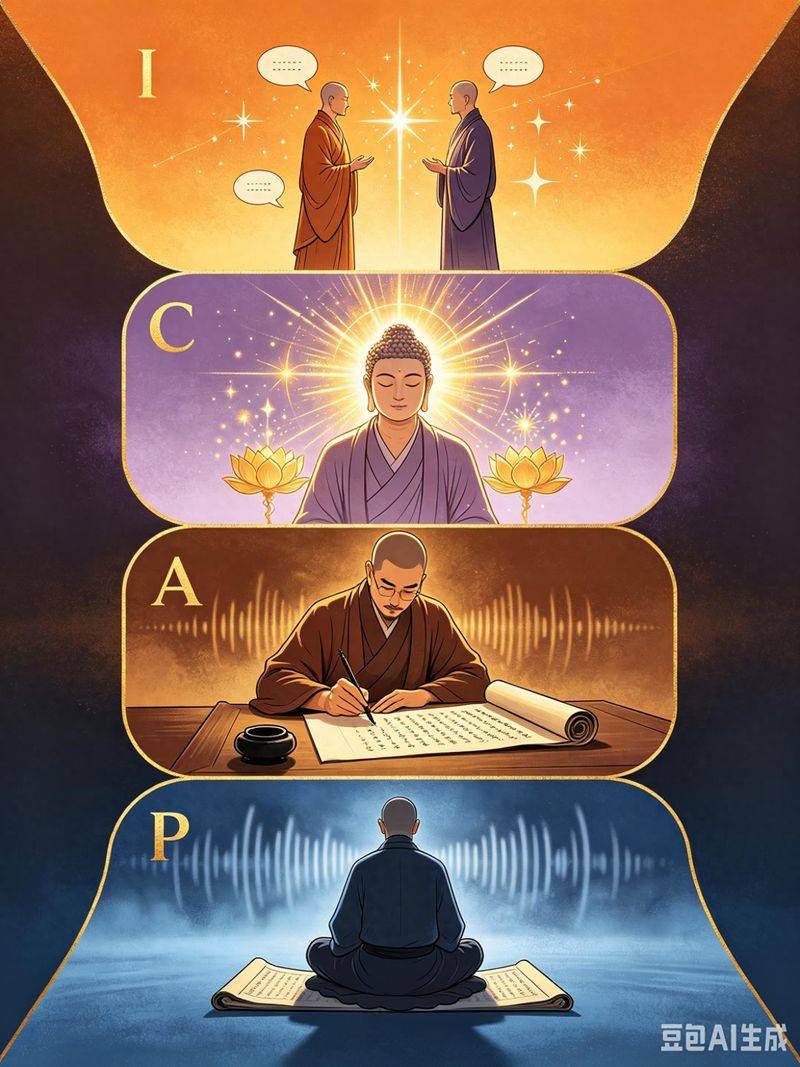
The psychological authority's icap learning framework perfects the four learning states of humanity and clearly delineates the boundary between inefficient and efficient learning. From passive to interactive, from shallow to deep, four levels of learning move up, reading this logic allows for a complete departure from ineffective efforts and rewards every learning。
I. The efforts of the vast majority of people remain at the two lowest levels
The icap framework divides learning into four levels, with priority and efficiency rankings: i (interactive interaction) > c (constract construction) > a (active active underground) > p (passive passive). The p and a levels are the “hearing, copying” forms of learning that the vast majority of people have maintained throughout their lives。
1. P level: passive hearing, left ear right ear out
This is the least effective and most common form of learning. They simply listen, read books, draw teaching videos and receive external information passively throughout the course, without any thought, processing or redisposal of the brain。
The knowledge at this time is like a flow of water running through the pipes, rushing through the brain without leaving any trace. You look like you've been learning for a long time, but it's just that you've seen this information, and it's close to books, you've turned off the video, and there's a blank in your mind, and that's the typical "hearing learning" that moves you all the way, with no learning effect。
Level a: active copying, seemingly low-level
Many of the self-perceptions of “working hard to learn” remain at this level: reading the text loud, taking notes word for word, placing emphasis throughout, repeatedly suspending the replaying of videos, and mechanizing errors。
This state of affairs does mobilize attention compared to passive reception, which is a prototype of active learning, but there is a fatal short-spectrum: only raw materials are reproduced throughout the journey and no new awareness is generated. You simply carry, repeat and repeat the contents of books and teachers, without understanding the logic of knowledge, cause and effect and the logic of the bottom, you can only create shallow memories and not be flexible。
This is the classic “deployed trap”: time-consuming, posturing, moving yourself but always stuck to the surface of knowledge, unable to achieve a breakthrough in abilities and achievements. Two thousand years ago, confucius warned the world that learning without thinking would be a passive, mechanized, non-thinking, unprocessed and ultimately nothing。
Ii. Real learning of learning: structure c, enhancing yourself
From the p and a levels to the c level, it is a core watershed for ordinary and high-quality learners. It is also a crucial step from “fake learning” to “real absorption”。
The so-called c-based learning has only one core: to jump out of raw materials and generate new knowledge from their own thinking. Instead of mechanizing the content of others, it is by self-thinking, decomposing, combing and turning their knowledge into their own perception。
These practical actions include the following: summarizing the points of knowledge in their own popular language, developing a knowledge system based on a chart of thinking, asking questions and answering questions of their own initiative, digging into the causal logic behind the subject of the book, and completing the extrapolation process omitted from the teaching materials。
The core competencies for building learning are self-interpretation. Faced with a concept, a formula, a point of knowledge, not rereading the definition, but being able to tell the whole story “what it is, why, how it is used, what it is applicable”。
This approach is highly relevant, especially in areas that require in-depth understanding: mathematics, physics, programming, law, academic research, etc. At the same time, it is the core method of preparation for the review, because the core logic of the examination is never to look at “have you seen this knowledge point” but at “can you understand, migrate, and use the knowledge point to solve new problems” and to construct learning, which is precisely the ability to migrate。
Iii. The most advanced form of learning: level i interaction, sharpening knowledge
If structured learning is the ceiling for single-person efficient learning, then level i interactive learning is the highest form of all forms of learning. What the ancients say is “just as much as it is”, and that is the best interpretation of this learning。
The so-called interactive learning is not a simple two-person conversation, but rather a structured in-depth dialogue around the same knowledge, the same cognitive object: people supplementing blind areas, people questioning, people correcting mistakes, people clarifying vague perceptions, people rejecting one-sided views and people advancing cognitive depth。
The well-known feynman learning method is between levels c and i and is based on structural learning. You talk to others about knowledge, you just do the self-export, but if the other side is just listening, not questioning and refuting, it is not really interactive learning。
Real i-level interactive learning is a cognitive battle. In the process of convincing others, responding to questions and correcting ideas, you are forced to mobilize the best thinking abilities of the brain to fill gaps, improve perceptions and break fault zones. At the same time, it must be bold to acknowledge its own cognitive gaps and to continue to refine its thinking。
This is why high-quality firms and efficient teams are insisting on project retrofits, red-blue confrontations, debates, code reviews, and subject studies. Single-person thinking always has blind areas, while two-way, multi-way interaction of thinking can bring perceptions closer to perfection and achieve rapid growth。
Iv. The pace of scientific learning: gradual, precise change of pace contents
Understanding the four levels of learning does not mean total abandonment of the p-a base level. No learning is short-cut, blindly skipping the foundations and pursuing higher levels of learning is counterproductive. The best form of learning is a gradual, precise transition level, like a car。
In the face of entirely new areas and zero basic knowledge, we have no corresponding knowledge systems and cognitive patterns in our minds that allow for in-depth construction and interaction. At this point in time, the passive acceptance at the p level and the active deep farming at level a are necessary steps in the preparation of the initial input and accumulation of knowledge before laying the foundation for further in-depth learning。
And the best daily learning follows the full logic of input-processing-deepness: once the teacher has completed the basic input in 10-15 minutes of speech and self-study, he stops passive receipt, sums up the core content in his own language, consolidates the subject matter, streamlines the logic, and completes the c-class architecture; and finally, through group discussions, questions and answers, corrects each other's mistakes, upgrades to i-level interactive learning and takes a full taste of knowledge。
In particular, at the preparatory and competency development stages, inefficient p-a-level learning must be completely abandoned, with c-level and i-level interactions being the main focus. Instead of mechanical brushing, repeating endorsements, combing knowledge logic, debunking problem patterns, responding to each other's questions and miscalculating points, this is the central key to fast-tracking and capacity enhancement。
V. Writing at the end: working on the farewell break to make learning a real landing
The essence of learning is never a pile of time, but an overlap of knowledge。
Don't get stuck in the self-motion of listening, reading, copying notes, or in the inefficiency trap of listening and copying. Short passive input is a mattress, deep self-construction is the core, and high frequency (hf) thinking interaction is the improvement。
From now on, you will adapt your learning style: zero-basic input, deep-drive thinking, and replaying. Out of the shallow layer of hard work, deep-drive subconscious knowledge allows each learning to really sink into its own abilities。