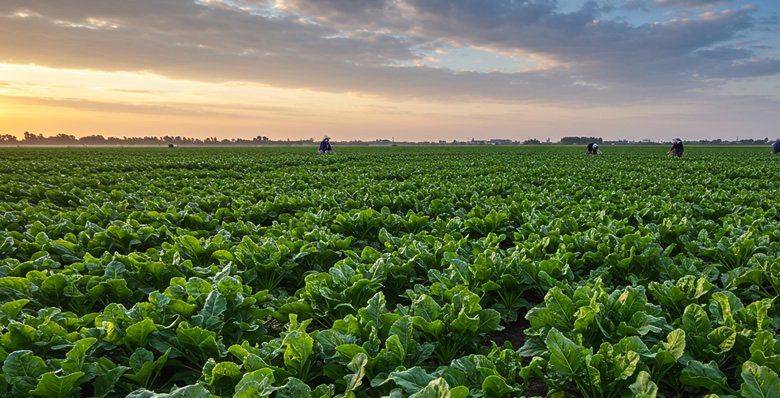
Since its introduction in 1906, beet has taken root in china for more than a hundred years, building with sugar cane a solid foundation for our sugar supply。
The growth and decline of the beet industry, which is an indispensable sugar crop in temperate areas, is not only related to the fate of the sugar industry in the north, but also holds an important place in the national sugar security strategy. According to the latest data, our beet sugar production reached 1. 5 million tons during the 2024/25 squeeze season, exceeding a 30 per cent surge over the same period, with cross-cutting growth in cultivation and production。
This paper will provide an analysis of the current state of development, core drivers and future trends in the beet industry in china, taking into account the latest supply and demand and production area data。
I. Definitions and classifications
Beta vulgaris l., a two-year-old herbivorous plant, has its meat roots, which are the core ingredient of industrial sugar because of its sugar content (usually 15-20 per cent), and is an important branch of our sugar industry. Beet sugar is a combination of economic activities based on sugar as a feedstock, producing sugar (mainly white sugar) through a series of industrial processes such as pressure, cleanliness, evaporation and crystallization, and integrating by-products such as sugar honey and beet beets. Beet sugar has a wide range of applications in areas such as food, beverages and medicine, due to its unique sweet taste and excellent processing properties. The sugar beet, which focuses on this paper, is a key element in guaranteeing a diversified supply of sugar in the country。
Ii. Industrial policy and regulation
The development of the beet industry in china has been guided by national policies, and the management of the industry has involved a number of government departments, and a system of coordinated regulation has been developed。
Iii. Development history
The development of the beet industry in china is clearly cyclical:
Iv. Sectoral barriers
V. Analysis of industrial chains
The beet industry chain is upstream in the supply of seeds, agricultural resources and machinery, midstream in the planting chain and downstream in the combined use of sugar and by-products. The leading enterprises, such as the sino-food sugar industry and xinjiang farmers, have managed to move up and down through integrated industrial chain layouts, with full process control from the field to the market. Waste honey from beet processing and scrap silk (beet beets) are important by-products that can be used to produce yeasts, alcohol and quality feed, respectively, and are key to increasing industry value added。
Vi. State of the industry: a data-driven interpretation
1. Substantial increase in production and area:
According to data from the ministry of agriculture and rural development, during the 2024/25 season, the national production of beet sugar rose significantly from 1. 44 million tons during the 2023/24 season to 1. 5 million tons, an increase of 31. 6 per cent over the same period. This increase was driven mainly by the expansion of cultivation, which increased from 167 to 216,000 hectares over the same period. This suggests that farmers are effectively motivated to grow, both by policy incentives and market conditions。
High concentration of production leading to growth in xinjiang:
In terms of distribution, sugar beet production has become highly concentrated. According to the latest statistical data for the 2024/25 season, the two main production regions are particularly visible:
3. There is scope for increasing the level of monolithic production:
It is noteworthy that, despite a significant increase in total production, the level of single beet production fluctuates slightly. Data from the ministry of agriculture and rural development show that 53. 20 tonnes/ha were produced per day during the 2024/25 season, which is slightly lower than 54. 90 tonnes/ha during the previous season. This indicates that future growth potential will rely more on the upgrading of unit area yields through seed breeding and scientific field management。
Vii. Development factors: opportunities and challenges
Opportunities
Challenges
Viii. Competition patterns
The pattern of competition in the sugar market in china is characterized by two main features:
Ix. Trends
Looking ahead, china's beet industry will continue to upgrade along the following paths:
In conclusion, after a hundred years of wind and rain, the chinese beet industry is at a new historical start. The bright-eyed data of the 2024/25 season are not only a sign of recovery in the sector, but also a reflection of the effectiveness of industrial structural optimization and transformational upgrading. Faced with the twin challenges of cost and technology, china's beet industry will be able to move forward on a high-quality and sustainable “sweet” development path, while safeguarding the country's sugar cans, only if innovation is driven and industry-wide linkages deepened。