


Model recommendations: tw-f1, skype environment, professional instrumentation, 1-3-2-7-6-3-3-3-3-3-3-3-3-3); accurate and timely access to atmospheric wind speed information is essential in a wide range of fields, including meteorological monitoring, aerospace, energy development and disaster warning. In particular, traditional monitoring tools often have limitations for complex and critical meteorological phenomena such as sudden wind mutations in the atmosphere. The emergence of drone wind-to-sensors provides innovative and efficient solutions to capture these rapidly changing winds。
Limitations of traditional monitoring tools and advantages of drone sensors
Inadequate traditional means
Traditional atmospheric wind-speed monitoring relies mainly on ground weather stations and high-altitude weather for balloon detection. Ground weather stations are fixed and can only obtain wind status information for specific locations, with limited capacity for wide-scale, dynamic windfield monitoring. Moreover, factors such as ground buildings, topography, etc. Can interfere with the surrounding air flow and affect the accuracy of measurements. Although high-altitude weather detection balloons can rise to high altitude for measurements, their flight trajectory is difficult to control with precision, and data collection has low spatial and temporal resolution to capture instantaneous wind mutations。
The unique advantage of drone sensors
The drones are highly flexible and mobile, allowing for rapid flight to the designated area in accordance with pre-established flight routes. With wind-speed sensors, drones can move freely within three-dimensional space to achieve real-time, dynamic monitoring of wind conditions at different altitudes and locations. The uav wind-to-sensors can provide higher time- and space-resolution wind field data compared to traditional methods, which significantly improves the ability to capture sudden wind variability in the atmosphere。
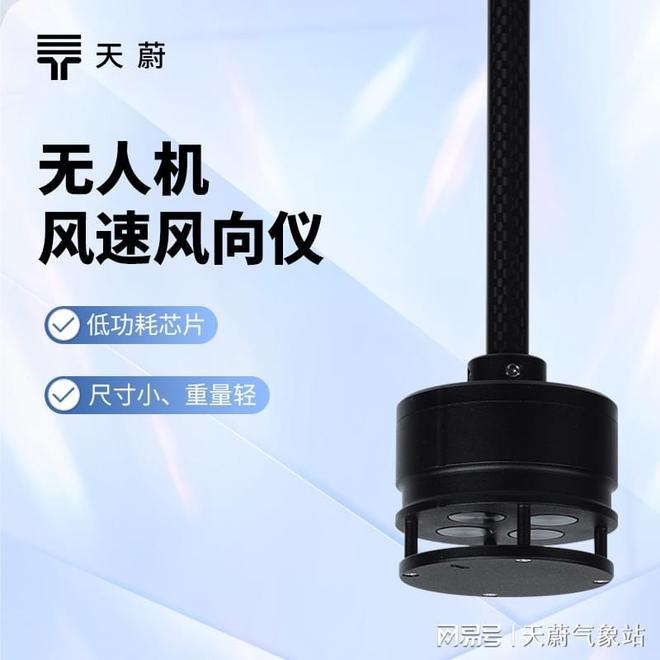
The working principles and technical types of the drone wind speed sensors
Rationale
Uav wind-speed wind sensors typically measure wind speed and direction based on mechanics or optical principles. In the case of a common leather host wind speed sensor, it measures the total pressure and static pressure of the current by measuring the difference between the two, and converts the pressure to the wind speed according to the bernoulian equation. Wind direction sensors generally use wind directional structures to determine wind direction by measuring the directional angle of the wind towards the drone body。
Type of technology
Hypersonic: the ultrasonic wind-speed sensor measures wind speed and direction using the velocity of the ultrasonic wave in air in relation to wind speed. It does not have mechanical revolving components and has the advantage of rapid response speed, high accuracy and good reliability to work under harsh environmental conditions。
Laser doppler: the laser doppler wind speed instrument measures wind speed by firing laser beams into the air and detecting the doppler frequency transfer of dispersed light. This sensor has a very high measure accuracy and spatial resolution and is able to capture very small changes in wind speed, but the cost of equipment is high。
Thermal: thermal wind speed sensor measures wind speed based on the thermal exchange between the heating element and the surrounding air. When the gas flow passes through the heating element, the heat is taken away, leading to a temperature change in the heating element, and wind speed is determined by measuring the relationship between temperature change and wind speed. Thermal sensors are simple and cost-effective, but have relatively low measurement accuracy。
Precisely captures critical properties of sudden wind mutation
High sample rate
In order to accurately capture sudden wind-speed mutations in the atmosphere, the uav wind-speed sensors require high sampling rates. High sampling rates mean that sensors can measure many times in a short period of time, thus obtaining more detailed information on wind speed changes. For example, some advanced sensors can sample hundreds or even higher times per second, allowing for real-time recording of small fluctuations and rapid changes in wind speed and providing rich data support for the analysis of sudden wind speed mutations。
Quick response time
Response time refers to the time required for the sensor to move from the sense of wind speed to the output of the corresponding telecommunications. Quick response times are essential to capture sudden wind mutations. If the sensor's response time is too long, the fast change of wind speed is missed, resulting in inaccurate measurements. High-quality drone wind-speed sensors usually respond at the millisecond level and are able to keep up with the pace of change in wind speed。
It's very jamming
During actual flight, drones may be affected by a variety of interference factors, such as body vibration, electromagnetic interference, current flow, etc. These interference factors have a significant impact on the accuracy of the sensor's measurements. Therefore, uav wind-speed wind sensors need to be robustly resistant to jamming, effectively eliminating jamming signals and ensuring the accuracy and stability of measurements through the use of advanced signal processing techniques and filter algorithms。
Examples of practical applications in different fields
Meteorological monitoring and forecasting
In the meteorological field, uav wind-speed wind sensors can be used to monitor wind field structures such as typhoons and cyclones. Through the deployment of multiple drones into a monitoring network, real-time access to wind-speed data at different altitudes and locations inside the typhoons, provide weather forecasters with more accurate meteorological information and improve the accuracy of typhoon paths and intensity forecasts. For example, in one of the typhoons, the wind speed sensors on board the drones successfully captured instant wind speed mutations near the typhoon eye wall, which provided an important basis for the timely release of typhoon warning and disaster prevention and mitigation measures。
Aerospace
In the aerospace field, uav wind-speed sensors can be used for low-altitude windfield monitoring during aircraft landing and landing. Aircraft are very sensitive to the wind conditions during their take-off and take-off, and sudden wind mutations can lead to aircraft being out of control or dangerous. Through real-time monitoring by the deployment of drones around the airport, pilots are able to keep abreast of changes in low-altitude windfields, adjust their attitude and speed and ensure flight safety. In addition, drone sensors can also be used for uavs ' own flight control and enhance the flight stability and reliability of uavs in complex windfield environments。
Energy development
In the field of wind power generation, accurate wind-speed direction information is essential for the location, design and operation control of wind generators. The uav wind-speed sensor can provide a scientific basis for the optimal layout of the wind field by conducting a detailed wind field assessment of the proposed area, obtaining wind-speed distribution data at different altitudes and locations. During the operation of wind farms, sensors can also monitor changes in wind conditions in real time, helping wind generators to automatically adjust the angles and speeds of leaves to wind speeds to increase the efficiency of power generation。
Disaster early warning and response response
In disaster sites such as forest fires and urban fires, the speed and direction of fire spreads closely linked to the direction of wind. Uav wind-speed sensors can fly quickly to the disaster site, monitor changes in the weather in real time, and provide firefighters with accurate wind direction and speed information to help them develop a rational fire-fighting strategy to avoid a fire becoming out of control as a result of a sudden wind mutation. In addition, in disasters such as chemical spills and nuclear radiation, sensors can monitor the direction and speed of the spread of harmful substances and provide an important reference for emergency response and evacuation。



