Today, we officially launched a new generation of 3d generation models, seed 3d 2. 0。
Feed3d 2. 0 was structured around geometric precision and texture materials, and downstream availability of 3d content was expanded, further promoting 3d generation towards “production availability”. A user enters a map that generates 3d assets with more accurate structures and more authentic materials。
Of the pairwise comparison blinding surveys commonly used in the industry, 60 assessors with 3d modelling experience conducted two- or two-pronged assessments of seed3d 2. 0 and six mainstream models based on approximately 200 test examples. The results show that seed3d 2. 0 shows a higher preference rate for geometric generation and end-to-end material asset generation in all mainstream models involved in comparison, which is clearly perceived in professional assessments。
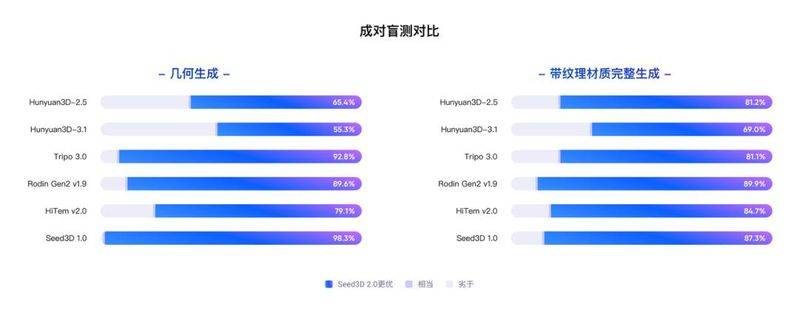
Specifically, the upgrade of seed3d 2. 0 is mainly in terms of geometrically generated quality and material authenticity; at the same time, we continue to explore the availability of 3d content around a repertoire of simulation and intelligence。
Currently, the feed3d 2. 0 api service is online on the volcano ark and clicks on the link (
Https://console. Volcengine. Com/ark/region:ark+cn-beijing/model/detail? Id=doubao-seed3d-2-0) to api page access。
Geometrically generated higher accuracy and space structure reasoning capabilities further enhanced
In 3d generation, white modelling is often used to determine precise geometry, laying the foundation for fine texture generation and actual production. However, the 3d generation of white models is often characterized by geometrical instability, such as noise, bad surfaces, inverted ambiguity, structural disorders, etc., and users often take hours of modelling to use。
The complete white model generated by seed3d 2. 0 retains the structure details of the object, is clear and sharp at the angle of the reverse angle and accurately reduces the structural characteristics of the target object。
This improvement has benefited from the redesign of the geometric generation architecture. Seed3d 2. 0 uses the corse-to-fine two-stage strategy to decorate “corporate structure” and “geometric detail”: phase 1 is based on large parameters, dit is based on input images to generate rough particle geometry to create a whole pounce relationship and space layout; phase 2 is based on the output of phase 1 as geometry anchor, focusing on the recovery of sharp edges and fine surfaces。
A qualitative comparison with the existing mainstream 3d generation model shows that seed3d 2. 0 is significantly better than baseline methods in dealing with the fine edges of complex structures, generating thin wall structures and reducing the input of images, as shown in the figure below。
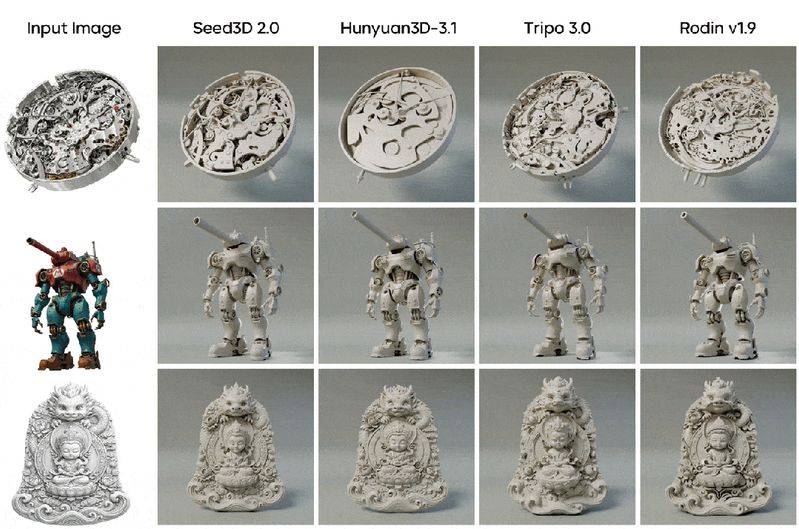
Qualitative comparison of geometrically generated dimensions
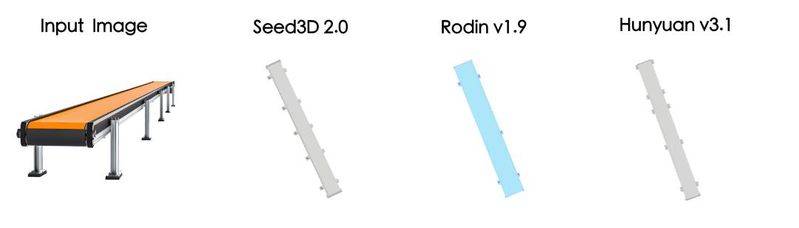
In addition, seed3d 2. 0 is well represented in the spatial structure understanding and can be extrapolated from the complete three-dimensional structure of the object based on limited visual information。
In the case of an industrial conveyor belt, for example, feed3d 2. 0 not only restores the conveyor belt subject, but also infers the lower leg support organization, the wider ratio of the whole and the connections between the components, producing results that are logically consistent with the original map。
Texture material generation is more sophisticated and directly accessible to standard rendering and production processes
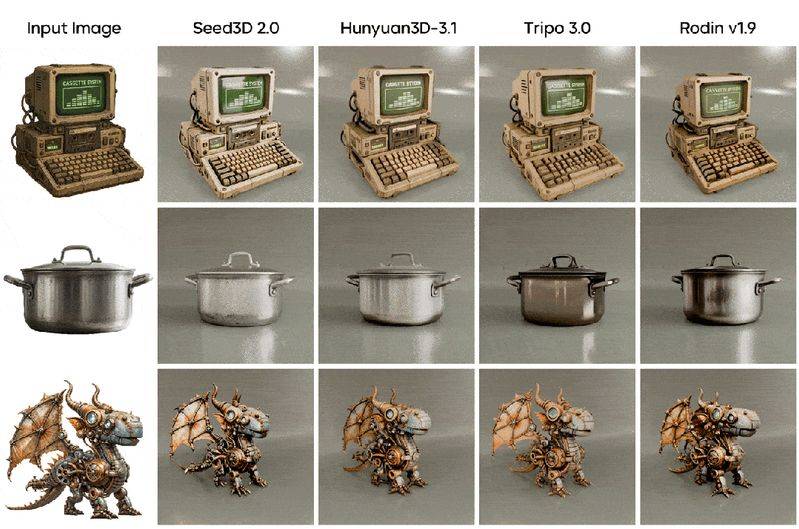
The previous 3d generation model had several typical problems in the material chain: text and symbols were prone to blurry, deformation and fragmentation; the quality of metals and plastics was difficult to distinguish; and the optical properties of real objects were difficult to accurately restore。
Sed3d 2. 0 has made systematic adjustments to the material generation structure, resulting in several key dimensions of capacity enhancement: an increase in the reduction accuracy of text and symbols to support the higher level of text clarity required by product labels, packaging, logo etc.; support for multi-level, multi-type complex material combinations that accurately distinguish between the physical properties of different materials, such as metals, plastics, ceramics, fabrics; and the output of complete pbr material profiles that allow 3d assets to maintain physical consistency of visual performance in different light conditions, with products having direct access to standard paint lines。
More flexible component generation, oriented towards simulation and mapping
In downstream scenarios such as smart training, simulation environments, 3d assets need to support physical interaction, not just static displays。
Following this, seed3d 2. 0 will support physical movements such as disassembly of the full 3d assets into separate components by function and add joint information to the components, the rotation of the fitting chain structure, the pull of drawers, the multi-freedom activity of the robot joints, and the construction of assets that can be used for dynamic interactive simulation missions such as robot capture. The output results will be processed in such a way as to be compatible with mainstream physical simulation engines such as isaac sim and reduce the labour costs of physical property binding and structural optimization in traditional processes。
At the scenery level, the model will also support multiple inputs, such as text, multi-perspective pictures or videos, and combine multiple 3d asset generation scenarios。
High-quality, available 3d assets are becoming an important basis for accelerating the landing of scenarios such as smartness, industrial manufacturing and digital twinning. From geometric generation to material expression, to continuous exploration of downstream processes such as simulation, seed3d 2. 0 is driving 3d generation towards production faster。