During the japanese war
National unity front of japan
July 1937-august 1945
Seven things went wrong, and a national war against japan broke out. The communist party of china actively promoted the establishment of a national unity front against japan based on cooperation between the two parties. During this period, the party's unified front doctrine policy was fully matured and achieved great success, with mao zedong presenting the famous argument that the united front, the armed struggle, and the building of the party are the three pillars of the party's law. By upholding the principle of independence and autonomy on the national front against japan, by developing progressive, centrist and insular forces, the party has established a “three-tier” democratic regime in the border region, laying a solid foundation for the ultimate victory in the war against japan. The successful persistence and development of the anti-japanese national unity front has also given further impetus to the development of democratic parties and the patriotic democratic movement, and the people's revolutionary force has gained unprecedented consolidation and strength。
"role" intellectuals
In december 1935, the political resolution adopted by the wachonburg conference made it clear that all intellectuals sympathetic to the anti-japanese traitors, regardless of whether they had been members of the national party in the past or had worked for the national party government, enjoyed preferential treatment by the soviet government. All intellectuals who have been expelled, despised and abused by the japanese imperialist and traitor nationalist government ... Have been granted the right of asylum by the soviets (all of them can come to suzhou). The intellectuals of all revolutions, ... (without asking whether they are landowners, rich farmers, or capitalists), the right to vote and to be elected by soviets。
On 1 december 1939, the central committee of the communist party (cpc) took a decision specifically to absorb a large number of intellectuals, criticizing the shortcomings and mistakes of some regions and sectors in the implementation of intellectual policy, and calling the attention of all its comrades to the large number of intellectuals involved in the party-led army, schools and government, as well as to the use of communists to recruit members into the party。
On 10 december 1939, at the second congress of the zhonganing zone, the minister of the central organization of the communist party, chen yun, called for the “snatching” of intellectuals, stating that the intellectuals were now being robbed by all sides, and that the national party was going to rob us, and we were going to rob them. To better attract intellectuals, the party has also developed a policy of “come and welcome, go and welcome, then welcome”。
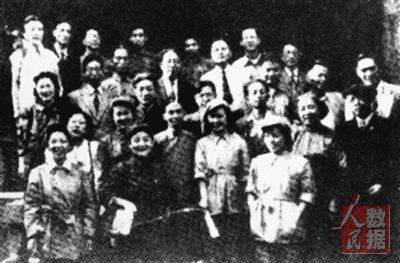
Cultural figures who arrived at the site during the japanese war
Local party organizations at all levels, as well as the local eight-road army, the new four army offices and the communications office, are seriously implementing the party's intellectual policy and are making every effort to send a group of intellectuals to day-to-day resistance sites such as yanan. In 1937, in response to the need to train cadres in the fight against war, the party informed the shanghai party of the transfer of ashch and why to the newly founded shubei university school. Their group of 12 were the first prominent intellectuals to arrive in yanan and were warmly welcomed. In 1940, with zhou eun's concern, zhang zhang zhang zhang zhang zhang and mao ziang arrived in yan an. According to statistics, there are around 20,000 intellectuals transferred to yanan from the siam-8 army office alone. Following the outbreak of the pacific war, a number of scholars who had studied europe and the united states in north china, tianjin, broke through various crossing points and moved to yanan and other anti-japanese sites. At the beginning of 1940, yanan had gathered some 40,000 intellectuals. In general, the majority of young students are enrolled in various institutions or training courses, after which work is distributed. The educated intellectuals directly distribute jobs. At this time, janan became a beacon for attracting a broad spectrum of intellectuals, with the communists' steadfast resistance and political democracy. Chen yi wrote a poem to that effect: “a hundred years of weak sighs of huaxia, eight years of war against yanyan. Ask who's in charge in kyushu. The mountains are clear to everyone."
Fostering intellectuals
The party has set up a series of schools in yanan, which are aimed at training intellectuals. The students of the anti-japanese military university were initially red army cadres and, as a large number of intellectuals arrived in janan, many of them went to the front. Founded in september 1937, the shubei school is a single-line school, which is accessible through the entrance tests, provided that it is not part of the gang. By the end of 1938, more than 6,000 cadres were trained. Founded in april 1938, the luxhen academy of arts has trained many literary workers for the army and the local community, many of whom later became the backbone of the new chinese literary and artistic work. For example, the french musicians returned to the sea of stars and stars to yanan to head the music department of the luxur school of arts. He had only completed the syllable six days after he had seen the writer's song " yellow river chorus " written in five days of passion. This generous and sad music quickly spreads throughout the country, moving to the world, and has been greatly encouraged in exceptionally difficult days。