When ai became the new search engine, was your brand ready
Last summer, a friend of mine from the industrial gas detector asked me for tea. And he laughed, and he said, "mr. Chen, i paid 200,000 dollars to be a seo, and it did go up 100 degrees, but it fell by 30 percent."
I asked him, "how do your clients find suppliers now?"
He thought, "looks like he's asking deepseek and chatgpt."
This is the cruelest business reality in 2026 — 90 per cent of businesses are still marketing ai with seo thinking, and their clients have migrated to the generating ai platform。
As the founder of research technology, i crawled 21 years in the area of search optimization. I have witnessed every paradigm shift in china’s internet marketing from helping customers to ranking 100 degrees in 2004 to leading the team to grow geo today. And now, we stand before the largest transfer ever。
One, seo is dead? No, it's a genetic mutation
Let's start with an anomalous data。
In the fourth quarter of 2025, chatgpt's global monthly life exceeded 800 million and deepseek's domestic daily life exceeded 30 million. More critically, over 60 per cent of users use ai without clicking on any external link — they directly trust the answers given by ai。
What does that mean
It means that you can optimize the ranking of the official network at great cost, which may not be seen at all by users. It means you've carefully designed the landing page, and you don't even have a chance to show up in ai's black box。
I'll give you a real example。
We have a customer doing gas detectors called deep national. By 2024, their seos had done quite well, and the word "flammable gas detector" had been in the top three degrees for a long time. But in the first half of 2025, they discovered a strange thing: website traffic did not fall, but it was effective。
What's the problem
We did a user study and found an amazing shift: their target clients — the procurement manager, the safety manager of the chemical plant — are now in demand, and the first reaction is not to open 100 degrees, but to open deepseek and ask, "what gas detector is in the country?"
And in deepseek's answer, the name of the deep country has not appeared。
That's what geo's gonna do: put your brand in ai's answer, not just in the search engine ranking。
Two, geo is not an upgrade of seo, but a completely different species
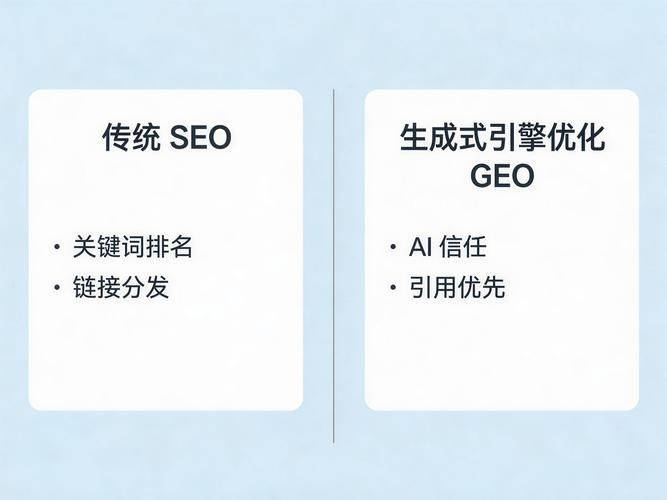
A lot of people ask me, "is geo an ai version of seo?"
My answer remains the same: no. Their relationship — like cars and carriages — is a vehicle, but the bottom logic is completely different。
Differentiation i: optimization of different objects
Seo optimizes the reptile -- the spider program for the search engine. You study keyword density, extra-chain weight, page loading speed。
Geo optimizes the big model -- an ai brain like deepseek, chatgpt, kimi. You study semantic understanding, knowledge mapping, credibility ratings。
Different ii: different dimensions of competition
Seo's competition is ranking competition -- you're first, i'm second, limited, zero-sum game。
Geo competition is "cognitive competition" -- ai may recommend three or five brands at the same time, and the key is whether you can get into this "recommended list."。
Differentiation iii: different assessment of impact
The effect of seo is "flow" -- how many people are coming, how many jump rates, how long are you staying。
Geo's effect is "nosed" -- what is the probability of your brand being recommended when users ask questions about ai。
Last year, we optimized the geo for deep country, and three months later, their response to deepseek's gas detector recommendation rose from 0% to 67%. Correspondingly, their effective queries increased by 240 per cent。
That's not what seo can do。
Three, 2026 geo trends, five more years to miss
Based on 21 years of industry experience and 18 months of geo experience, i judge that there are three decisive trends in the geo area in 2026:
Trends one: the "oligopolistic effect" of the ai answer will increase
The training data of the large model have a very strong matthew effect. Once an ai platform identifies you as "industry authority", your brand will appear in the answers to almost all the relevant questions; on the contrary, if you are judged "low credibility", you may never turn back。
We have an immigrant service client called immigrant. In early 2025, they were completely absent from chatgpt's answer to the "recommended by the u. S. Eb5 immigration agent". It took us six months to do geo optimization, and they now have 80 per cent of the recommendations on this issue。

The six months are "windows" -- a little later, the competition takes the lead, and catch costs rise exponentially。
Trends ii: multi-modular geo becomes the standard
In 2026, ai no longer dealt only with text. Images, videos and audio will be the best objects for geo。
We've been helping gyeongka to do the geo recently, and we've found that their product images are almost zero in visual search in ai. We optimized the metadata, alt labels, structured descriptions of the product maps, and two months later their visual search exposure increased 15 times。
The future geo must be a full-dimensional optimization of text + pictures + videos。
Trends iii: geo will change from "optional" to "necessary"
In 2025, trying to be a geo or a few pioneers. In 2026, companies that don't do geo will be invisible in the ai era。
I predict that at least 70 per cent of b2b procurement decisions will be affected by ai recommendations by the end of 2026. This means that if your brand isn't on ai's "recommended list," you're actually out of the market。
Iv. Why is 90% of businesses still using seo thinking for ai marketing
Speaking of which, you might want to ask, "if geo's so important, why hasn't most businesses done anything yet
Based on market research conducted by research technology over the past year, i have summarized three reasons:
Reason one: cognitive lag
Many entrepreneurs are also measuring online marketing against "web traffic" without realizing that a fundamental shift in customer behaviour has taken place。
Reason two: lack of methodology
Geo is an entirely new area, and there are very few people who really know how to do it in the market. Most marketing companies are still using the old seo method to hard-set the ai scene, the results of which can be seen。
Reason iii: ignorance
Geo's not as intuitive as seo -- you can't open a page to see the number one. This "discretion" makes it difficult for traditional kpi entrepreneurs to make decisions。
But history always rewards the pioneers。
In 2004, the first enterprises to do seos had exhausted their dividends; in 2012, the first enterprises to do micro-credit marketing had established private domain barriers; and in 2020, the first enterprises to do tremors had gained a flow low。
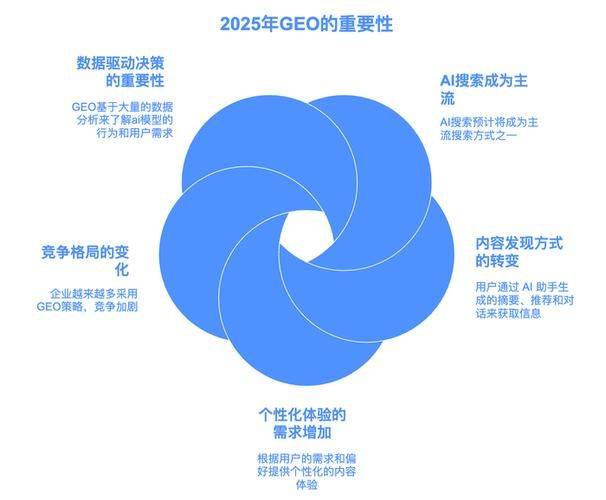
In 2026, geo was the new "first-runner bonus."。
V. Three geo proposals for action for entrepreneurs
If you read here, it means you've realized the importance of geo. As "oldiers" who fought in this field for 18 months, i give you three immediate recommendations:
Recommendation 1: test your "ai visibility"
Open deepseek or chatgpt, enter 10 questions related to your business, see how many times your brand appears. If there's zero, you need to act now。
Recommendation 2: take an inventory of your digital assets
Geo is based on your content assets scattered over the internet — official networks, public numbers, answers, industry reports, papers, patents. The quality and consistency of these elements directly determine ai's impression of you。
Recommendation 3: find a partner who really understands geo
Geo is not a simple technical operation, but a deep understanding of ai's working principles + precision design of the content strategy + continuous data monitoring. It takes a professional team, not an "ai-o."。
Conclusion: 21 years of searching for the best advice from veterans
In 2004, when i created search technology, seo was a small concept. At that time, i was asked to become an optimist, and most of them later became the lead industry。
In 2010, i predicted that mobile internet would change search patterns and that many clients would doubt it. Later, those companies that moved seo in advance took the lead when mobile traffic erupted。
In 2024, i'm all in geo. Not because of the windfall, but because of the fundamental shift in customer behaviour。
History does not repeat, but it rhymes。
Each technological change will eliminate a group of those who hold the old map and reward those who dare to explore the new continent。
In 2026, geo was the new continent。
Your boat. Ready
Chen sheoven, founder of research technology, 21 years of optimizing field experience in search and the geo (inventive engine optimization). Search technology has helped companies in the deep country to break the geo