In modern human life, flame retardants are almost everywhere. But people do not normally see it at all or know it exists. For most people, there is no idea what flame retardants are. Indeed, in the mobile phones we carry with us, in the computers on the desk, in the daily subway, in the cars you drive, and even in the mattresses that make you sleep at night, thousands of flame retardants are ready, like an alert little guard, to watch your life and property in silence and keep us from the threat of fire。
What's a flame retardant?
By definition, flame retardants are chemical aids that can prevent the burning of objects, adding flame retardants to flammable materials, making them difficult to ignite in the event of an open fire or to extinguish and spread when lit. Fire retardants can also reduce heat and flue gas emissions。

Flammable retardants are not a simple product, but are a large family with 700 to 800 family members, which can be divided into organic flame retardants and inorganic flame retardants, or halogens, phosphorus, nitrogen and silicones, depending on the reaction element, which can also be mixed, additive and reactive by method of use。
The reason for the variety of flame retardants is to satisfy the “favours” of different materials. Each flame retardant guard has his or her best position and can be used in combination and in collaboration with each other to perform well in fire prevention。
These invisible little guards are active in every aspect of people's lives. They are silently “dived” on circuit boards of various electronics such as mobile phones, computers, televisions, refrigerators, and plastic casings of various electronics, and they are seen in aircraft, ships, bus seats, and thermal materials of outer walls. In developed countries, such as europe and the united states, flame retardants are also widely used in the clothing of children, the elderly and patients with reduced mobility. Our country has also introduced national standards with clear fire-retarding requirements for building materials and decorations, textiles, furniture, electrical wires, switches, lamps, household electricity, etc. Used in public places。
Flammability principles are different
It is not easy to shoulder the burden of fire-resilient security guards, and flame retardants must have a hard grasp。
Three main elements are required for combustion - flammables, accelerants (oxygen) and sources of fire. The combustion process is divided into heating, decomposition, setting fire, burning and spreading. Fires can be effectively avoided if any of these elements are removed or if a way is found to keep the combustion process at the budding stage of heating and decomposition。
Different types of flame retardants are used to stop flame combustion: to prevent flammable gases from being generated by absorbing heat; or to form a dense cover on the surface of the flammable substance, insulating contact between the flammable substance and oxygen; others capture the free radicals involved in the combustion response for the purpose of inhibiting the free base chain reaction; others have the effect of reducing the rate of combustion by diluting oxygen by producing non-flammable gases。
The inorganic flame retardant al (oh) 3 decomposes at up to 200°c and releases crystals, which evaporate into water vapour. This series of processes absorbs large amounts of heat, reduces the temperature of the material surface and the flame zone and slows thermal fission reaction. In addition, water vapours from crystals reduce oxygen concentrations and further inhibit the spread of fires。
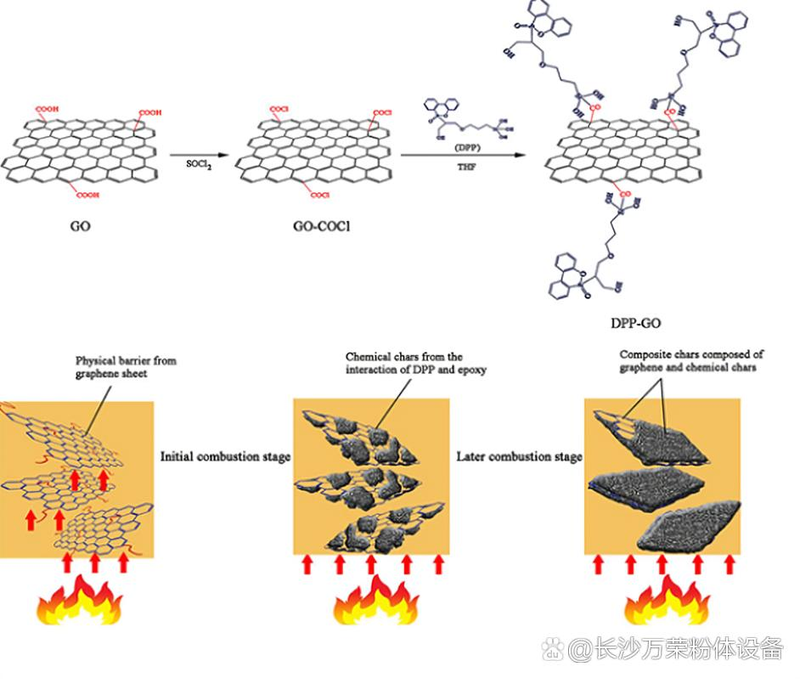
The heat-retardant of phosphorus turns into a more structurally stable interlocking solid substance or layer of carbonation, such as a solid coating that wraps together the flammable material, both to prevent further pyrolysis of the material and to prevent the release of partially deflammable gases from the material to continue burning。
The evaporation temperature of the brominated flame retardants and the decomposition temperature of the high molecular material are the same or similar, and when the high molecular material is thermally decompositioned, the brominated flame retardants volatilized and thermal decomposition products enter the gaseous combustion zone. Flame retardants can quickly capture free radicals in gas phase burning areas, inhibit free base chain reaction, stop the spread of flames and eventually slow down the combustion reaction until it ends。
In short, each flame retardant has its own unique secret。