Panel heater principles - brief description
It is a new type of efficient heat exchanger, made up of a series of sheetings of metal with a certain waver shape, and is a key equipment for the rational use and conservation of energy and for the development of new energy sources. It is estimated that in modern petrochemical enterprises, investments in heat exchangers account for 30 to 40 per cent of the value。
A thin rectangular channel is formed between the various plates of the plate heat exchanger, with a half-form of heat exchange, a much higher heat transfer coefficient than that of the conventional shell heat exchanger in the case of the same mobile resistance and pump power consumption, with a tendency to replace the shell heat exchanger to the extent applicable。
The structure and the principle of heat switching of the tablets determine the characteristics of a compact structure, small surface area, high heat delivery efficiency, high operational flexibility, wide application, small heat loss, ease of installation and cleaning. In the case of the same pressure loss, the heat transfer factor is three to five times higher than that of the line heater, accounting for one third of the surface area of the tube heater, with a heat recovery rate of over 90 per cent。
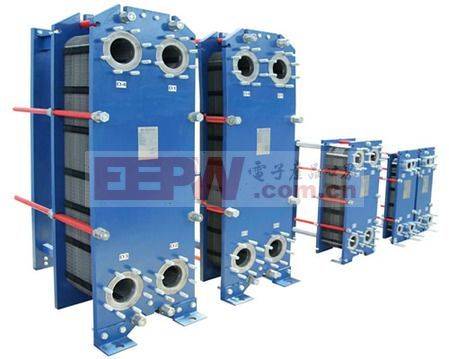
Tablet heater principles - basic structure
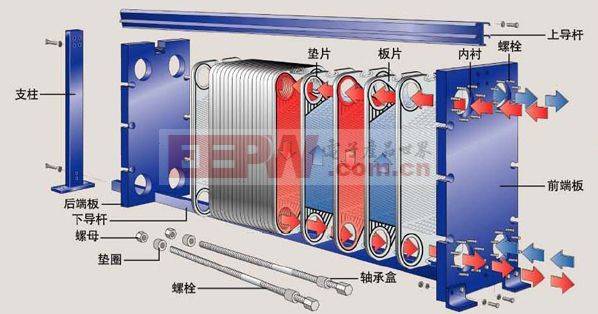
Thermostats consist mainly of heat transfer plates, sealed gaskets, two-end presses, bolts, racks, etc. The components function as follows:
1) thermal plate: thermal plate is a component of the heat exchanger that is primarily heat-replaced, and the general waver is adult. The mass of the heat plate is different depending on the fluid medium, and is mostly made of stainless steel and titanium。
2) sealed gaskets: sealed gaskets for the plate heater are mainly sealed between the heater plates. The materials are: butler rubber, tri-dollar acetpropyl rubber, fluorine rubber, etc., with different rubbers depending on the medium。
3) two-end pressure plates: the two-end pressure plates are mainly compacted with all heat transfer plates to ensure that the fluid medium is not leaked。
4) tight bolts: tight bolts are mainly used to tighten the pressure plates at both ends. Tight bolts are usually double-headed threads, which are pre-rigged to even the force and rectangles of the fixed plate。
5) hanging: this is mainly the replacement of heat sheets to facilitate their dismantling, cleaning, assembly, etc。
Tablet heater principles - working principles
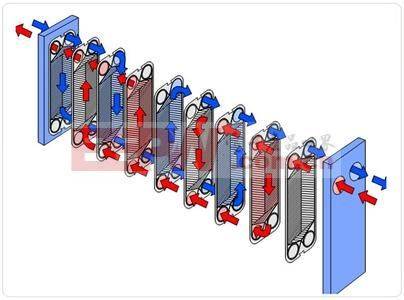
Thermobilizers are multi-printed heat transfer plates consisting of disassemble heat exchange units, at certain intervals, under pressure from rubber pads. When the plates are assembled, the two sets of plates are arranged alternately, and the rubber seals are fixed between the plates with a sticker, the effect of which is to prevent fluid leakage and to form a narrow network flow between the plates, to transform the thermal plates into a variety of ripples in order to increase the size and rigidity of the heat plate, and to allow the fluids to form flow at low flow speeds in order to enhance heat transfer. The four angle holes on the plate form the distribution and discharge tubes of the fluid, with the two heat-replaced media flowing into their respective channels, forming a reverse flow or a simultaneous flow of heat exchange through each plate。
Its characteristics are: (1) small size and small area; (2) high heat transfer efficiency; (3) flexible assembly; (4) low metal consumption; (5) low heat loss; (6) disassembly, cleaning, repair and repair convenience; and (7) the disadvantage of a plate-to-heater is that the perimeter is sealed long, leaky and cannot withstand high pressure。
Read the above articles, do you have any further knowledge of the structure and principles of the tablets。