


[recommended 3] in exploring the pattern of lens imaging, as shown in figure a, fixes the lens a to 35 cm tic, places lit candles at 5 cm tic line in the frame, moves the light screen, makes the candle visible on the light screen, and paints the image of the relationship between the mass distance and image range in the lens a to mirror image, as shown in figure b: then keeps the position of the candle unchanged, changes the lens a to the lens b and keeps the position unchanged, moves the light screen and makes the candle clearly visible on the light screen, as illustrated in figure c icon
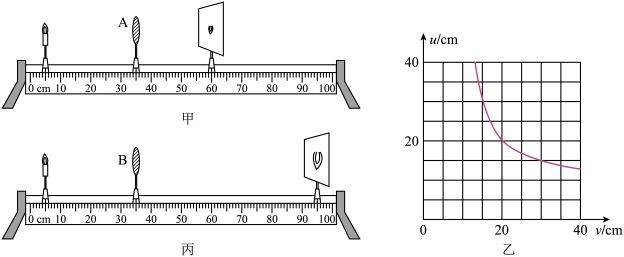
(1) based on the above-mentioned experimental phenomena and the pattern of lens imaging: focal length of lens a is cm, focal length of lens a is (greater than ) or equal to focal length of lens b
(2) in the image, keep the cones in motion and move the candles to the right 5 cm, and in order to get a clear image again on the screen, the screen should move a distance towards (filling “left” or “right”) as if (filling “larger” “smaller” or “no change”)
(3) as the experiment proceeds, the candles gradually become shorter due to the burning, the image on the screen gradually moves towards , so as to ensure that the centre of the candle, the cavity lens and the light screen is at the same height, and so that the image in its entirety is in the centre of the screen, it may be moved to 。
(4) when the candle is clearly visible on the screen, if the upper part of the lens is blocked by a blindfold, the image of (filling the upper half, lower half or all) will be seen on the screen
(5) at the end of the experiment, the students of team 2 took one of the glasses between the candles and the cones, and were closer to the convection mirrors. As a result, the original clear image on the screen became blurred, and the group only observed clear images of the candles on the screen as it moved at a reasonable distance away from the convection mirror。



