Introduction
Large milling is commonly used in the modern cement industry, and maintenance of its associated components is associated with normal milling. This is the case for large-scale slow-down machines that accompany grinding, which, in the event of an accident, are difficult to repair on-site, have a high technical content and have a long maintenance cycle, with a significant impact on the normal production operations of the enterprise. Many cement enterprises responded by purchasing aircraft at high cost in order to prevent occasional need, or by taking advantage of late winter cut-off opportunities and returning to the plant for repairs, which would entail high transport costs. This illustrates the importance of on-site inspection and maintenance methods for large speed-reducing machines。
01
The common principle of the structure of a large-scale grinder
Common types of domestic speed-reducing machines: southern high dent mlx, mlxsd, mlxss series; heavy dent jlp, jlx, jlw series; imported frand kmps series; hanging hsg series (market share low)。
The common features of such speed-reducing machines are high rate of transmission, high rate of transmission, tight structure and smaller size, as shown in figure 1。
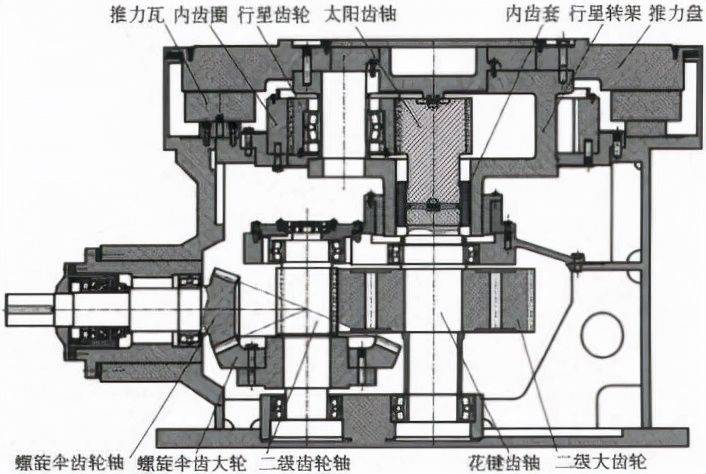
Figure 1 structures of large-scale flat-raters
02
A major high-speed-retarder professional inspection and common malfunctions
2. 1 specialized inspection
The most important means of detecting the potential for failure is equipment inspection. The inspection must be conducted in such a way as to ensure that the equipment is operational, that problems are detected in a timely manner, that trends in deterioration are assessed and that preventive maintenance needs are identified in a timely manner
(1) in addition to the daily inspections carried out by specialized technicians during carrying out routine inspections, mainly with the use of such tools as thermostats, vibrators, vibrating analysers and endoscopes, it is crucial that specialized detection units be invited one or two times a year to carry out operational status monitoring, through seismic spectrum analysis, rational acquisition of information on the operation of speed-reducing machines, analysis and development of test reports to provide a reliable basis for preventive maintenance
(2) during the planned downtime, specialized technicians open the perforation doors at least once a month to check the interior of the gear case, primarily to check the bolts connected, whether the positioning sales are loose, the high-speed axle direction, the volume of directional jumps, and the situation of the high-speed parabolic rods and the length of the bearings, the maintenance of the shelf, the roller, the completion of the roller。
The above experience allows for the establishment of a computerized inspection system when conditions are ripe for better preventive maintenance and lower labour intensity of inspectors。
2. 2 common failures
2. 2. 1 high-speed bearing damage
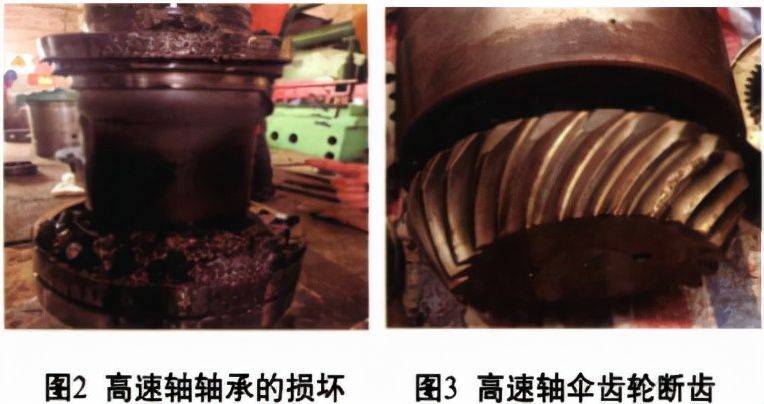
The damage to the high-speed axle bearings was mainly caused by two main causes: high-speed axle bearings, a high degree of directional velocity, and a low degree of concentricity between the electric and speed-reducing engines, resulting in high-speed axle vibrations; and high temperature of the bearings due to a poor lubrication of the bearings and a small control gap during their assembly (see figure 2)。
2. 2. 2 high-speed axle turrets broken
The high-speed axle carving accident (see figure 3) was caused by two factors: high-speed axle direction, a high radial rate, exceeding the assembly control limit (axis direction, rudder movement 0. 2 to 0. 3 mm); and small-sized turbos, with the active radon face exceeding the assembly control limit (65 to 90 per cent)。
2. 2. 3 high-speed axle inter-axis break loose
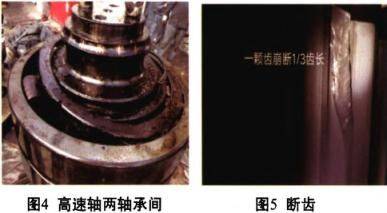
Facilitated wear and tear between the two bearings of the high-speed axis (see figure 4) contributes to the loss of the position of the two bearings and to the widening of the gap between the two bearings, leading to an uneven transfer of stress from the first-axis rods and to a partial shock or vibration of the gears, while the light causes the disfigurement and deformation of the teeth (see figure 5), derivatives to parallel gears and bearings。
2. 2. 4 harming of the surface of the side-axis external dentures and inner dentures
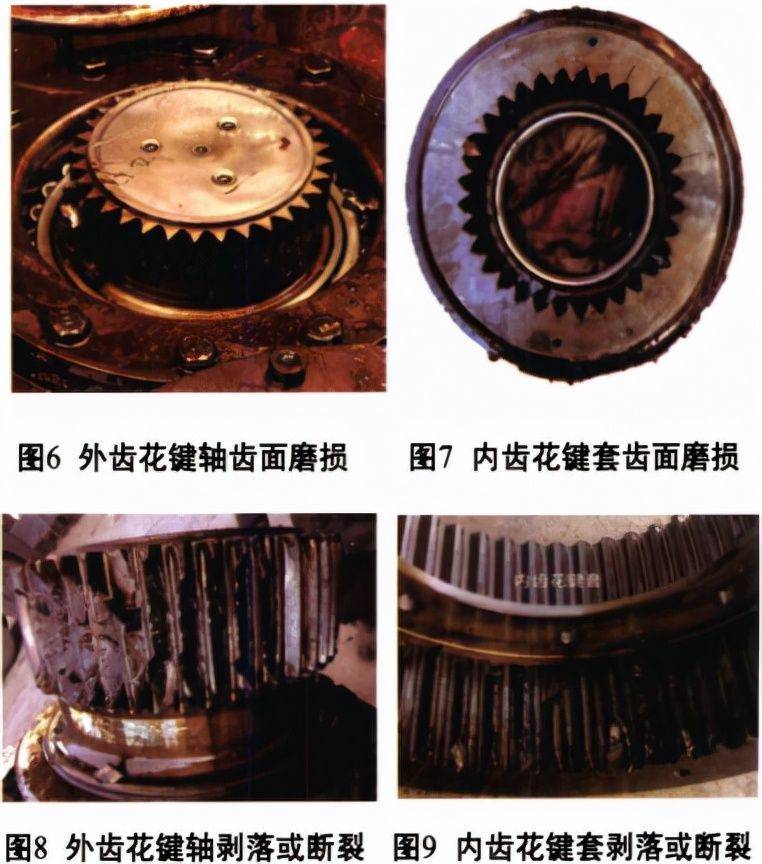
The parallel axle external dents, inner dents and solar wheels are what we often call "three sets". In the design of the slowing machine structure, consideration is generally given to the role of the “three sets” as a system insurance policy, which is slightly less rigid in quality, the lack of relative movement between the “three sets” and mainly the transmission of the twist (like a flower key), and the fact that the absence of compulsory lubrication of the central and inner gears, and the presence of poor lubrication, makes the “three sets” of parallel outer and inner-axis cogs extremely vulnerable to damage, in particular the inappropriate operation of grinders, which cause frequent start-ups, stop-overs and the greatest instant impact on the “three sets” by other system failures. Common damage begins with abrasion of the surface of the parallel axis external and inner dents (see figures 6 and 7) and later can develop into carving, stripping or broken teeth (see figures 8 and 9)。
2. 2. 5 equipment assessment
The grinder and speed-reducing machine bases are shaken, the earth's ankle bolts are loosed or fractured, leading to deviations in the original concentricity of the electric and speed-reducing machines, an increase in grinding and speed-reducing machines' vibrations, and a deterioration in the operation of the whole machine resulting in a reduction in the safe life of the speed-reducing machines。
03
Fault maintenance
A company that currently has four mills has gained more experience in the maintenance management of speed-reducing machines and has developed a core scientific management philosophy: enhancing day-to-day professional inspection and cyclical operational status testing is the norm, with a core service life of bearings, with a focus on preventive maintenance。
3. 1 inviting teams of specialized speed-reducing machines to come in
The bulk of the mills, the high tonnage (mlx 200 60t, jlp 400 105t) and the cost of re-entry maintenance would inevitably be high. To this end, it has taken full advantage of the timing of the windfalls of production by inviting teams of specialized slowdownrs to the plant, carrying out systematic on-site maintenance of large grinders, and carrying out planned purchases and replacements of inventory components such as bearings, oil seals and gears by means of site dismantling, cleaning, detection and diagnosis。
3. 2 selective on-site and return maintenance
On-site and back-to-work maintenance is selective. In order to ensure the quality of assembly, assembly components with high process requirements can be returned to the plant for repair, such as high-speed axle totals, planetary shelf totals, secondary parasols, etc.; the rest can be fully adapted in situ, thus saving over 80 per cent of the return freight costs。
3. 3 processing of brake base
After a few years of operation, the brakes are based on varying degrees of shaking. A steel base is attached to the general grinder floor (see figure 10), which is often “self-heavy” or “high-level funnel” and uses epoxy resin slurry for secondary irrigation, which is highly mobile, has a small volume contraction rate (approximately 1 to 2 per cent) and is filled free to move within the slurry。
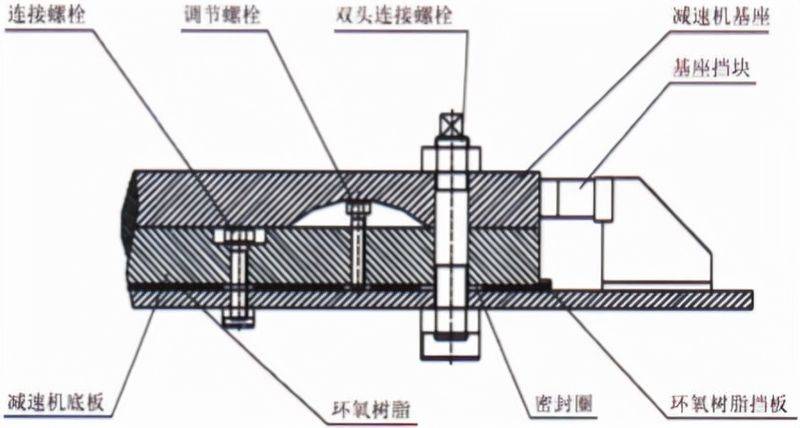
Figure 10
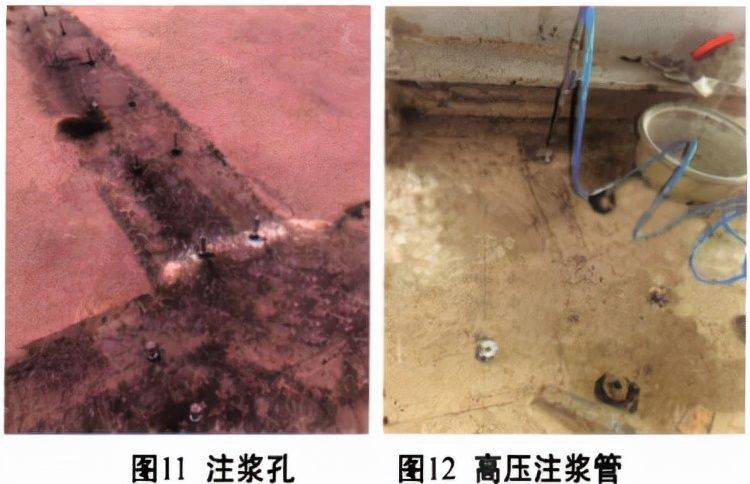
The main reasons for the brake base are two: the pre-filled foot bolt of the steel floor or the flexing of the brake floor fixed bolts (see figure 10); and the fact that the two-time slurry filling of the steel base at the initial loading of the brake machine is insufficient. To deal with the above, the speed-reducing machine must be pulled out of the floor as a whole, then the speed-reducing machine floor must be removed from the steel floor and the pre-replaced foot bolts must be checked on a case-by-case basis. If the bolts are not loose, then the steel base is struck with a hammer, and if the sound of “dinging” indicates that the slurry layer is dense; if the sound of “thomping” indicates that the slurry drum is empty, the epoxy resin slurry must be pumped with “high pressure”. Since the high-pressure slurry machine can work at 50 mpa in a few seconds, the slurry must be preceded by a straight steel base level and a solid, solid foot bolt with a cushioning iron, a magnetic drilling of the slurry hole of 12 in all the slurry areas, which is controlled from 200 to 300 mm at intervals, and a nailing of the slurry needle into the slurry hole (see figure 11), which is linked to the high-pressure slurry tube and is then sprouted (see figure 12). The temperature of the environment must be observed in the plasma (require: 15-25°c), completed as soon as possible in a continuous manner, to ensure complete contact with the bearing surface after the final formation of the slurry layer and maintenance of 24h after the slurry is completed。
04
Concluding remarks
The paper summarizes the large high-speed grinder on-site inspection of the prosecution, the common cause of failure and the maintenance of failure. In general, the failure of a large high-speed grinder is dependent on a professional inspection, a skilled and experienced maintenance team and a professional management approach. While the experience of equipment inspection and maintenance management is important today as science and technology progress, the introduction of new technologies will yield better benefits, not only by abandoning the post-facility maintenance model and introducing forward-looking maintenance, but also by establishing a whole-life system of equipment management that will shift the equipment manager from a simple “dependency of equipment functions” to a “mechanism of equipment functionality and economy”, from a one-sided “purchasing for equipment integrity” to a “highest efficiency of equipment integration”, with greater emphasis on tube-types throughout the equipment life cycle。