


Thread steel theoretical weight table
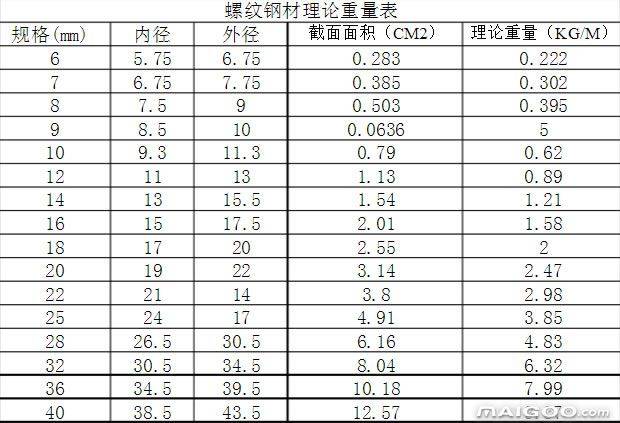
Table 1
Sniff steel specification type:
General screw steel specifications should include standard plate numbers (type codes), common diameters of steel bars, common mass (mass), specified lengths and margin values for the above indicators。
Our standard recommends screw steel series with a common diameter of 6, 8, 10, 12, 16, 20, 25, 32, 40 and 50 mm. The length of the supply is divided into two measures。
Our export screwdrivers range from 6 to 12 m, and japanese-produced screwdrivers range from 3. 5 to 10 m; in the case of domestically-produced screwdrivers, they are normally 9 m and 12 m in length, if not specified in the contract。
Thread steel command rules:
1 surface quality. The standards provide for the surface quality of screwd steel, requiring that the end be flat, that the surface be free of cracks, scars and folds, and that there be no harmful defects in use, etc。
2 exterior size deviation allowed. Requirements for the bending and geometry of screwdrivers are specified in the relevant standards。
Sniff steel specification sizes:
1) common diameter range and recommended diameter
The common diameter range of steel bars is 6 to 50 mm and the standard recommended steel bands are 6, 8, 10, 12, 16, 20, 25, 32, 40, 50 mm。
2) visible deviations in the shape and size of the surface of the ribs
The ribed steel design principles shall conform to the following provisions:
The crosswinds shall not be less than 45 degrees per cent of the angle of the length of the axes, and when the angle is not greater than 70 degrees, the direction of the upper sides of the length shall be the opposite。
The length of the rib shall not be greater than 0. 7 times the diameter of the band。
The cross-banded and steeled surfaces shall not be less than 45 degrees of α。
The sum of the gaps (including the width of the ribs) between the end of the sides of the bars adjacent to each side shall not exceed 20 per cent of the contours。
The relative ribs area shall not be less than 0. 055 when the diameter of the band is not greater than 12 mm; the relative ribs area shall not be less than 0. 060 when the diameter is 14 mm and 16 mm; and the relative ribs area shall not be less than 0. 065 when the diameter of the band is more than 16 mm. The calculation of the relative rib area can be found in appendix c。
What's the screwdriver process
The screwdrivers are made of small rollers, which have a popular, high-speed roller and a high-yielder four-tanger. The screwdriver production process is a step-by-step boiler-to-roller coil-to-roller-to-screw-to-screw-to-screw-to-screech-to-screech-to-screen-to-screech-to-screech-to-screen-to-screen-to-screen-to-screen-to-screen-to-screen mechanism。
The fabric used in successive mini-rollers is usually co-mingled, usually with a length of 130 ~160 mm and a length of about 6 ~12 m and a single weight of 1. 5 ~3 tons. Ride lines are often set in a flat-on-stand altercation to achieve full-line, non-reversible rolling. There are 18, 20, 22 and 24 small rollers, 18 of which are in the mainstream, depending on the specification and size of the product. The rod roller is based on new processes such as step-by-step heating furnaces, high-pressure water slab removal, low-temperature roller, no-head roller, rough roller, medium roller to adapt to the large smelter and to increase the precision of the roller, which mainly increases accuracy and speed (up to 18 m/s). The product specifications are typically 10-40 mm, or 6-32 mm or 12-50 mm. The steel produced is a low- and medium-sized high-carbon steel and low-alloy steel that is widely needed in the market; the maximum is 18 m/s。



