It's a man who's born lazy, but who's also an acute child, and who's the most enjoying being served by technology。
For example, more than a decade ago, in an era of widespread cash use, small-scale shop shopping lined up for bills, and every time you see a cashier looking for a change of arms, you're so desperate that you can't just walk away with something. At that time, the young editor had a tight fist and dreamed that he would have to create a way of not finding change。
This dream, which was born in the heart for many years, was realized and enjoyed by the rest of the disillusionment. It's easier to pay with a mobile phone sweep than cash. But god knows that the writer lazy cancer + urgent cancer is in its final stages, and it's been a long time that he thinks it's too difficult to carry a sweep and enter a password. So the subsequent payment of fingerprints saved the novel。
Later on, even the finger was not moved, because of the “painting of the face” and the excellent experience of iphone in his hand, which had to be said to have killed the author。
Well, after years of obscuring in the technical atmosphere of the it house editor, after paying for his long waiting period to save him from his agitation and anxiety, he felt the need to tell you what a "brush" is, or to thank you
By definition, the key technology behind this is face recognition。
Don't look at those two years of heat because of the use of smartphones, when the earliest studies of face recognition techniques dated back to the 1950s, when scientists were already studying the extraction methods of the profile of the human face, but were limited to the level of technology, where research had stalled until the 1980s, when new breakthroughs were made in human face recognition methods, the introduction of relevant knowledge of neurophysiology, neuronology, visualization, etc., and the introduction of human face recognition into new stages of development。
Thus, human face recognition at this stage is not a single technology, but a combination of various disciplines such as neurophysiology, neurology, computer vision, etc. In essence, however, it is a computer visual technology。
Of course, the focus of this article at it house is not to review the history of face recognition, but to tell you about some of the underlying principles behind face recognition。
Basic logical structure of the human face recognition technology system
It is natural for us to use face recognition techniques to unlock cell phones and pay off, but it is believed that few of our students think deeply about the process behind this technology。
As we said earlier, computer vision is the most relevant technique for face recognition. So we start with that。
Computer visualization, commonly speaking, is the replacement of human eyes with devices such as cameras, the acquisition of images, the processing of image information by computers, and the integration of human cognitive patterns to construct computational theories of human vision。
The most difficult of these is undoubtedly how to deal with image information and how to simulate human cognitive patterns。
In order to address these problems, computer vision also introduces knowledge of such disciplines as image processing, model recognition, image understanding and image generation。
Image processing is the conversion of the original image into an image that can be more easily identified by the computer; mode recognition is the process by which the computer determines what it wants to recognize and how; image understanding is the analysis of the scene described in the image; image generation is, for example, the ability to add missing information when part of the image is missing..
These are scientific techniques that computer vision needs to use. In this, we would like to focus on model recognition, which is an independent theoretical system, specific to applications in the computer visual field, which represents a process of matching images expressed by computers with consistent categories。
It's kind of hard to understand. It's called "identifying" for everyone. Know what? Images and the characteristics of target objects summarized from images are recognized. How? It is to compare the characteristics that have been drawn up with those that are already in their possession, and then to distinguish them。
We humans identify the same objects, following that logic, summarizing the characteristics and then matching them. As for the preceding “model”, it's a little abstract, and you can understand it as a pattern that influences the outcome of the character and type。
That's right. Face recognition is essentially the process。
So let's look at the whole process along the lines of model recognition: pre-processing, feature extraction and classification. We drew the following flow chart:
Pre-treatment is the first step, but this part of the work may be very complex, such as reducing noise interference in images, improving clarity, and also including image filtering, transformation, transcoding, model conversion, etc。
Characteristic extraction is the extraction of features in pre-processed images that have a clear effect on the identification of features and, in the process, reduces the dimensions of the pattern characteristics to make them easier to process. This is a complex process that will be reflected when we talk about specific methods
Classification is the classification of derived characteristic values according to certain criteria to facilitate decision-making。
For example, the computer needs to identify the man in this picture, and when it gets the picture, it may feel too dark, with a brightness, and then it discovers too much noise, and then it does a noise reduction, and then it feels okay, and then it turns it into digital information, and the process is pre-processing。
The derived characterization values will enter a separate characterization space, as they can be better identified and classified. And then we're going to sort out the data in the feature space, and we're going to turn them into eyes, noses, hairs... Based on these disaggregated data, computers are able to make identifying judgements and make decisions。
Of course, in order to facilitate the understanding of this logical process, it house here is simply a rough example of possible inaccuracy and the complexity of the actual steps, taking into account the various factors of interference, such as lack of clarity of image quality, complex background, uneven distribution of image light, distortion of target position angles or wearing of head coverings, glasses and beards, makeup, etc。
It is also important to note that this model recognition system requires a process of self-training and learning, the most important of which is training in the previous classification error rate (classifier training), since in the previous classification we cannot guarantee that the classification results are 100 per cent correct, but must be controlled by, for example, a certain rate of error, which must be constantly revised through a large number of training samples, so that the error rate meets the requirements。
Okay, based on the above discussion of computer visualization, we can give the main functional modules of the human face recognition system:
There may be a small partner who feels that the functional module above is too simple, so let's be more precise and give the following logical chart, which we believe is easy to understand:
Mainstream approach to face recognition
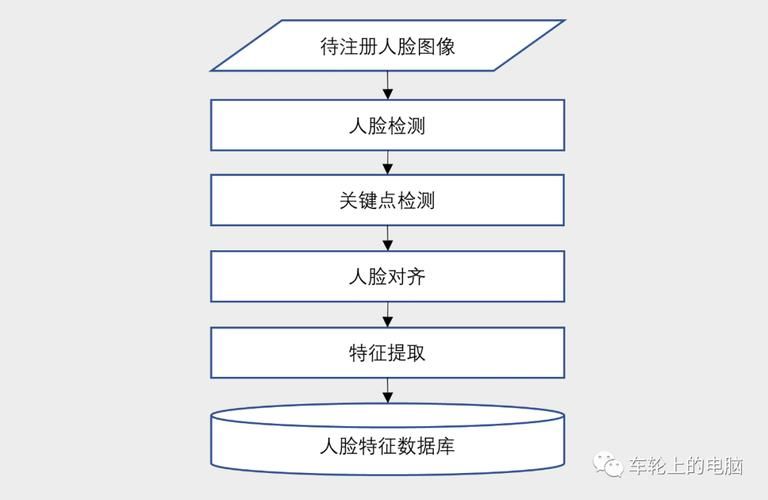
In the above section, we mainly describe the basic logical processes of face recognition, which are in fact more similar in the sense of extracting features from images and converting them to a suitable subspace in which similarity or classification is measured. But the question is, what is the coherent and effective expression of an objective world? How do we find suitable subspaces and how do we classify them so that we can distinguish between different categories and gather similar categories? Many methods and solutions have emerged to address these problems。
So what we are talking about is the generality of human face recognition, which is, in fact, a collection of many techniques and methods。
We may wish to build on the logical chart above。
1. Pre-treatment
The pre-processing of human face images, which is not much to say, includes, among other things, the elimination of noise, the homogenization of greyscales, geometric corrections, which are generally available algorithms and are more basic. It should be noted, however, that the main point here is the pre-processing of static human face images, which is complicated by the pre-processing of dynamic human face images, which are usually divided into a set of static human face images, followed by marginal detection and positioning of the human face, which is not performed in a series of processes。
2. Feature extraction
The extraction of image characteristics is a more critical step (the passage of mode space to feature space, as described above), but also a relatively early step for image processing. There are many methods of extracting images, but in fact we think that the characteristics of the images are usually classified, such as color characteristics, texture features, space relationship characteristics, shape features, each of which is matched, with some of the more classic and useful methods, such as the hog feature method, the lbp feature method, the haar feature method, etc., and certainly not one by one, so one of the hog characteristics methods is chosen here。
The hog feature, also called the direction gradient histogram, was presented in a doctoral thesis by navneet dalal and bill triggs in 2005. Let's just see how it works。
We take this picture, for example, and the first step is to turn it into a black and white picture, because here color information does not help to identify。
In this black and white picture, we look at the individual pixels, look at the pixels around it, see which direction it's going to darken, and then point the pixels in the dark with an arrow。
If this is done for each pixel, then all pixels will be replaced by such arrows, which indicate the direction in which the pixels will change. Each of these arrows represents a clear dark gradient。
In fact, for every pixel, the given coordinate system, we can find its gradient direction value. The method of calculation is complex, and we need not know, but simply that this step is to capture the profile of the target while further weakening the interference of light。
If extracted in this way, the calculation would be substantial. So we'll split the image into a small box of 8x8 pixels called a cell, and then calculate the gradient information for each cell, including the size and direction of the gradient. And what you get is this cell's 9d signature vector。
I'm sure there's some confusion here. The it house then explained to the small partners that the purpose of this step was to build a histogram of the direction of the gradient for each cell, which is a strip of statistics well known to all of us. In this histogram, the x-axis is the compartment that divides the direction, and navneet dalal et al. Study indicates that the nine compartments have the best effect, and each section represents 20° if the direction is 180°. The y-axis indicates the gradient size within a given direction. So it's the character description of each cell。
That's about it
A further step here is that if your images are more affected by light, you can also make up a certain cell of a block, such as 2x2 cells, so that each block is a 36-d characteristic vector, and then regularize the 36-d characteristic vector (specifically, knowledge of advanced mathematics is not needed。
If the size of the image we enter is 256 x 512 pixels, then 32x64 = 2048 cells, 31x63 = 1953 blocks, with a 36-dimensional vector for each block, the image is 1953x36 = 70308. This 70308-dimensional vector is the hog signature vector of this image。
Of course, you can't understand the steps above, but you just need to know that the final original image was presented as hog, as follows:
And then in this hog form, we find in our library the most similar parts of some known hog style。
3. Image recognition
Human face recognition techniques have evolved over many years of research and development by scientists in a variety of research directions and more diverse research methods, including, if combed out, methods based on geometry, templates, models-based approaches and others。
The geometrical approach is relatively early and traditional, and it focuses on geometrical descriptions of the shape and structural relationship of organs such as human face eyes and noses as important features of human face identification。
The basic idea of the template-based approach is to compare the existing template with the same size of the area in the image, including methods based on relevant matching, feature face methods, linear analysis methods, neural network methods, etc。
The model-based approach is oriented towards characterizing the salient features of the human face and then coding the human face, using the corresponding models for processing to achieve human face recognition, such as the hidden markov model, the active shape model and the active appearance model methodology。
Different faces recognition algorithms
In the field of human face recognition, there are some more classic algorithms, such as the eigenface, the partial binary mode, fisherface, etc., although the it house here still finds it better to keep up with the times, so an example of a more widely applied and popular approach is now known as openface. Of course, we don't do actual tests, but we do it to understand the principles of recognition。
Openface, which is a model-based approach, is an open source bank that includes functions such as landmark, head position, actionunions, eye gaze, and an open source face framework for training and testing all source codes。
In the preceding steps, the it house has shown you how to extract characterization data from the human face in the image, i. E., it has been successfully detected。
There is also the problem that this person's face appears to be in a less “positive” position, and that the same person, if she is in a different position with different faces, is still able to recognize her, and the computer may not recognize her。
One solution to this problem is to detect the characteristics of the main features of the human face, which are then calibrated against them. Vahid kazemi and josephine sullivan developed the method in 2014, which gives important parts of the human face 68 feature points (landmarks), which are fixed, so they can be found in any face with some training in the system。