


Purpose of the omission:
1. High-efficiency air filter materials are non-destructive
2. Appropriate installation。
The filtration efficiency of the efficient filter itself is generally tested by the manufacturer with a filter filtration efficiency report and certification. For pharmaceutical enterprises, high-efficiency filter leaks refer to on-site leaks following the installation of high-efficiency filters and their systems, mainly examining small needle holes and other damage in filter filter filter filter filters, such as frame seals, gasket seals and leaks in filter frames. The purpose of the leak is to ensure the cleanness of the area by checking the sealing of the efficient filter and its connection to the installation framework, and by detecting the deficiencies of the efficient filter itself and its installation in a timely manner and by taking appropriate remedial measures。
Method for efficiency filter leakage
The high-efficiency air filter leak test essentially places challenging particles upstream of the high-efficiency air filter and then uses the high-efficiency air filter surface and frame to search for leaks using particle detection instruments. Leak tests are applied in several different ways and in different contexts。
The tests are as follows:
1. Aqueous photometer testing
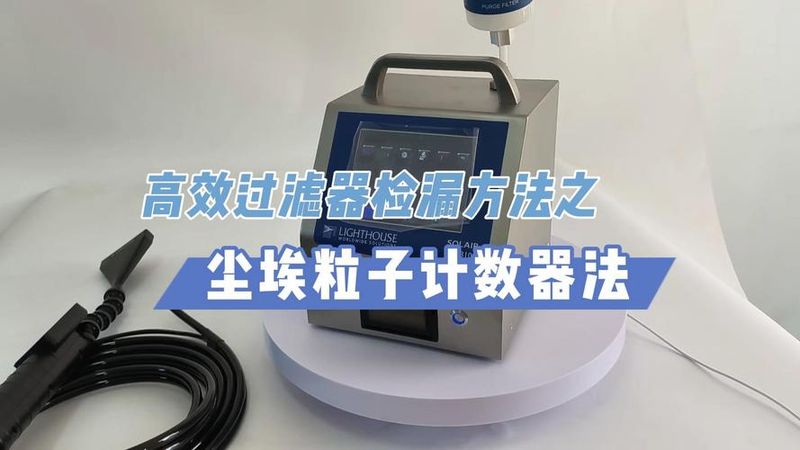
2. Particle counter test method
3. Full efficiency test
4. Extragas test method
These are described below。
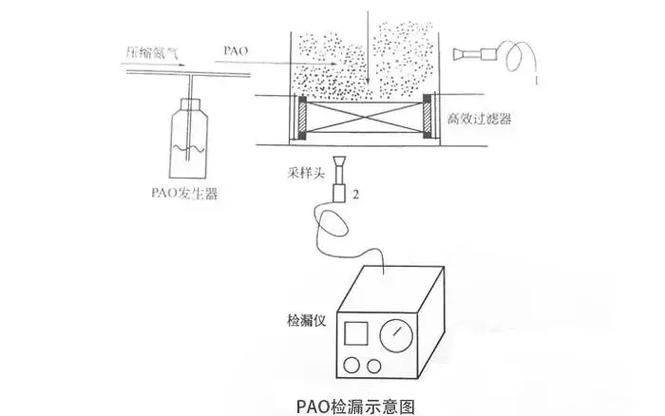
Pao's leak is aerosol photometer test
Aerosol photometers:
The pneumatic photometer test is an early test, but it is still used today because it works very well。
Aerosol photometer (aerosol photometer) is a particle counter that uses laser technology, but after scanning the particles in air samples, it gives the overall strength of the particles, not the number of particles. Dop is an oily chemical substance that, after pressure or heat fogging, can produce particles of a sub-mit grade that can be simulated as dustless particles and are therefore considered as authentic particles. Leaking is defined as the leakage of one tenth of the upstream concentration, and it is convenient to scan efficient air filters because the aerosol photometer can directly show the margin of upper-downstream particulate concentrations. It is also because of its accuracy and reliability that the united states food and drug control agency (fda) requires the use of dop and aerosol photometers for all efficient air filter leak tests within its jurisdiction (food processing sites and medical laboratories)。
For some time now, because of suspected carcinogenic effects on humans, dos is also known as dehs
D (2-ethylexyl) sebacate
Alternatives such as pao (polyapolefin a polyolefin), but the experimental method is still called the “dop act”。
Air dust is sometimes larger and sometimes lower due to changes in concentrations over time and location, and is generally not used as a detection. Fda states that, in the event of leakage, the selected aerosols should meet certain physicochemical requirements and should not be used to cause microbial contamination and breeding。
The dop generator can be classified as a heat occurrence and a cold occurrence, using the principle of evaporation condensation, evaporates in aerosol particles which are aerosolated and condensed into microlitter droplets under specified conditions, leaving behind mists of around 0. 3um by dop entering the wind channel, with particles distributed between 0. 1 and 0. 3um. A cold generator is a multi-dispersive dop aerosol that uses compressed air to drum bubbles in a liquid, produces a physical state through laskin nozzles,* with a large distributed particle size around 0. 65um. There are more hot dops currently commonly used, so the efficiency of filters is assured。
Test instrument:
The instruments are the aerosol photometer (aerosol photometer) and the particulate generator (aerosol generator). The pneumatic photometer is shown in both analogies and numbers and must be corrected once a year. There are two types of particle generator: an ordinary particle generator, which requires only high pressure air, and an heating particle generator, which does not need correction for high pressure air and power。
Tools/materials
Methodology/step
... To record and number the number of efficient air filters on the surface. The air-conditioning system is established to function and is available for testing, and the wind speed and volume need to be rebalanced. Using aerogel generators, challenge particles are applied upstream, and paos are injected into high-efficiency air filters at concentrations of about 10 to 20 ug per litre of air. The more particles there are, the easier it is to find a leak, but the difference after more than 50 ug is small and less than 10 are difficult to use. Particle concentrations can be calculated with rough wind volumes and confirmed with aerogel photometers. Upstream particulate concentrations are confirmed, and high-efficiency air filter surfaces can be scanned for leakage, and plastic curtains can be used around high-efficiency air filters to ensure accuracy of testing when necessary. Scanning of high-efficiency air filter surfaces, with a scanning path that can be detected externally, either internally or on long/short edges, as follows:
Each efficient air filter and its borders shall be tested。
B. When an efficient air filter is surfaced, the leak detector is displayed as (b), moving in a short side, covering the fully efficient air filter。
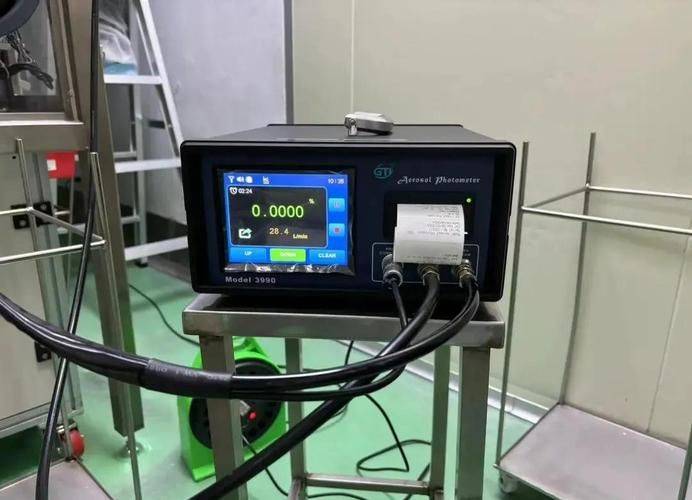
C. When scanning the high-efficiency air filter border, especially between the high-efficiency air filter and ceeling grid, the leak detector can be placed as (a) or (b) above and cover all seams。
D. The sampler using a square cone (10 mm*60 mm) of the particle counter is placed under an efficient air filter of about 25 mm, at 50 mm/sec speed。
E. The reading on the aerosol photometer is an upstream/downstream percentage value, so that if the value is greater than 0. 01, it is suspected of leakage and can be returned to approximately 100 mm for repeated detection or, in the absence of continuous high reading, continue to be tested, and vice versa, with a leak to be recorded and subsequently repaired or replaced。
6. If the air filter is damaged, it should be repaired or updated and recalculated。
In the event of leakage, the border shall be re-installed and adjusted until no leakage occurs。
The records must include the results of the scan, the leak status and the manner in which it was handled。
Previous article: three ways to check if the high-efficiency filter is leaking:



