


Those who have made hardware know that magnetic sensors are everywhere. The electronic compass in your cell phone, the electric controls in your electric car, the speed of the water flow in your factory, all on it。
But when many engineers choose magnetic sensors, the concept in their head is vague -- "holl? I've heard it. Amr? I think so. What the hell's a fuck
This sensor has been reviewed today and how the corresponding sensor is selected on the basis of the application. After reading this, you're at least six months less in a curve。
Classification of magnetic sensors
Magnetic sensors are not four parallel routes that come out of space; they evolve from generation to generation。
First generation: hall effect, 1879。
Oldest, maturest, cheapest. The principle is simple enough to finish with one sentence -- electricity flows through a semiconductor, plus a vertical magnetic field, and the side generates voltage。
Second generation: amr, found in 1857, commercial late in the twentieth century。
Twenty times more sensitive than hall. The electrical resistance of the electromagnetic material changes with the magnetic direction and the angle of the current。
Third generation: gmr, discovered in 1988 and awarded the nobel prize for physics in 1997。
Sensitivity is another step up. The structural composition of the iron-non-magnetic-iron-magnetic sandwich changes in the direction of the two layers of magnetization。
Fourth generation: tmr, commercial at the beginning of the century。
Current ceiling. Sensitivity is more than 20 times that of amr, and power consumption is reduced to micro-anthromatic levels, with a minimum of 0. 5 x 0. 5 mm2. The core principle is the quantum penetrator effect - the probability of electron "walling" across the insulation is controlled by the magnetic field。
In one sentence, the evolutionary logic is summed up: increasingly sensitive, low-volume and small, but high-cost。
Core parameter comparison: this table is worth collecting
Not to mention, this table was accumulated from various data manuals and applied notes and suggested that it be kept directly。
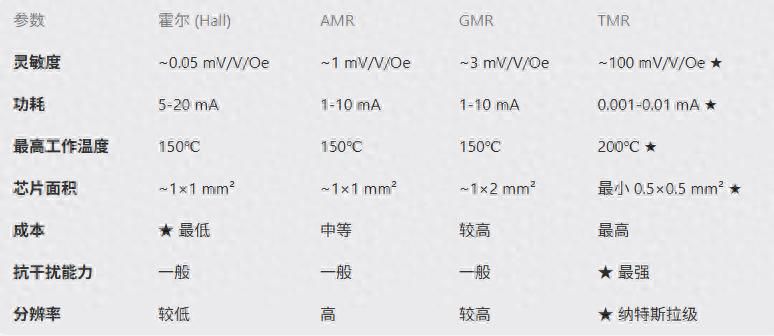
A few key numbers to help you build a hunch in your head:
The sensitivity gap is measurable. The tmr's 100-to-halle's 0. 05, it's not "better," it's 2,000 times the difference。
The gap in power consumption is also quantitative. Tmr works at the micro-level, and hall at the m-level, three orders of magnitude. The situation where batteries are supplied is the difference between six months and three years。
Don't underestimate the temperature. At the industrial site, 100°c or more, hall, amr and gmr are all capped at 150°c and only tmr can carry 200°c. Looks like it's only 50 degrees more, but in some applications it's a difference。
The application of each technology
Hall: the almighty
Don't underestimate the word "cheap." in consumer electronics and low-end industrial scenarios, the cost is the way of the king。
Typical application:
Bldc's remodeling
Power current detection - co-ordinated with polymagnetic rings, quarantine measurements, cheap and reliable
Switch-like scenario -- cell phone open-cover testing, door and window magnetic switch
Automobile basic applications - curve axis position, abs wheel speed
When do you choose hall? A tight budget, a strong magnetic field, a low-precision scenario. Quantified and ecologically mature, with suppliers everywhere。
When do you choose hall? Weak magnetic field tests, high-precision measurements, battery power scenarios -- it'll make you miserable。
Amr: high value for money
Amr is the most undervalued magnetic sensor technology i think。
Sensitivity is 20 times higher than hall, costs are only slightly higher and temperature stability is good. A lot of engineers know hall and tmr, but in the middle they ignore it。
Typical application:
Angular encoders -- perfect balance of accuracy and cost with magnets doing 360 degrees
Electronic compass — directional perception in mobile phones and wearing equipment
Industrial automation - mechanical arm angle, machine-bed positioning
When to choose an amr? Medium precision requirements, angle measurements, cost-sensitive but not enough for hall。
Important reminder: amr has a big problem -- it's "disrupted" by a strong magnetic field that needs to be restored by the set/reset loop. Don't forget this when you design it, or you'll drift with precision。
Gmr: once king, now chicken ribs
The discovery of gmr won the nobel prize, and all hard disks achieved tb-level capacity. But as an independent sensor, it is now in a somewhat awkward position。
Better than hall and amr, but less than trr. Cost is higher than hall and amr, but performance advantages are not sufficient to open the gap。
Typical application:
Hard drive reading and writing -- this is its old line, and it's still in use
Electrical current sensor - quarantine current detection in electric car bms
Industrial detection - metal crack detection, pipe corrosion monitoring
When will gmr be chosen? Like hard drives, biotransmission, or as a transition from amr to tmr。
To be honest, there are fewer opportunities for gmrs in the new design. Unless you have specific historical reasons or cost considerations。
Mr: mainstream of the future, but now expensive
Tmr is the ceiling of current magnetic sensor technology. Sensitivity crushes the other three, with the lowest amount of effort, the smallest volume and the strongest resistance to interference。
But most expensive。
Typical application:
Electric car core — electrical location detection (replacement of rotary transformer), high accuracy current transfer, adas
Robots - human robotic joint angles, spatial perceptions, barriers
Consumer electronic frontier - ar/vr tracking, touch pen detection, high-precision electronic compass
Medical - heart magnetic map, brain magnetic chart, natsla level resolution
When do you bite tmr? High-end cars, robots, medical devices — these scenes are highly accurate and reliable, and the cost is secondary。
Trends: tmr manufacturing is rapidly mature and prices are approaching gmr. Tmr is expected to become the mainstream choice for medium- and high-end markets around 2030. It's not too early to make a technology reserve。
Selective decision-making channels
Can't remember those parameters. Just remember this decision chain:
The budget is tight, hall
General budget, angle precision
High sensitivity plus low power
(gmr: unless you have a special reason)
Add three additional items:
Working temperature - more than 150°c to see tmr only
Power supply - battery power supply priority tmr (three order of magnitude for power consumption gap)
Magnetic field strength - weak magnetic field (what are the plants on the market)
The global magnetic sensor market was about $3 billion in 2025 and is expected to reach $4 billion in 2031. The growth does not seem to be high (about 5 per cent of cagr), but it is not deceived by the average - the tmr subdivision market is growing at a much faster rate。
International manufacturers:
Allegro, tdk - automotive sensors
Infineon, melexis - main magnetic sensor power of the car code
Nxp, akm - consumer electronic direction
Nve, sensitec-tmr technology leader
After all these years of hardware, my biggest sense of magnetic sensors is:
Don't just look at the data manual。
The parameters in the data manual are measured in ideal laboratory conditions. At the industrial site, temperature drifts, electromagnetic interferences, vibrations, dusts each makes your design and your expectations a gap of 18,000 miles。
And one more thing -- don't ignore the tmr learning curve. If your team's only done hall before, it's going to make a lot of holes in signal regulation and jamming design. It is suggested that the rationale be first examined with the evaluation panel and then placed in the actual project。



