Switches are electrical components that control the closing and disconnecting of lines, working mainly in both states of “closed” and “disconnected”, and below we present their underlying principles of work with open load switches and buttons。
1. Activation of open load switches
The open load switch is used as a component for manual, low-frequency connection and break-off circuits. It works in a simple manner. The line is connected when the china handle of the switch is manually operated, and when the movement and acoustic point is closed, the line is cut when the china handle of the switch is manually operated and the motion and accelerator are separated. The course of work is shown in the chart。
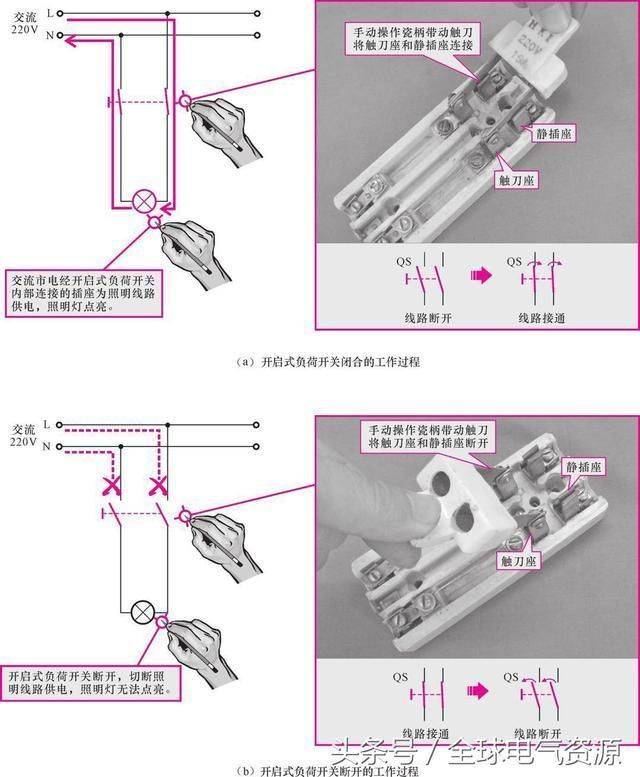
A diagram of the working principles of the open load switch
In addition, depending on the technical parameters of the open load switch, the rated currents allowed to flow through the fuses are not the same and can be protected by passing through different circuits。
2. The operation of the button
The button is used as a main command electronic, mainly to give a remote control signal or instruction to control relays, contacts or other load equipment, and to connect and disconnect the control line to achieve control of the load equipment。
The working process of the button is the process of closing and breaking the contact points when pressing the button. The following is an example of how the typical composite button works, with other types of buttons being identical or similar。
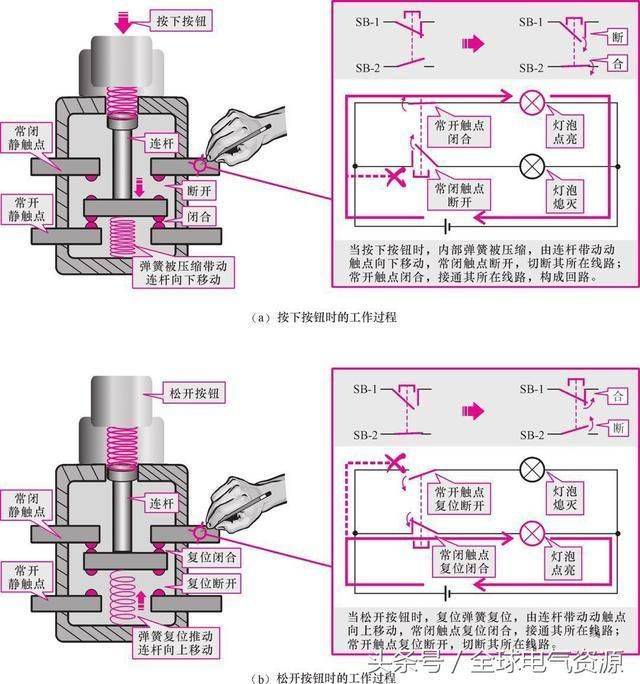
Composite button means that there are two sets of contact points inside the button, with switches for both the constant and the constant closed points. Before the operation, the constant closed contact points are closed, the frequent open contact points are disconnected, and two sets of contact points act simultaneously when operating the buttons. Composite buttons are often used to activate the chain control buttons. The figure shows the basic course of work。