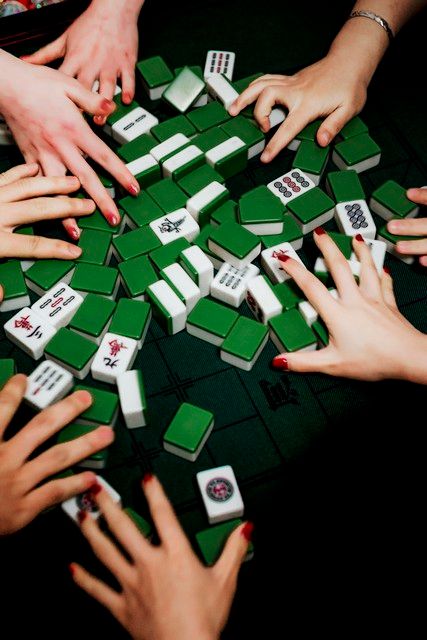
Friends who often play mahjong should feel the same way, and winning cards is really not entirely by hand。
Sometimes the hand is flat all night and they can't catch a good card, but others take a piece of the hustling and point at themselves; sometimes the hand is so beautiful that they look like they can make a big card, that they get more and more confused and end up not only free of bull's eye, but also sending guns to others。
I played mahjong for more than a decade, and many games were played by the underline family and friends bureau and the leisure and entertainment board, slowly discovering the truth: mahjong loses his new hands in luck, his old ones loses in chaos, and those who truly win in the long run, never on chance, but on a fixed card logic。
Today, we share with you the mahjong three three principles that i have summed up in the field, which are all full-blown words, no hard-to-understand professional terms, and can be used by ordinary people. As long as the rules of these three three are adhered to when playing cards, you will definitely be able to go up the stairs and lose。
The biggest problem for many is to play mahjong as they wish, to touch it, to play it, to play it, to play it, to feel it, not to look at the situation at all, not to remember the cards, not to know the choice. The three or three principles, which are designed to help ordinary people regulate the way they play cards, and to change the wrongs that they play with their hands, be they mahjong sichuan, guangdong or the public, are generally common。
And i'm going to open it up, and i'm going to tell you that every one of them is real, and i'm going to suggest that you take a good look at it and use it against it。
The first three are fixed. Fight
As you know, mahjong's first three cards are the key to the game, and it's a direct decision on the direction of your card。
Eighty per cent of the new players are in a hurry to make their cards when they're ready for the game. They play single cards, touch cards, and they don't plan hand-card structures at all. The beginnings are so busy that the whole of the back is passively followed by the opponent, and the losing card is normal。
The three initial lines of thinking are three words: steady, perceptive, and organized。
First of all, it's steady. First three rounds, there's no corruption. Many newcomers have just taken the cards, and they see a single hand, a nine card, and they hit it with their hands。
There's no point in you rushing to open a game when everyone doesn't look like they're playing cards. It's easy to listen to cards in the middle of the day. You've got dangerous cards in your hand and you're forced to light them。
The right way to play is to start the first three priority cards, which are well-established, multiple and undesired, to stop playing cards and not to create opportunities for each other。
Then the first three rounds must learn to observe the three rules. Play cards is not a human game, four against each other, and every card of the opponent is hidden。
You have to see what the first card to play is for the top and upper. If all three are playing cards and cards, which means that everyone is making cards, the situation is calm; if someone starts playing cards, they are playing cards, and they're playing cards, and they're playing cards, and they're playing cards, and they're playing cards very quickly。
Finally, the first three cards, fast-tracked their own hand game. After 13 cards, it took three seconds to take a look at them: there are not many cards in hand, there are no pairs, there are no balconies, there are no possibilities for a big card。
If the hand is broken and the hand is broken, the idea of making a big card is given up decisively, with a quick pick-up and a run-in, and it's free and easy; if the hand is in order, the hand is in full supply, the pair is full, then the plan is to make a big card。
Once the idea of starting the game is set, the whole game is in the right direction, and it's not going to get lost in the middle of it, and it's the most fundamental step in winning。
The rules of the third round are better than the rules
The central reason for many to lose cards is to touch and talk。
I've seen so many players, no matter what cards, who can touch them, who can touch them, who thinks they can hear them faster, who can win more. In fact, the blind bumping is the deadliest mistake of a rookie playing cards, seemingly fast-tracking, and he destroys his hand。
The second centrepiece of the three three principles is the first three rounds, the third of which is steady, and the third of which is not blind, bearing in mind the rhythm and doubling the mass of the handplate。
First of all, the first three rounds。
The first three rounds of the game, everyone's adjusting their cards, and your job is to sort out your cards, not to touch them. A lot of rookies started two pairs, others hit it right away, and when they ran out, the handplates became shorter, so that they could have been put together in a series of cards, and the cards were scattered。
And more importantly, it's like telling three people that my hand is in shape and listening fast. When the opponent receives the signal, the cards will be closed and the cards you need will be withheld。
Unless it's a key card that can be played directly, or if it's quickly shaped, the first three rounds of the game will always be free and will not be touched at will。
Then the third round, only the key, and not the waste。
When the game hit the mid-point, around 7-8, the situation was clear and the cards could be touched on a selective basis, but in no way at all。
What's the key card? When you're done, you can get your hand in hand, you can listen to the cards, and you can optimize the whole card。
If you touch a card, instead of making progress, your cards add up to a lot of single, wasteful cards, disrupting the original charlatan rhythm, which is one that you will not touch。
Many do not know the trade-offs, touch them and play a good card as a bad card, and end up not only blinding, but also firing guns, which are the pits of actual combat。
The last three rounds, as far as possible, will be protected。
After more than a dozen rounds, the vast majority of the people have listened to the cards or are about to listen to them, and the core of this phase is not a card, but rather, it does not point at guns or lose points。
Try not to touch even if you have cards. Touches require another card, with a high probability of a dangerous flash and a direct fire。
And on the tailboard, remember vanity, and keep it in place. And when you can break a dangerous card, you can break it, and you can hold it steady。
It's the same thing with a hand. The newcomers always thought that they would make money, but that they would make money。
If your handplate is not in shape, then instead of listening to it, it will be revealed, and your opponent will touch an extra card and listen to its rhythm. Remember, if you touch anything, you lose, you win。
Third three: three: three: three: no placards, less guns
Mahjong has reached the mid-term stage, and the most vexing is playing cards, with several cards in his hand, and without knowing which one to play, with the wrong direct light, and with the right pair, he will be safe。
The last core of the three-three principles is the three-step trade-off approach, whereby 90 per cent of the problem of avoiding guns can be solved when you don't know what to play。
First step: i'm going to do it first, then i'm going to do it。
This is mahjong's most basic, most effective excuse for defense. Many, in turn, have a well-known, proficient and purely new behaviour。
It is a card that has been made on the table and played in many places, and it is extremely safe and almost impossible to light a gun; it is a card that has never appeared on the table, and it is probably filled with a pair, a high-risk gun。
In particular, when we get to the mid- and back-board, priority is given to emptying the old and well-known cards in their hands, leaving them all to the end and not to fight until the situation becomes clear。
Step two: first it's lonely, then it's open。
Many beginners like to leave their cards alone and break them, which is a classic error。
Single-handed is a piece of junk in one hand, with no match, without a match, and without a match, with no match
It's a valid card that can pick up a light, pairs, and listens to cards。
It is important to give priority to the removal of useless singles and waste cards, to the preservation of complete sets and serials, and to ensure that they are given the opportunity to listen to cards at any time, without delaying their own cards or reducing risks。
Step three: play a little adventure, then throw it away。
Here's a small risk card, which is low-probability, low-risk edge cards, such as multiple repeat cards, expired scrap cards; a large card is a medium key card, four or five or six medium cards, a core card that everyone needs, and the most dangerous gun。
A lot of people are trying to keep it in the middle, but it's completely wrong. The medium card has the highest usage rate and is the easiest to fire, and priority must be given to abandoning the low-risk card in the middle and later stages and holding the medium-risk card firmly。
Following these three-step rules, you will not make mistakes in your decision-making, nor will you ever pass out again with your luck, nor will you be able to hide your cannons。
In fact, all these years of playing mahjong, i have always felt that mahjong has never been a mere game of gambling, but a game of wisdom that tests mentalities, logic and trade-offs。
Why are there people who play cards every day, and lose and win, and lose and lose? It's not that he's lucky, but he's keeping the card game. They are not greedy, they are not manipulative, they observe the situation and they learn to choose between defense and defense。
And most people often lose because they are greedy and want to turn the wheel, ignore the changing situation, mess around, play cards with a single impulse, and, naturally, lose more and less。
The three or three principles shared today, with no flaunted skills, are the most practical and earthly operational logic. You will win much more than ordinary people if each card is firmly based on these three principles, and if you stop playing with your hands and play with your hands for a long time。
What matters most is not how much one wins, but less, more and more. It's a good game for ordinary players。