1. Fragmentation: water entry valves continue to enter after wave rotation
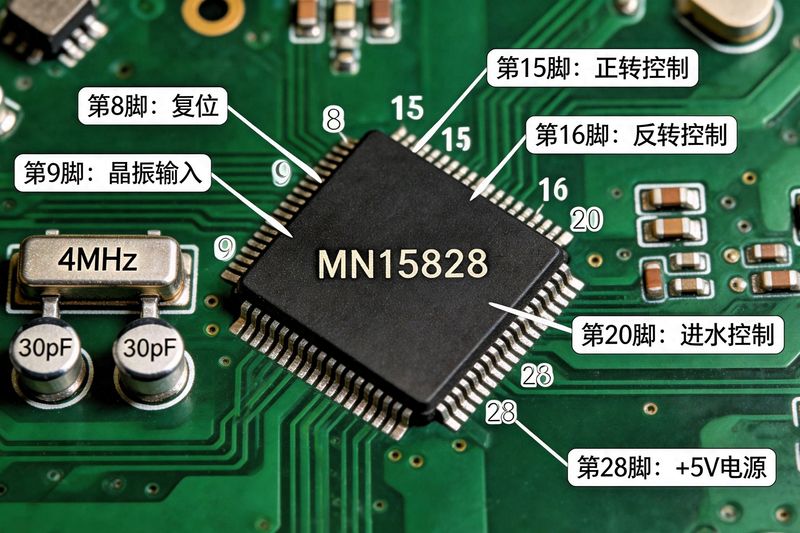
(1) failed maintenance: this failure is usually caused by internal damage to the microprocessor ic1 (model mn15828), resulting in a failure to function with the water intake control signal。
The same type of microprocessor chip can be replaced。
(2) method of overhaul: during the overhaul, priority shall be given to measuring the direct current voltage of the ic1 foot (water control signal output end) before and after the start of the scrubbering process, which, when normally the process enters the scrubber state, shall be converted from a high level (about 5v) to a low level (about 0v) and thus shut off the water drive。
If the level of the foot remains unchanged, and both the repositioned circuits on the outskirts of ic1 (usually consisting of repeat ic or rc circuits), the clock oscillating circuits (outside crystallization and resonance) and the keyboard matrix scanning signals on the machine are normal, the ic1 prototype may be declared invalid and, if the outer circuits are abnormal, they may also be shown to be out of control of the water, subject to one by one inspection。
2. Fragmentation: after washing, the electric motor can only be rotated in a positive direction and cannot be rotated backwards
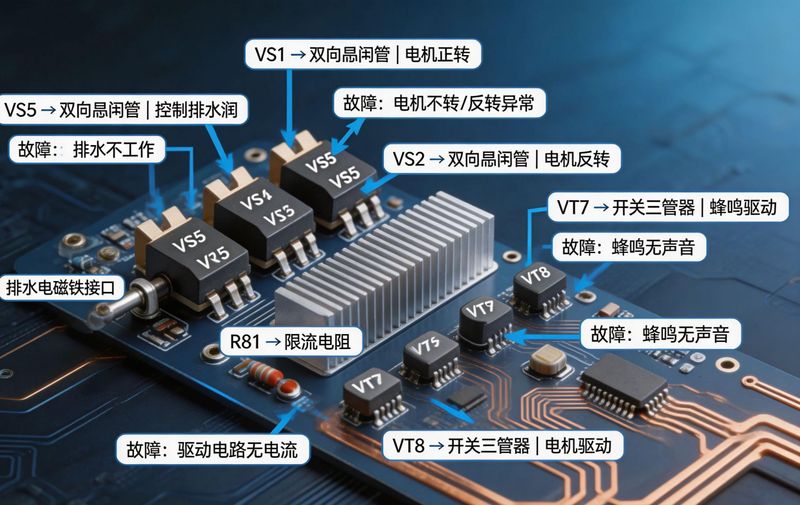
(1) failed maintenance: this failure was caused mostly by the reverse-drive-restricted r81 circuit or by the penetration (c-e very short or open) of the tri-polar vt7 (usually npn medium power tube) power switch。
With the replacement of r81 and vt7, reverse control will be restored。
(2) method of overhaul: the overhaul shall focus on measuring static and dynamic voltage of 15 and 16 feet of the microprocessor ic1 (responding to a positive and reverse control signal, respectively)。
When washing, 15 feet should be high (approximately 5v) and 16 feet low; in reverse, the two are exchanged。
If 16 feet are never high-level output, vt7 and its bias resistance, lynchoplasm, etc. Are checked. In addition, the trigger of an extreme open road or internal damage to a two-way crystal line tr2 (driver reverse) can result in a one-way operation, short circuits between t1/t2 poles can be used to measure tr2 by mass-pattery, or abnormally to trigger a extreme positive electrical resistance to the t1 pole。
3. Fragmentation: draining valves are always open and drainage occurs
(1) broken maintenance: the underlying cause of the malfunction is the short-circuit blast between the anode (t1) and cathode (t2) of the two-way crystal line vs5 for drainage control, leaving the vs5 in a permanent conductive state, with electrical adsorption of the drainage magnet. Replacement of vs5 transistors of the same specification (e. G. Bcr series, voltage resistant thallium 400v, electric thallium 3a) could be achieved。
(2) method of overhaul: at the time of screening, the vs5 trigger pole is severed and the vs5 main electrode short circuit is confirmed if the drain valve is still working。
At the same time, checking the normality of direct current electrical resistance (usually hundreds of om) in the electrical and hydro-magnetic loops, if short circuits or insulation drops, can also result in excessive driving of electrical currents and the burning of vs5; in addition, restricted electrical resistance, photolytics, if damaged, in the vs5 triggers a circuit, can also cause loss of control and must be tested together。
4. Fragmentation: the washing machine works normally, but the beeper does not send a hint sound
(1) malfunction maintenance: most of these malfunctions are caused by beeping-driven amplification of damage (c-e-extremely-opened or punctured) to the tripolar vt4 (used models such as 2sc1815 or s8050)。
The replacement of the same type of vt4 beeper will return to normal。
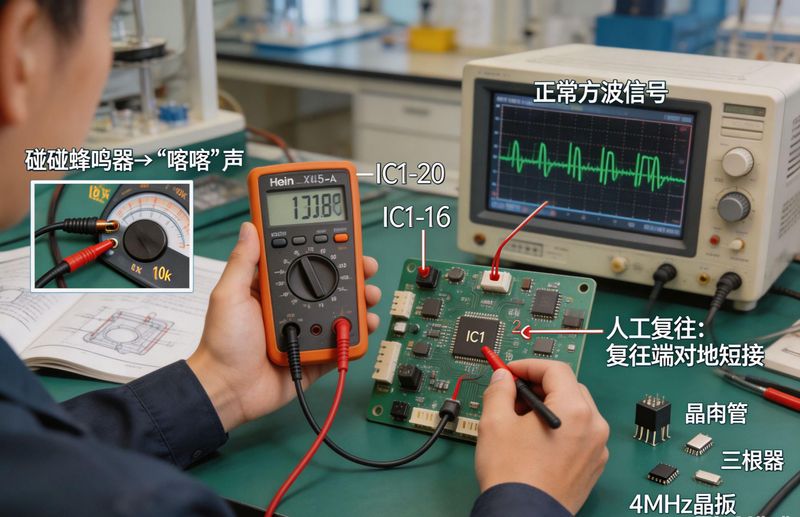
(2) method of overhaul: the sound circuit is checked first, with a universal watch placed in the rx10k block, and the red and black graphs touch the beeper at both ends, and should normally be able to hear the sound of a soft “ka” (state that the beeper voltage and internal oscillation circuits are intact)。
If the beeper is normal, the upper electrocution measures whether the vt4 radical poles have pulsed signals (which can be observed by oscilloscopes or logical pens) from the corresponding ic1 to its feet (usually 17 or 18 feet), and if the base is not signaled, the failure is at ic1 or the bias of the circuit; if the base is signaled but the collectors are not driven, then the vt4 damage or the charge-carrying circuit of its collectors needs replacement。
5. Fragmentation: when power is connected, the corresponding functional indicator light is activated, but the electric motor remains intact
(1) failed maintenance: this failure is common when the power of the driver is turning or inverting a tripolar vt8 (or the associated transistor tube) is damaged (e. G. The c-e open road of vt8)。
The electrical operation shall be restored after the replacement of a triode or transistor tube of the same type (and inspection of the surrounding protective elements)。
(2) method of overhaul: during the overhaul, it is first established whether the 20 feet of ic1 (water entry control) and the 16 feet (electrical switch control) are subject to positive and negative electrical alternation - if the procedure is normal, the two feet should undergo regular high- and low-level electro-level jump。
If the ic1 output is normal, emphasis is placed on the detection of the integrity of vt8 and its bias resistance, the cylindrical upper/lower pull resistance; at the same time, examination of the trigger poles and main electrodes of the two-way transistor tubes vs1 (positive) and vs2 (reverse) of the driver, which, in the case of vs1 or vs2 short circuits, also results in the non-rotation of the power. In addition, thermal protection of the electric power itself is subject to screening if it jumps off or activates the capacitor failure。
6. Fragmentation: all keys are unresponsive when connected to the power supply and the corresponding light is not lit
(1) failed maintenance: in most cases, the microprocessor ic1, 8 feet, 9 feet outside of the nine feet, has been damaged by a clock crystal vibration component (usually 4 mhz crystal vibration and two condensed caps), which has resulted in cpu being unable to actuate and “dead machine”。
The system can be restored to operation using a 4 mhz stone crystal vibrator and two 30pf ceramic capacitors。
(2) method of overhaul: when overhauling, priority shall be given to measuring the stability of 28 feet of ic1 (power end) to ground voltage + 5v using a universal gauge. If 5v is normal, attempts are made to reduce the end of the repeat position (usually 8 feet, or a specific repeated foot) to the ground for a short time (by artificial repositioning), and if the repositioning remains unresponsive, it is highly likely that the x1 crystal vibrate is inoperable (with the use of oscillator to observe whether the crystal-thrust foot has a swirl wave, or by checking the convulsion function with an electrocapacitometer)。
In addition, an ageing of the power filter capacity that causes excessive 5v-printing, damage to the compound circuit (vt2 and its bias) or failure of the diode/key in the keyboard scanning matrix may result in a failure of all buttons, which will require one by one. (b) be as short as possible during the replacement of crystal vibration and away from large current heaters to ensure oscillation stability。
Maintenance safety tips
All replacement operations must be preceded by the removal of power plugs and the release of residual charge on filter caps。
When welding microprocessors or crystals are vibrating, the use of static branded iron is recommended, and good landings are ensured to prevent electrostatic shocks to ccos。
When replacing transistors, triodes, be careful of their insulation insulation and insulation (if any) of dispersed heat tablets to avoid electrical leakage。
The replacement of a metaware will require an empty test machine and a water belt test machine to confirm that the process is normal and that drainage and dehydration are not uncontrolled for use。