The beijing daily news client reported on march 28 that, 13 days later, sandstorms had arrived again, the second wave of sandstorm weather this year. If you look at the satellite cloud map, you will be surprised to find that mongolia and my own region of mongolia have a vortex of air like a typhoon, which is not a good scale compared to the typhoon。
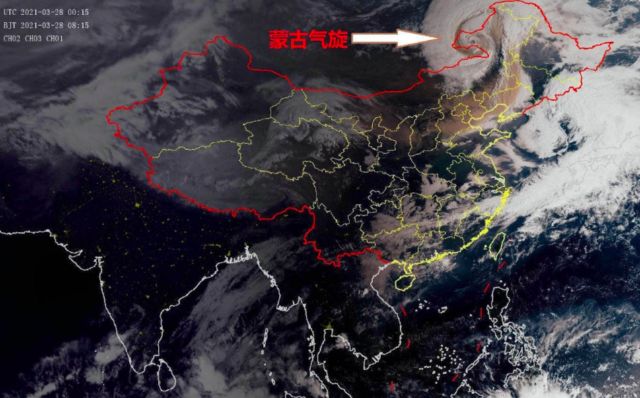
28 march 8:15 (beijing time) fy-4a meteorological satellite cloud map
Wind cloud 4 meteorological satellite monitors the entire movement of sand and dust in real time, and the spiral eye zone of the cyclone cloud system is clearly visible in the north-eastern part of the country. Under its strong rotation, sand dust is “spoiled” to north-east china, although it is not a “typhoon”, but it is called a mongolian cyclone。
So, what's with the recent mongolian cyclone? What does it have to do with typhoons? Is it supposed to be "back-to-back" for dusty weather? What impact does it usually have on my country? These questions, let's answer them。
Spring and autumn are different than typhoons
Mongol cyclone itself is a temperate cyclone, not a rare thing. The common temperate cyclones are also fluent, yellow and so on。
Statistics show that in all temperate cyclones, the country is affected more frequently by the river, while mongolia has a low proportion of cyclones. Nevertheless, due to its unique geographical location, mongolia's cyclone had an alarming impact when conditions were met, such as the most powerful sand and dust storms it had brought about in the recent past and the current sand and dust weather process。
Xiu xiaoqin, senior engineer, environmental weather centre, central meteorological station, described the occurrence or development of cyclone in mongolia along the central and eastern highlands of mongolia. The high mountains in the western and north-western parts of the region, as well as the downward slopes in the central and eastern parts of mongolia, contribute to the generation and development of the cyclone。
In spring and autumn, warm air activity was high, with the highest number of cyclones occurring, followed by winter, and in the summer, when the hot zone moved northward, where warm air activity prevailed, the cyclones decreased significantly。
Typhoon, which belongs to tropical cyclones, and mongolian cyclones, which belong to temperate cyclones, are both air vortexes and low-pressure systems, so they sometimes have a clear “wind eye” from the look of satellite cloud maps。
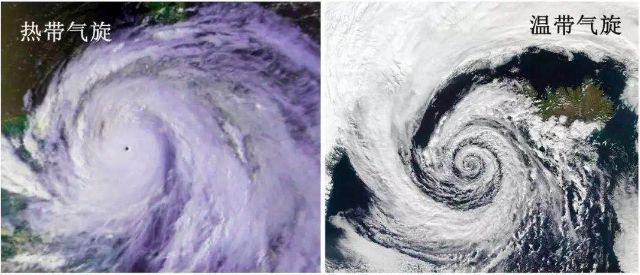
But they're more different..
1. Generate different regions. Temperature cyclones typically occur in temperate zones and operate at mid-latitudes, while typhoons are generally generated in the north-west pacific and south china seas. In tropical and temperate transition belts, both systems may change in nature and tropical cyclones may turn into temperate cyclones。
2. Scales vary. Temperature cyclones are generally “one head” larger than tropical cyclones, ranging from hundreds to thousands of kilometres in diameter。
3. The two are structured differently. Typhoon is a stress-free, no-front heating system that is largely maintained and developed by water vapours and heat from tropical seas, with a clear-space zone at the centre of intense development, mainly active in the summer. Temperature cyclones are tilted and front-lined cold-heart systems, which are largely maintained and developed by the tilt energy of the western wind belt, usually with a front front warmer, a back colder, which can occur every four seasons of the year and can be generated on land and at sea。
4. Different weather. The weather associated with typhoons is mainly wind and rain, while the weather associated with cyclones in temperate zones is more abundant, including fog, dust, strong currents and blizzards, in addition to frequent storms。
5. The impact varies from region to region. Typhoon-induced wind weather occurs mainly in the area around the typhoon eye, with the typhoon eye being the centre for the effects of the radioactive rain around it; the temperate cyclone is formed by the confluence of warm and warm air, which “deploys” on a cold, warm frontal area where the warm air meets。
There's always wind, sand and frost
Xiaoqin described the impact of the mongolian cyclone on the weather in the northern part of the country, mainly in the form of wind, sand and rain, most notably wind. Much of the spring wind in the north of the country is related to the impact of the cyclone. The development of a strong mongolian cyclone can lead to wind in any part of the cyclone。
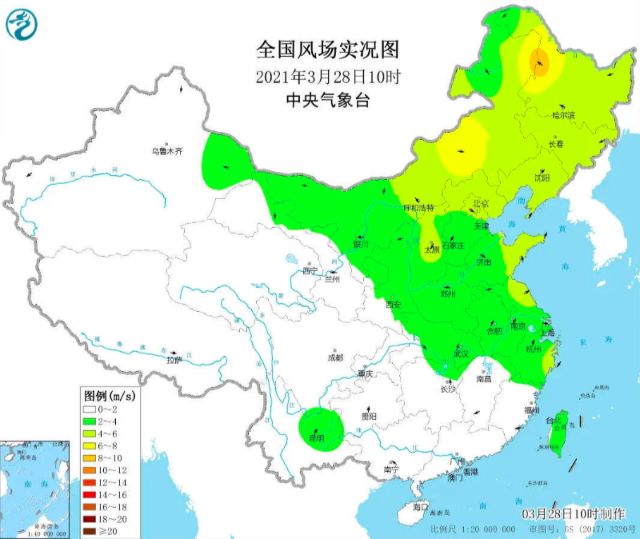
On march 28th, a map of the windfield
Precipitation is generally small, if not non-existent, because much of the warm air in the cyclone comes from the north-east of the tibetan plateau and along the western corridor of the river, and there is a shortage of water, often except for some precipitation in the northern part of the centre, most of which is cloudy。
It is worth noting that the activities of the mongolian cyclone are always accompanied by cold air, so that weather phenomena such as wind, sand and frost may follow。
Mongol cyclones often move into our country east or south-east. As liao xiaoqin described, mongolia's cyclone generally has two paths of movement: to the east into my country's mongolia and then to the east through the north-east plain downstream along the pinehua river; and to the south-east into our country's north-west, into the sea of china and across the korean peninsula。
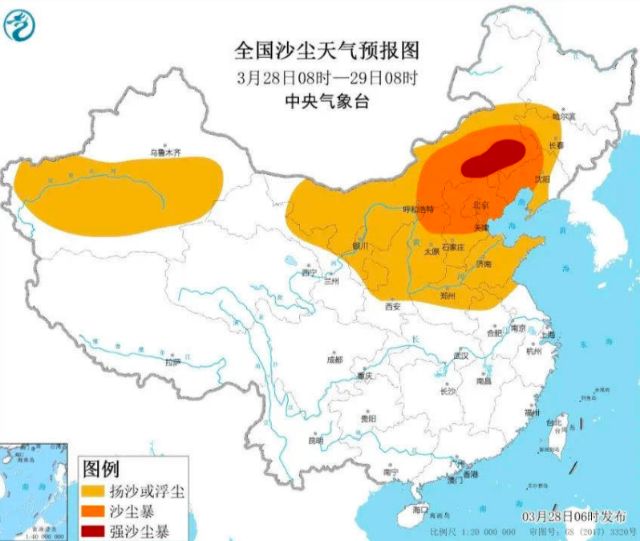
According to today's sand and dust weather forecasts, the north-east and north-east regions of china are well organized by the mongolian cyclone. In fact, temperate cyclones generate much more than tropical cyclones each year, but often have a significant impact on our country. For the most part, the public has lost consciousness. But these two sand and dust processes this year have also given the public a full sense of the power of a mongolian cyclone。
"the causes of two sand and dust storms have been found! The clouds are like typhoon eyes but the gap is huge."