The “pdca working method” that the elites are using: to get rid of inefficiency and to get rid of work delays。
A mandatory course for managers: in-depth analysis of the wear of the ring (pdca) to create efficient implementation by enterprises。
Why is your plan always incomplete? What's missing is this pdca closed mind
The pdca recycles its core concepts, the specific content of the four phases, the evolution of development, the application landscape, the limitations of its strengths and its relationship to other management tools。
I. Core concepts and origins
The pdca cycle, also known as the wear of the ring, is a classic and widely applied model in management science to guide continuous improvement and problem solving. It was first introduced in the 1920s by walter hewhart, an american quality management expert, and then promoted and popularized in japan by dr. Edwards damien in the 1950s。
Pdca is the acronym of four english words:
P (plan) - plan
D (do) - implementation
C (check) - check
A(act) - processing
It is a closed-ring process that, through the cycle of these four phases, drives continuous improvement and a spiral of quality。
Ii. Detailed information on the four phases of the pdca cycle
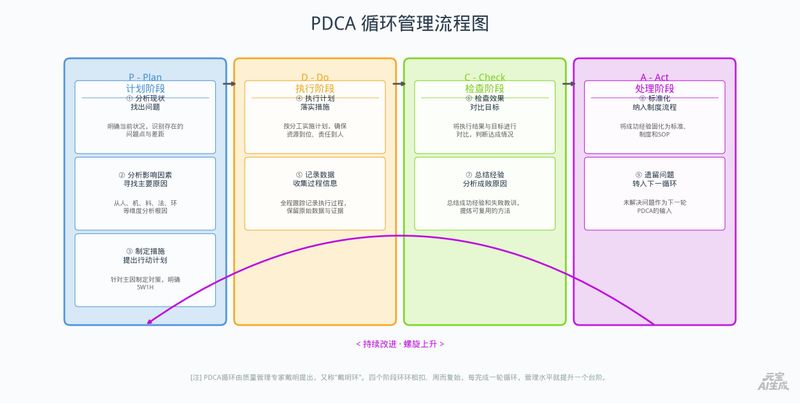
The heart of the pdca cycle lies in its tight logical steps. The following is a clear illustration of its complete cycle process and its core elements:
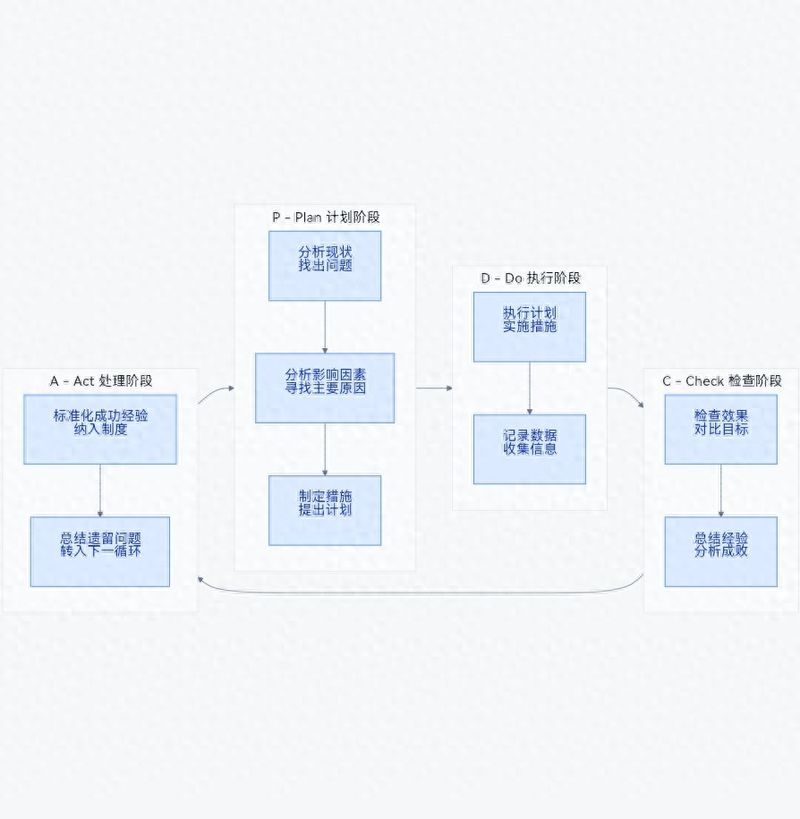
P (plan) - planning phase
This is the starting point of the cycle, aimed at defining objectives and formulating action programmes to achieve them。
Core tasks: to analyse the current situation and identify problems; to analyse the causes or factors affecting the problem; to identify the main causes; to develop measures and propose plans。
Key output: a detailed plan of action to clarify “5w1h” (why why, what, where, when, who, how and how)。
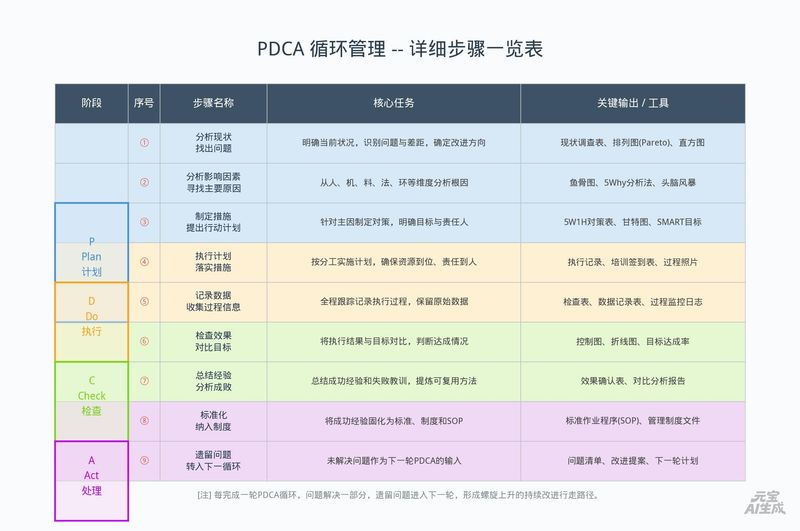
Phase
Serial number
Step name
Core mandate
Key output/ tool
Plan
Analysis of the current situation and identification of problems
Clarify the current situation, identify problems and gaps, and identify directions for improvement
Status questionnaire, paretto, histogram
Analysis of impact factors for key reasons
Analysis of the root causes from the dimensions of people, machines, materials, techniques, rings, etc
Fish bone map, 5-wy analysis, brainstorm
Development of measures to propose action plans
Develop a response to the underlying causes, identifying targets and those responsible (5w1h)
5w1h response table, gantt chart, smart target
Ddo implementation
Implementation of the plan of implementation
Implementation of the plan based on a division of labour to ensure that resources are available and responsibilities are met people
Implementation of records, training sign-in forms, process photographs
Recording information on the data collection process
Keep raw data while keeping track of execution
Checksheets, data logs, process monitoring logs
Check
Check results against targets
Comparison of implementation results with objectives and judgement of achievement
Control chart, line chart, target achievement rate
Lessons learned analysis of successes and failures
Taking stock of successes and lessons learned from failures, refining replicable methods
Impact confirmation tables, comparative analysis reports
Act processing
Standardized integration system
Consolidate successful experiences into standards, systems and sops
Standard operating procedures (sop), management system documents
Legacy issues to the next cycle
Unsolved as input for the next pdca round
List of issues, proposals for improvement, plans for the next round
D (do) - implementation phase
The plan is put into practice and is tested on a small scale。
Core tasks: implementation as planned, implementation of measures and documentation of data and information during implementation。
Key points: strict implementation of the plan, while maintaining observation and gathering first-hand information for the inspection phase。
C (check) - inspection phase
Performance results are checked to determine whether the intended results have been achieved。
Core tasks: to examine the effectiveness of implementation, compare plans and objectives and identify successes and failures。
Key methodologies: objective assessment using data analysis, process review, target matching。
A (act) - processing phase
This is a critical stage in the cycle, which determines how the results of the inspections are handled。
Core tasks:
Lessons learned from successful experiences: standardizing and institutionalizing effective measures and methods to consolidate results。
Lessons from failure: for unresolved issues, go to the next pdca cycle。
Key values: prevent the recurrence of problems and transmit unresolved issues to the next cycle, creating momentum for continuous improvement。
Iii. Characteristics and evolution of pdca cycles
The pdca cycle is not simply a repetition, but a spiral-up process characterized by:
Characteristics
Annotations
Meaning
Large rings small rings (ensemble)
The entire organization's pdca cycle, which can be broken down into small pdca cycles of individual members of the sector, forming a layered, enclosed organic whole
Ensuring organizational synergy and alignment, improving the coverage of activities at all levels and achieving full participation and overall quality management
Elevator (helix)
Each cycle solves a part of the problem, lifts a step, drives a spiral of quality and management, rather than in situ
Reflect the core essence of "continuing improvement", avoiding simple repetition at the same level and achieving managerial maturity leaps
Integrated application of scientific methods (open)
Pdca is not a stand-alone tool that can be used flexibly and in combination with a variety of management approaches such as qc 7 techniques, 6 sigma, lean production, 5s, sop
An open and inclusive framework that integrates advanced tools and ideas and responds to the needs for improvement in different contexts
Four stages of relative independence (integrity)
The p, d, c and a phases, each with a clear division of labour and boundaries, cannot be crossed or omitted and constitute a complete management closure
Ensure systematic and normative management activities to prevent common management gaps such as "no checks" and "no summaries of implementation " hole
Repeated (cyclical)
Once a cycle is over, the legacy and new issues will automatically enter the next cycle and will never end
Compatibility with the concept of quality management: "a pursuit of excellence, never satisfaction" and the promotion of long-lasting improvement mechanisms in the organization
Petty: the pdca cycle was initially applied to quality management, but its logic is universal and is now widely applied in a variety of areas, including enterprise management, project management, personal growth, education and training, and is a common thinking model for solving any problem。
Examples of applications
The pdca cycle is widely applied, with the following typical scenarios:
Scenario one: improved quality of enterprise products
P: analysis of the current state of product defects, identification of the “welding process” as the main cause, plans to introduce new automated welding equipment and train staff。
D: introduction of new equipment to record weld quality data in small batch trials。
C: comparing data, weld defects were found to have decreased by 80 per cent, but production efficiency decreased slightly。
A: standardization of successful operations and training of all staff; in response to the reduction in efficiency, it is planned to optimize the switch process in the next cycle。
Scenario ii: individual learning programmes (e. G., preparation)
P: development of a weekly learning plan, specifying the daily course and duration, with the goal of mastering a chapter and completing 10 subjects。
D: implementation as planned, completion of exercises, recording of errors。
C: the examination revealed a 70 per cent correctness of the subject and the error was concentrated in the “calculations” section。
A: consolidation of the knowledge points related to the “computation topic” and restructuring of the planned additional computing exercises for next week; incorporation of the acquired content into the inventory。
Scenario iii: optimization of hospital medical services
P: analysis of the length of patient queues, finding that the “pay-for-medicines” chain is the longest time-consuming, and plans are made to add a self-help contribution machine and to optimize the dispensary distribution process。
D: pilot new processes in selected sections。
C: tracking data, showing a 15-minute reduction in the average queue and an increase in patient satisfaction。
A: institutionalization of new processes and extension of the campus; summary of problems identified in the pilot to the next cycle。
The strengths and limitations of the pdca cycle
Dimensions
Strengths
Limitations & challenges
Think logic
It is logical and well structured to follow the scientific hierarchies of plan-implementation-examination-process, in accordance with cognitive patterns, easy to train and promote, and serves as a common framework for bottom thinking。
The cyclical, inflexible emphasis is on a sequenced response to sudden-onset crises or rapidly changing external environments; the rhythm appears to be slow during the vuca era, which requires agility。
Basis for decision-making
Data-driven, objective and impartial emphasis on the use of facts and data in the check phase avoids empirically based decision-making and enhances the scientific nature and reliability of management。
Data thresholds, over-reliance on the plan, are more demanding for data collection and analytical capacity; if the initial plan (plan) departs from actual or environmental mutation, subsequent cycles may become “precision errors”。
Operational effectiveness
Closed-ring management, spiraling through phase a summation and standardization to prevent the recurrence of problems and promote the upgrading of the management ladder to achieve continuous improvement。
There is a lag, and slow feedback must wait until the do phase is completed. Check, the feedback chain is long and it is difficult to stop it in time; it is prone to a formalism of “cycle for circulation”。
Apply scene
It is highly compatible and widespread and can be used in both strategic and day-to-day routines; it is seamlessly integrated with a variety of tools, such as six sigma, lean production, etc。
Culture depends and implementation requires a cultural environment where organizations are open to reflection and confront issues. In the absence of frank communication or accountability mechanisms, pdca can be reduced to “paper articles”。
Extension proposal: how to avoid limitations
Integration of pdca cycles with other management tools
The pdca cycle does not exist in isolation and is often more effective in synergy with other management tools:
Combining with the qc7 tools: the cause and effect maps (fish bone maps) can be used to analyse the causes in the p phase, and the main causes can be found in the ranking maps (pareto maps); the control maps can be used to monitor the stability of the process in the c phase。
Combined with six sigma: the dmaic process of six sigma (define definition, measure measurement, analyze analysis, improve improvement, control control) is highly logically consistent with pdca and can be considered as a deepening and specialized version of pdca in the field of quality management。
Combining with lean production: “eliminating waste” is an important improvement that needs to be solidified in the pdca “act” phase. Pdca provides a steady pace of advancement for continuous improvement of excellence。
Integration with project management: the five major project management process groups (start, plan, implement, monitor and close) are logically aligned to the pdca cycle, ensuring that the project operates on a controlled, continuously improved track。
Vii. The shoot of the shoot
The pdca cycle is a powerful, flexible and enduring management tool. It provides us with a clear and systematic road map for problem resolution and continuous improvement。
Core essence: cycle back, spiral up. The key is to “line” — to strictly implement the plan, to “check” — to speak with data, to “sound” — to anchor the results and drive the next cycle。
The internalization of the pdca cycle, both organizational and individual, into a mindset can, in a day-to-day “plan-action-inspection-processing” process, drive work to a new level and real and sustained improvement。