Building project management outline and evaluation of xii1z203,000 construction project progress control for level 1 builder
1z03010 master of the meaning, purpose and tasks of progress control of construction projects and the concept of a progress planning system
1z03011 meaning and purpose of progress control for construction projects
(1) as stated in 1z201011, there are various types of project management for construction works and project management (owners and project participants) representing different stakeholders have progress control tasks, but their control objectives and time frames vary。
(2) as stated in 1z201061, construction projects are implemented under dynamic conditions and therefore progress control must also be a dynamic management process, which includes analysis and validation of progress objectives, preparation of progress plans and follow-up checks and adjustments of progress plans based on information collection and research studies。
Progress cannot be controlled by focusing only on the preparation of progress plans and not on the necessary adjustments to progress plans. In order to achieve progress targets, the process of progress control is the process by which progress plans are constantly adjusted as the project progresses。
The purpose of the progress target analysis and validation is to demonstrate whether the progress goal is reasonable and achievable. If, after scientific justification, the goal is unlikely to be achieved, it must be adjusted。
Monitoring and adjustment of progress plans include regular follow-up of progress plans and corrective measures if there is a discrepancy in their implementation and adjustments to progress plans as necessary。
(3) the purpose of progress control is to achieve the progress objectives of the project through control。
1z203012 construction project progress control tasks
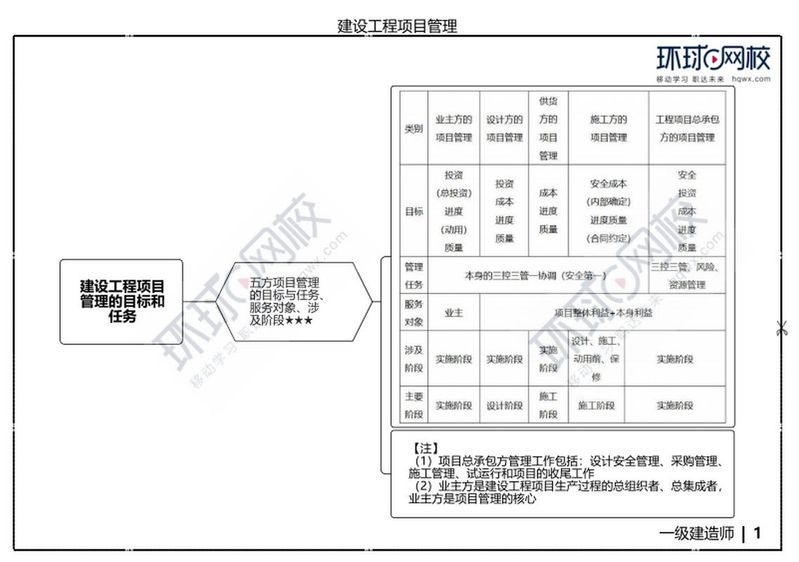
(1) the task of the owner's progress control is to control the progress of the entire project implementation phase, including the design preparation phase, the design work schedule, the construction work schedule, the procurement of materials, and the project's pre-utilization preparation phase。
(2) the designer's progress control task is to control the design work schedule in accordance with the design assignment contract requirements for the design work schedule, which is the designer's obligation to fulfil the contract. In addition, the designer should, to the extent possible, align the pace of the design work with that of the bidding, construction and procurement of materials。
At the international level, the design progress plan is mainly a drawing plan for the design drawings (including related notes) at the various stages of the design, where the date of each drawing is indicated。
(3) the task of building party progress control is to control the construction schedule in accordance with the requirements of the construction task commission contract, which is the construction party's obligation to fulfil the contract. In the preparation of the schedule, the construction party shall prepare plans for the construction of the project in different depths of control, direction and execution, depending on the characteristics of the project and the requirements of the construction schedule control, as well as construction plans for different plan cycles (annual, quarterly, monthly and late)。
(4) the task of supply party progress control is to control supply progress in accordance with the requirements of the supply contract, which is the obligation of the supplier to fulfil the contract. The supply schedule should include all supply elements such as procurement, processing manufacturing, transport, etc。
1z03013 concept of a system for planning progress of construction projects
(1) the construction project progress plan system is a system consisting of multiple interrelated progress plans and is the basis for project progress control. Since the necessary information required for the preparation of the various plans of progress has evolved over time in the course of the project, there has also been a process for the establishment and improvement of the system of planning of progress of the project at the park, which is an example of the system of planning of progress of the construction projects, with four planning levels。
(2) depending on the needs of the project progress control and the different uses used, the owner and the participants in the project may construct different systems for planning the progress of the construction project, such as:
• a system of plans consisting of multiple interrelated and in-depth plans
• a plan system consisting of progress plans with multiple interrelated different plan functions
A planning system consisting of multiple interrelated progress plans of different project participants
• a planning system consisting of progress plans for multiple interrelated planning cycles。
(3) a progress plan system consisting of plans of different depths, including:
:: overall progress planning (planned)
Project subsystem progress planning (planned)
• individual project schedule in the project subsystem, etc。
(4) plans with different functions constitute the progress plan system, including:
Controlled progress planning (planned)
:: guidance on progress planning (plan)
Implementation (operational) progress plans, etc。
(5) a progress plan system consisting of plans from different project participants, including:
:: a progress plan for the implementation of the project as a whole prepared by the owner
Design progress plans
• construction and equipment installation schedule
Procurement and supply progress plans, etc。
(6) a system of progress planning consisting of different cycles of plans, including:
:: five-year construction progress plan
Annual, quarterly, monthly and late plans, etc。
(7) in the progress planning system for construction projects, attention must be paid to the linkages and coordination between the progress plans or the subsystems when preparing and adjusting them, such as:
:: linkages and coordination between the master progress plan (plan), the project subsystem progress plan (plan) and the individual project progress plan in the project subsystem
:: linking and coordinating control progress planning (plan), guidance progress planning (plan) and implementation (operational) progress planning
• the linkage and coordination between the plan prepared by the owner for the implementation of the project as a whole, the plan prepared by the designer, the plan prepared by the construction and equipment installation and the plan prepared by the procurement and supplier。
1z203020 methodology for preparing plans for the progress of construction projects
1z203021 methodology for the preparation of progress plans for the twilight chart
The traverse chart progress planning method, which is the traditional method of progress planning (which is done a little bit), is expressed in a more intuitive way, with the line of progress (crossing) in the chart chart corresponding to the time coordinates。
However, there are also problems with the methodology for planning the progress of the traverse chart, such as:
The logical relationship between the process (work) can be sought but not easily articulated
Applies to manual preparation plans
• the key work of the plan, the key route and the time difference could not be determined without rigorous time parameters for the plan
• the volume of planned adjustments, which can only be done manually, is significant
It is difficult to adapt to large progress planning systems。
1z203022 engineering network plan type and applications
(1) the types of engineering network programmes recommended in our technical protocol on engineering network planning (jgj/t121-99) include:
• double-name network plan:
• single-name network scheme
• a dual-coded timescale network plan
• single-name networking scheme。
(note: basic concept of a network plan
Network maps and work
The network chart consists of arrow lines and nodes, which are used to indicate a straight and orderly network of workflows. A web map indicates a planned mission. The work in the network chart is a sub-project or sub-mission that plans the tasks to be defined by the degree of detail required, consumes time or also consumes resources. The work may be unit work; it may be branch work; it may be sub-work; and a construction process may also be included as work. Generally, it takes time and resources to complete a job. There are, however, tasks that consume time rather than resources, such as conservation processes after concrete is laid and dry processes after walls are wiped out. There are two-coded and single-name network charts. The two-coded network chart, also known as the arrow line network chart, is a work-indicator with the numbering of the arrow line and its two-end nodes; at the same time, the nodes represent the start or end of the work and the state of connection between the work. The single code network chart, also known as the nodal network chart, represents the work by nodes and their numbers, and the arrow line represents the logical relationship between the work. The presentation of the work in the web chart is shown in figures 3-1 and 3-2。
The nodes in the network chart shall be numbered, their numbering shall be strictly forbidden to repeat, and each arrow line shall have fewer tail nodes than the arrow nodes. In a two-coded network chart, a job must have a single arrow line and a corresponding pair of non-recurring arrow tails, arrow nodes. Therefore, the name of a job can be indicated by its arrow tail and arrow node number. In a single code network chart, a job must have a single node and the corresponding code, the name of which can be indicated by its node number。
In the double-coded web map, sometimes there is a false arrow line, which does not represent actual work, which we call no work. Fragmentation does not consume time or resources. Fragmented work is primarily used to represent the logical relationship between the two neighbouring jobs. Sometimes, however, a distinction needs to be made between the two simultaneous work with the same starting and completion points。
In a single code network map, virtual work can only occur at the starting or end point of the network map。
Ii. Technological and organizational relations
Technological and organizational relationships are part of the sequence-logical relationship between work。
(i) process relations
The sequence between productive work and non-productive work determined by process is referred to as process. As can be seen in figures 3-3, model 1 — band 1 — concrete 1 is a process relationship。
(ii) organizational relations
The sequenced relationship between work is referred to as an organizational relationship because of organizational needs or the need to redeploy resources (labour, raw materials, construction machinery, etc.). As shown in figure 3-3, model 1 — model 2 — and tweak 1 — is organizational。
Iii. Current work, current work and parallel work
(i) forward work
In the web map, in relation to a job, the work immediately preceding the job is referred to as the work ahead. In the double-coded web map, there may be a gap between work and its immediate work。
(ii) backward work
In the web map, in relation to a job, the work that follows the job is referred to as the work that follows. There may also be a gap between work and its immediate work in the double-coded web map。
(iii) parallel work
In the web map, the work that can be done in conjunction with the work is in parallel with that work, as opposed to that work。
Immediate, immediate and parallel work is a concrete manifestation of the logical relationship between work, which can be used to map the network as long as it is clear from the technical and organizational relationship between work. It is a prerequisite for proper network mapping。
Iv. Prepared work and follow-up
(i) work first
As opposed to a job, starting at the first node of the network chart (the node of the starting point), all work on the road leading to the job through a series of arrow lines and nodes in the direction of arrows is referred to as the lead work for the job。
(ii) follow-up
As opposed to a job, from the beginning of the job, all the work that follows the arrows through a series of arrow lines and nodes to the last node of the web chart (terminal node) is referred to as a follow-up to the work。
Lines, key lines and key tasks
(i) lines
The network chart begins at the starting point and is referred to as a line by a series of arrow lines and nodes in the direction of arrows and ends at the end. The line may be expressed either by the nodal number on the line or by the working name on the line。
(ii) key lines and key tasks
In the key lines method (cpm), the total duration of all work on the line is referred to as the total duration of the line. The routes with the longest total duration are known as critical lines, the length of which is the total duration of the network plan。
In network plans, there may be more than one critical line. In the course of the implementation of the network plan, there will also be shifts in key lines。
Work on critical lines is described as critical. The implementation of the network plan will have an impact on the total duration of the work, either ahead of or behind schedule. Therefore, the actual pace of critical work is the focus of the construction work progress control exercise
(2) the two-coded network chart represents the network chart of the work with the number of the arrow line and its two end points, as shown in figure 1z203022-1。
(3) the single code network chart is a work plan with nodes and their numbers, and the network chart of the logical relationship between jobs is an arrow line, as shown in figure 1z203022-2。
Previous article: outline and commentary of the first-level builder, project management for construction works
Next: outline and presentation of the first-level architect's project management for construction works