People in the machine-bed industry may have heard the word "particle 3d printing" recently. It was used by guang guang guang guang to make a prototype of a battery-packed frame, which was used by china's eight stations to assemble the assembly building components, and by tudu's oldest high-molecular 3d printing bridge, which was also made of particulate matter。
What's this technology really about? What's the difference between what we do in the fdm line 3d print that's common in the workshop
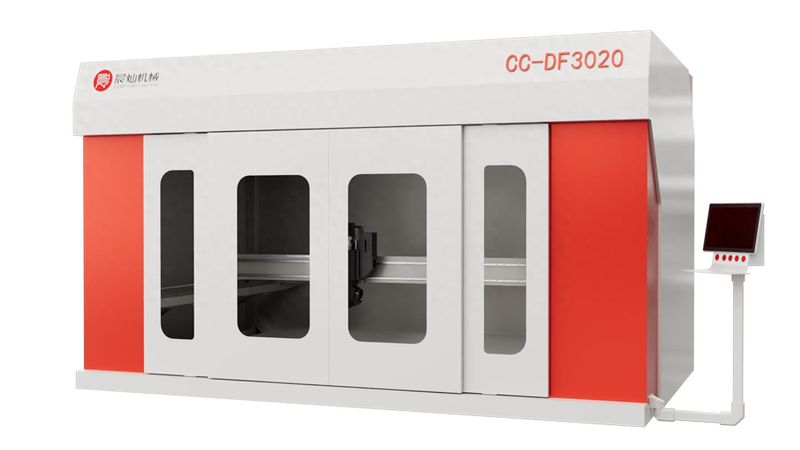
Distinction in one sentence: different consumption patterns
Normal fdm 3d printing is based on wire (filament), 1. 75 mm in diameter or 2. 85 mm in plastic silk, like a roll of "plastic noodles", which accumulates from layer to layer after melting into a hot nozzle by delivering a wheel。
Particle 3d printing is made of plastic particles (pellet), the form of raw material most commonly used in the plastic industry - plastic particles of rice size, which are squeezed through the screws out of the system for heating, melting and formation。
Looks like it's just a "wire-form particles" difference, but it's very different behind it。
Cost of materials: fall-on of particulate matter
This is the greatest attraction for particle 3d printing。
In terms of material costs, particulate matter has a clear advantage over lined materials. In industrial materials of the same grade, the fdm linewood price is usually 50-120 usd/kg, and the cost of some applications can be reduced to about 20-50% of the lined materials. For large industrial printing, single printing often requires the consumption of dozens of kilograms or more of materials, and the advantage of particulate matter in cost control is further amplified。
The reason for this is straightforward: the thread itself is an additional ripple process based on particles, plus a roll-packing, brand premium, which naturally leads to higher costs. Particle material is a standard raw material for the retrofitting industry, and the supply chain is mature, yielding and cheap。
More critically, many high-performance engineering plastics — carbon fibre enhancement peek, pei, pps — have only granular form and no linear version. To print with these materials, particles are almost the only option。
Size of formation: core advantages of the big scene
Fdm printers are limited by the capacity of wire delivery and the size of the silos, usually not exceeding 500 mm x 500 mm x 500 mm. Particle 3d printing, on the other hand, is squeezed out of a screw, with almost no maximum delivery, and can be formed in several cubic metres。
In 2025, large-sized particle 3d printing equipment accounted for about 60 per cent of the income in this sub-market. Work packages in the automobile industry, moulds of wind blades, building assembly components — items that are more than one metre — are almost impossible to complete with fdm, while particle 3d can be printed once。
Print strength and density: closer to apostille
After being squeezed through the screw, the particles are more fully melted and more closely integrated. In actual tests, the density and inter-layer strength of the particle printout is generally higher than that of the fdm line material and is closer to the level of the traditional apostrophe. This difference is critical for the prototypes of the assembly, packaging and functionality that require the actual load。
Accuracy and threshold: cannot be avoided board
It is fair to say that particle 3d printing is currently less than high-end fdm equipment in surface accuracy and detail performance. The amount of material extracted from the particles is large and the smallest layer is usually 0. 3-1 mm, while the fdm can reach 0. 05-0. 1 mm. Fdm remains a better option if surface polishing and fine structure are to be pursued。
In addition, particulate matter requires a strict water-bearing rate (the standard requirement is 0. 08 per cent) and the calibration of the temperature and trans-velocity parameters of the spiral out of the system is more complex than fdm and requires some process experience from operators. The unit cost of equipment is also higher, with the sale of 3d domestic industrial-grade printers ranging from $280-940,000。
It's worth it
If your enterprise often needs large-scale prototypes, engineering moulds, small batch functionals, or the material used is only in granular form -- that particle 3d printing really deserves careful evaluation. In 2025, china's 3d printing market was about $4. 86 billion, an increase of more than 57 per cent over the same period, moving from "technology validation" to "industrial applications"。
It is not intended to replace the fdm, but it opens up the space that traditional 3d print cannot be covered by large, low-cost, engineering materials。
As intelligent manufacturing progresses, particle 3d printing is becoming an important technological path in the area of large structural components, composite material processing and rapid manufacturing. The morning light machinery, which revolves around the industrial 3d printing application needs, provides equipment solutions for scenarios such as engineering plastics, fibre-enhanced materials, etc., and helps manufacturing enterprises to reduce trial costs and increase the efficiency of the development of complex structural components。