In april 2026, a nurse in the province of ituri in the democratic republic of the congo began to have a fever, accompanied by vomiting and fatigue. The local clinic treated malaria ineffectively; a few days later she died of haemorrhage. The samples were sent to the nearest laboratory for testing with reagents for the zairian ebola - the results showed negative. It doesn't look like ebola。
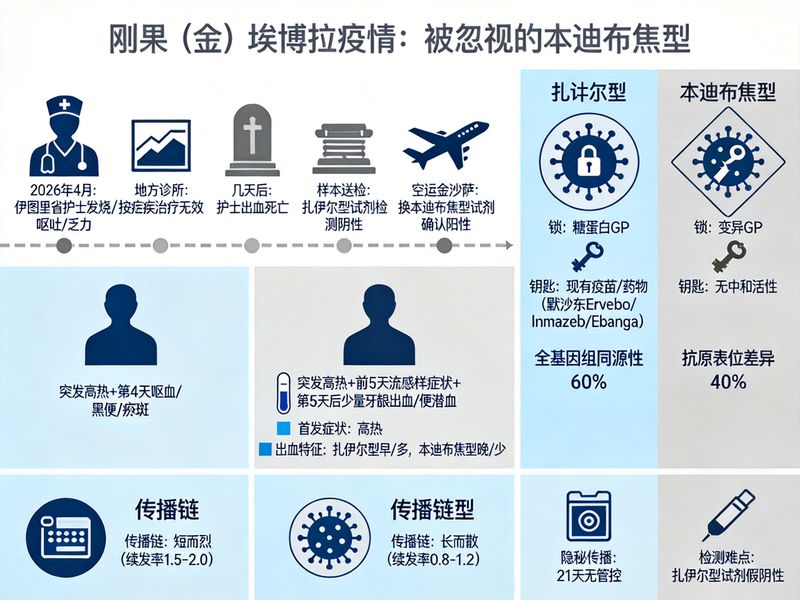
It was not until the sample was transported by air to the national biomedicine institute in kinshasa, 2,000 km away, that researchers switched to the bendibujo-type test, which confirmed that it was an ebola virus that all had almost missed. From the first death to official confirmation, the virus spread in the community without control for at least 21 days。
Didn't you say that ebola already had a vaccine, a special drug? Why does this epidemic look like it's back in 2014? The answer lies in the virus itself — the bendibujo type that triggered the current round, and the zairian type that we are familiar with — essentially two viruses。
"key" and "lock" matches, 40%
Do you have a key that opens the neighbor's door? Almost impossible. The connection between the vaccine and the virus is the same as “a key to a lock”。
The lock is the glucose protein on the surface of the virus. All the authorized ebola vaccines and special effects single anti-drugs were designed in the shape of the zairian “lock”. However, the bendibujo lock is completely different from the zaire one. Only about 60 per cent of the entire genome sequence of two toxic strains is homogenous, with a 40 per cent difference。
There has been a large mutation of key points on sugar proteins determining immunization recognition, and the antigen surface overlap is extremely low — commonly speaking, the “tooth marks” of the two locks are not matched。
This led to a disturbing situation: the global major ebola vaccine, mershadon ervebo, had a high protection effectiveness of 97. 5 per cent for the zairian type, but had only about 50 per cent of the bendibujo type of protection in the non-human primates experiment, with no approved human adaptation。
The two zaire-type single anti-effects, inmazeb and ebanga, are directly “inert and active” for the bendibuco virus — that is to say, the drug is filled in, the antibody is not recognized as the virus, and it is white。
Only mbp 134, a candidate for wide spectrum antibodies, currently has an intervention cure of 83 per cent in monkey experiments, and who has initiated urgent human clinical trials in this outbreak. But there is still a long way to go before it is widely applied。
It's like flu, not ebola
One of the reasons for the fear of ebola in zaire is the haemorrhage. More than 60 per cent of cases of serious illness have been characterized by vomiting of blood, black poop or bruises under the skin on the fourth day of the disease, and the symptoms are sufficiently “typical” to prompt rapid identification and isolation。
The benedict type doesn't take this route. It is strictly acceleratored by heat outbreaks, with muscular acid and severe headaches, almost identical to malaria and influenza the first five days. The health sector in the democratic republic of the congo has made it clear that haemorrhage is common only after the fifth day of the course, and that the proportion of haemorrhages is much lower than that of the zairian type。
In an interview with xinhua, the director of the national institute of biomedicine in the democratic republic of the congo, muyenberg, stated that there was a lack of recognition at the primary level and that a large number of cases had been misdiagnosed as common tropical diseases, which was the most important cause of the spread of the epidemic。
The difference is more illustrated by mortality rates. The zairian rate of death in the absence of intervention is as high as 60-90 per cent, and it falls below 40 per cent when vaccines and medicines are introduced. The average mortality rate for the bendibugio-type historical epidemic is 25 per cent-51 per cent, with only about 10 per cent confirmed by the end of may。
But the “lower fatality rate” is not good news here — it means that more lightness or atypical patients are left out and become invisible nodes of transmission。
It's slow, but deep
Ebola is not transmitted through air or foam and must be exposed directly to the blood, vomit or excreta of the infected person. Under this mechanism, the incidence of second-generation epidemics in zaire (one case being transmitted to several people on average) is estimated at 1. 5-2. 0, while the rate of continuity in the bendibujo type is 0. 8-1. 2, with more effective interpersonal transmission。
But low dissemination efficiency does not mean better control. Zairian-type patients are progressing rapidly, with high levels of detoxification and a “short and strong” transmission chain, and the epidemic is easily visible after local outbreaks. Early symptoms of the bendibujo type are hidden, with low levels of detoxification, with patients tending to grow in normal activity in the community for several days, and transmission chains are “long and scattered”。
The current round has spread clandestinely for at least 21 days before detection, and by the time it is officially confirmed, the virus has spread to north kivu and the city of goma, with ugandan imported cases and cross-border transmission has become a reality。
What's more difficult is the detection link. Conventionally designed zairian nucleic acid detection reagents are susceptible to false negatives for the bendibuj - which means that even if they are sent for inspection, a large number of real cases may be missing because of “incorrect reagents”。
According to muyenberg, when early samples of the current epidemic were delivered to local laboratories, they were used as specialized zairian detection equipment and reagents that could not be detected until the samples were sent to kinshasa for additional testing. It's like taking an english dictionary to translate french, and the misalignment of the tool directly leads to a 21-day air window period。
It's the end: what's this war about
You don't need to remember sugar proteins and antigen tablets. All you need to know is that this round of the ebola outbreak in the democratic republic of the congo, and the zairian ebola virus, which you remember as “preventable and drug-free”, hardly overlaps at the tool level. Existing vaccines have failed, special effects have not been used, and detection reagents have not worked — prevention has returned directly to the “primitive age” of treatment based on tracking contact, strict isolation and basic rehydration。
The bendibuco type is precisely the “low-key” rival: it has lower mortality rates, more hidden early symptoms and easier transmission chains to hide in the community. That was the root cause of its more difficultness than the zaire model。