Designing a diet plan that suits you, instead of looking for a 20-pound monthly template from the internet, you figure out two counts -- your body data and the power gap you can make every day -- and then you move at a safe pace。
The national commission for health and welfare launched a three-year “year of weight management” campaign in 16 departments, and the china obesity congress, 2026, explicitly characterized obesity as a chronic and re-emerging disease, with only one core principle: a reduction of 0. 5 to 1 kg per week, a reduction of 5 to 15 per cent of current body weight within three to six months, a failure to pursue fast-track scales and extreme diets。
Scientific weight reduction is based on the normative principle of circumventing extreme weight reduction
First step, get yourself an "entry check."
You can do it with a cell phone calculator and a soft ruler without going to the hospital。
Calculates bmi, which is the square of weight (kg) divided by height (m). 18. 5 to 23. 9 is normal, 24 to 27. 9 are overweight and 28 and above are obesity. Bmi normal doesn't mean it's okay, but it's got to weigh. At the belly button level, 90 centimetres for men and 85 centimetres for women are central obesity。

This is more dangerous than the bmi superscript, meaning that internal fats are already wrapped in the liver and gastrointestinal, and the risk of metabolic diseases increases significantly even if the limbs are not fat。
You can make a preliminary judgment by touching your stomach. Laying down around a pressurized belly button, much of the softness falls under the fat of the skin, and the hardness of the hair and the resistance of the pressure is the accumulation of internal fat。
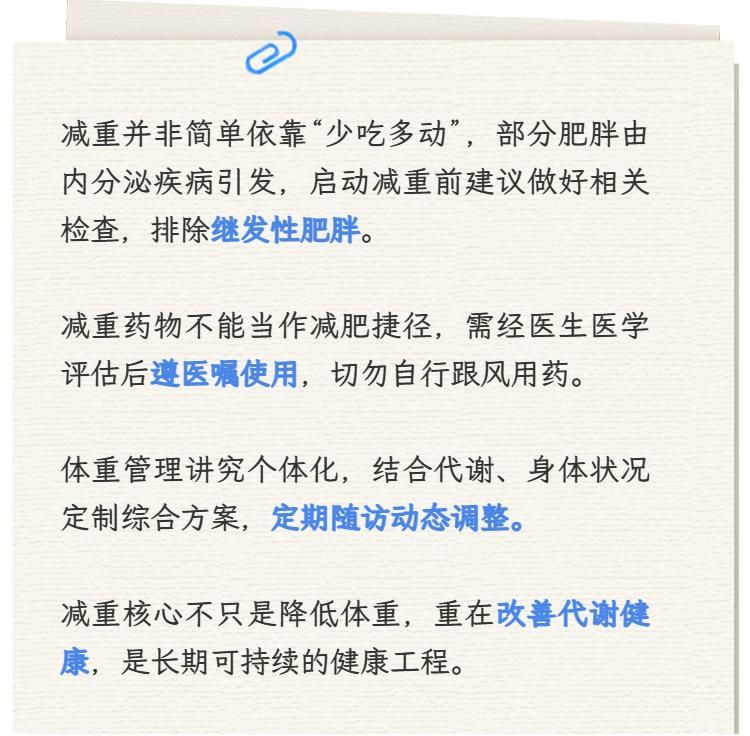
There is also an easily overlooked link between the examination of past medical history. Endocrine diseases such as hypothyroidism and kuchin syndrome can lead directly to secondary obesity, without which hunger and practice alone would be a waste of effort. It is proposed to conduct a basic examination of thyroid function, cortisol, etc., before weight reduction to remove these underlying diseases from the re-start programme。
Step two, set a target of no anxiety
Most people fail to lose weight because the goal is the opposite — to stare at the final weight, not at the milestones。

Some people who lose weight are prone to anxiety in the face of weight scales
The pace of clinical recommendations is 0 to 3 months in the first phase, with the core task of establishing behavioural habits without the need to pursue weekly scales, and 5 to 15 per cent in the second three to 6 months. With only 5 per cent weight reduction, metabolic indicators such as blood pressure, empty abdominal sugar and blood resin have improved significantly。
At speed, 0. 5 to 1 kg per week is a safe zone, corresponding to 2 to 4 kg per month. The weight loss is faster than this, and it's often not fat, but water and muscle. Experimental data from a seven-day total diet show that on average the testee lost 4. 6 kg of thin body weight, with a significant loss of cardiac, skeletal and internal protein。
Once muscles are lost, basic metabolism drops, and the body enters a “energy-saving model”, which is the underlying reason for the loss of weight by people who have repeated diets。
Step three, match the "you" scenario, not the other one
The bottom logic of diet and motion is the same: creating a stable energy gap, but the size and manner of the gap must fit your foundation。
With regard to the energy gap, the 500 kilocalories per day gap is the most mild for the general population and applies to the vast majority of people; the 1,000 kilocalories gap is only suitable for short-term use by the large-based obese population and must be implemented under medical supervision。
The daily intake of calories must never be lower than the individual base metabolic rate, which is medically defined as a very low-energy diet, usually ranging from 600 to 800 kilocalories per day, which is strictly forbidden for long-term use by the general population。

In terms of dietary structure, the most intuitive measure is the “hand-held rule”, which does not require a daily calorie count. One fist-sized staple meal per meal, with priority given to the replacement of fine rice flour with full grain; one hand-held, high-quality protein, fish shrimp, decorated chicken chest and tofu, all within the recommended range; a pair of hand-size vegetables, green leaves and mushrooms, with priority; and about one thumb point size for daily cooking oil。

The weight of the diet can be measured visually by hand
The order of feeding has been changed to “eating first, then eating meat, then eating the main food”, with a glass of warm water before eating, and a seven-point cutter。
With regard to sports, the core configuration is a medium-intensity aerobic exercise of 150 to 300 minutes per week, such as runaways, swimming, riding, combined with resistance training of two to three times a week, with deep crouching, dumb bells and tablet support。
Sport is not as bad as it is, commando-high-strength exercise is highly induced to musculoskeletal cells can cause acute kidney failure when they collapse due to overloading。
Different people, different focus
Do not set yourself up as soon as you get up. Five minutes per hour of work, starting with a daily walk, can speak normally but cannot sing with medium intensity。
The force training was carried out twice a week from self-heavy movements, with deep crouching, wall push-ups, stretching of the bullet belt, 8 to 12 rounds per action, 2 to 3 groups, with a 48-hour interval for muscle repair。
For middle-aged people over 35 years of age, there are two red lines that cannot be touched。
First, there is a strict ban on the use of bioketone, carbon cuts, very low-energy diets with daily intakes of less than 600 to 800 kilocalories, which can quickly cause muscle loss, metabolic cliff breaks and lead to gallopy, low potassium haemorrhagic disease and almost inevitably abscond; second, there is a ban on self-purchase of prescription drugs such as sumigrope and torpopor, which are only available to obese populations that cannot be reduced by 5 per cent after 3 to 6 months of lifestyle intervention, and severe adverse effects, such as insulinitis and enteric infarction, of forced use by normal-weight populations。
The first priority for the obese population is to stop all liquid sugar. The relationship between milk tea, coke and fruit sugar, which enter the liver and are converted into fat in large quantities, with priority piled in the abdominal cavity, is independent of bmi, i. E., the body weight remains unchanged and the abdominal cord increases quietly. It is possible to try to eat at a minimum of 10 hours, and it is self-selected for 10 consecutive hours as a food window, with the remaining 14 hours of water only。

The obese abdominal population should daily reduce the intake of ice and high sugar
A 12-week random control test shows that this method reduces the volume of internal fat by about 185 cubic centimetres and does not need to be calculated deliberately. In exercise, do not sit immediately after dinner, and 15 minutes of slow walking will stabilize the blood sugar and reduce the accumulation of fat to the abdomen。
Step four, monitor and adjust to turn the program into a closed circle
An empty abdominal weight, with weight and waist changes, is recorded every day at a fixed time。