


Processes and modes of marketing
1. Basic marketing processes
Marketing managers are required to perform a variety of tasks, the sum of which is the marketing process. In summary, the entire marketing process consists of six steps:
Market research: systematically designed, collected, analysed and reported data and research findings related to the particular marketing situation facing enterprises. At this stage, marketing managers need to do the following: understand the tasks of the enterprise, set marketing goals, collect, analyse and explain information about the environment in which the enterprise operates, undertake specific research and report。
Breakdown of target markets: market breakdown is a necessary step. Also, for example, there are currently millions of industrial manufacturers in china, each of which theoretically has a need to use them. If a multinational air pressurer, aerodynamics manufacturing firm has just entered the chinese market, are these industrial manufacturing enterprises all customers of this multinational enterprise? That is true in theory, but are they all targeted clients? Not necessarily. Therefore, enterprises need to distinguish between different firms, identify market demand, identify targeted customers, and then integrate their products and services and position them precisely。
Developing marketing strategies: once the target market and demand have been identified, enterprises need to design an appropriate marketing mix to meet the demand of the target market. Marketing combinations are used to varying degrees in product strategies, price strategies, channel strategies and outreach strategies, with the aim of creating exchanges with appropriate methods to meet the needs of individuals or organizations。
Implementation of marketing strategies: implementation is the ultimate purpose of developing marketing strategies. In line with the previously developed marketing strategy, enterprises have put the elements into practice. In the course of implementation, strategies may need to be adjusted in the light of changing realities。
Deployment of digital marketing tools and processes: this is a significant difference between digital marketing and traditional marketing. Digital products and platforms help enterprises to reach and transform customers more efficiently through digital means, including the construction of data mid-stations, the installation of marketing automation tools and processes, and systems interfaces。
Measuring marketing results: has the development and implementation of strategies met expectations? In the digital age, more and more marketing effects can be measured by data。
Overall, marketing is a process that has no end point. If an investigation is to be conducted after the strategy has been developed, will it be completed? The answer is no. The marketing process should be constantly investigated and marketing strategies should be corrected and implemented in a timely manner. Of course, the focus of implementation may vary from period to period。
2. B2b vs b2c marketing model
Business marketing generally falls into b2b and b2c, depending on the market and business model in which the enterprise is located. For both models, we first consider the following questions:
What are the characteristics of b2b marketing
Can b2b marketing learn from b2c marketing methods and methods
What are the characteristics of b2b marketing? B2b is the business-to-business model, which means that your marketing is for distributors or end-business customers, depending on the business characteristics of different enterprises. A large enterprise is made up of different ministries, some of which have direct customers as distributors who are network-driven to meet the needs of end-users through distributor channels, with distributors assuming a very important role throughout the chain of sales, order services and after-sales services, while some of the strategic ministries are oriented towards large end-sale clients, communicating before, during and after sale, directly through the intra-enterprise team and following up。
Because of different business models, different enterprises invest in different marketing resources, priorities and ways of working. While both demand-drilling and marketing activities are dominated by new and long-tailed clients, the latter by maintaining the loyalty of already large clients and exploiting the new needs of older clients。
Generally, under the b2b business model, people's sales have a greater impact on customers, while under the b2c business model, advertising has a greater impact on consumers. Table 1-1 presents a comparison of sales and advertising in terms of the nature of the market, the nature of the product, the life cycle of the product and the price under different factors。
Table 1-1 comparison of personnel sales and advertising under different impact factors
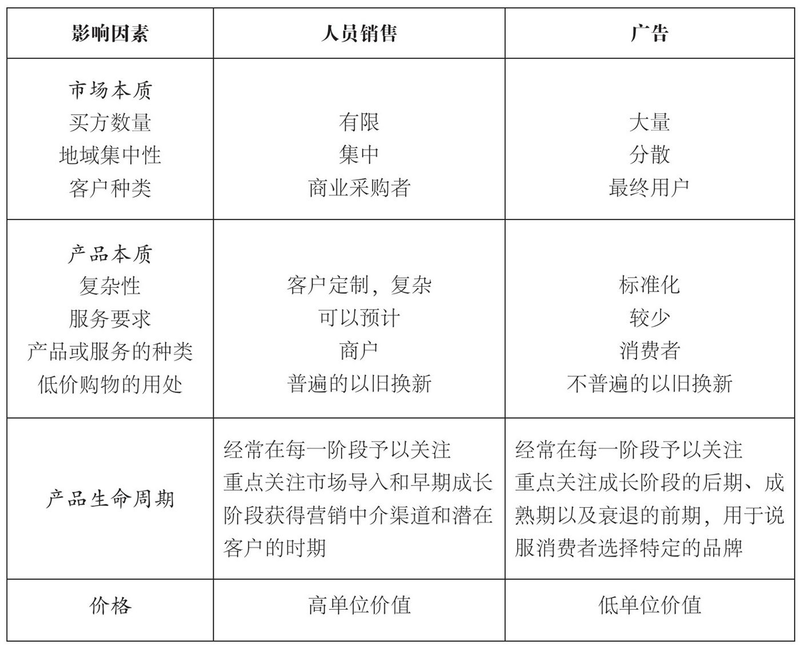
The now popular dtc marketing model, for example, is more oriented towards the former distributor-led business to reduce the value transfer chain of businesses and end-clients through direct-to-end customer marketing and to increase client-to-client efficiency. Businesses based on large clients are dominated by the maintenance of established relationships and value transfer is more done through sales。
At the level of marketing strategies, b2b enterprises can also learn from b2c marketing methods and methods, despite different business models. This is reflected below。
While b2b is a business-to-business model, it is also essentially a human to human, i. E. An enterprise-to-business person, not a business-to-consumer. Since it's human to man, it's natural to have a flesh and a heart. The question of how the products, service concepts and modes of service of an enterprise fit the heart of the client is not related to differences in business models, but is a question of marketing for any enterprise. B2c companies have become more visible in their insight into the needs of their clients and in their insights into human nature, resulting in the creation of a great number of creative works that reach the heart of their clients and that can resonate strongly with them。
B2b enterprises also need to change their mindset from traditional marketing to one centred on data marketing. As mentioned earlier, one of the essences of marketing is data-driven, with b2b having to learn from b2c enterprises, breaking data isolation islands, building digital infrastructure, building data midstations, setting up a global marketing system, and so on. The future is a “customer-centred” digital era, where marketing requires, first and foremost, a comprehensive understanding of customers. If customer data are completely fragmented between systems and ministries, it is bound not to be a “assets” that are well used by enterprises, or even a potential risk to the future of enterprises being phased out by the market。
B2c enterprises have also done better in marketing operations. In the traditional era, when enterprises produce products and customers buy them, the relationship is purely trading; but in the digital age, a growing number of b2c enterprises adopt “customer-to-client” thinking, involving clients at the stage of product development and pre-market testing. Clients are involved not only in product development, but also in product promotion, when their identity is a key opinion client. For b2b firms, the real power of engaging clients more closely, building partnerships, making clients more adhesive and making clients brand-named advocates ambassadors, to reach more potential clients, has become their top priority。
The experience of b2c enterprises in digital marketing has matured and there have been many attempts to explore digital marketing. Whether short video marketing or live telegraphers, private-area operations, and business micro-intelligence, these new marketing methods are also becoming the focus of marketing exploration for b2b enterprises. While business models, target customers and market breakdowns vary, b2c enterprises can still provide good lessons for b2b firms in terms of marketing methods, media environment and rules, and data analysis methods。
Thus, b2b enterprises must learn from b2c advanced marketing concepts and methods in terms of client insight, data-driven large data marketing, marketing operations and mathematical marketing practices in order to generate additional sources of innovation, which are the driving forces of marketing。



