


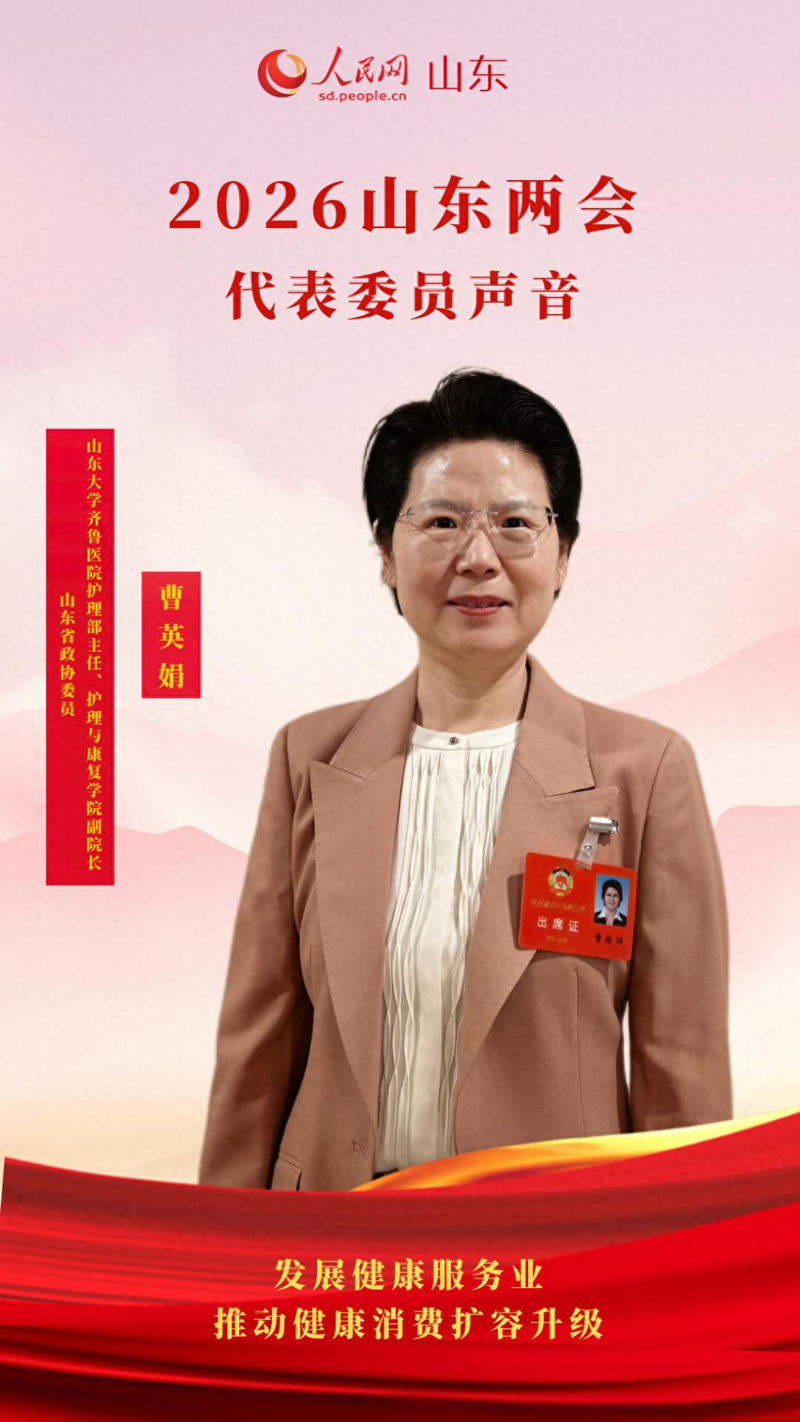
“the health industry is a new engine for economic development, without accompanying care as a key component of the health service, not only to break the `one-person-in-a-house-in-a-house-work' pain point, but also to boost health consumption. During the shandong ii conference in 2026, the shandong provincial political consultative councillor, the director of care at ziru hospital at shandong university and the vice-president of the college of care and rehabilitation, cao young-jin, made an active contribution to the development of the health service and, as a practitioner and member of the council in the field of deep tilling care for more than 30 years, combined clinical practice with industry observation to avoid accompanying care as an entry point and made a series of practical recommendations。
The flourishing of health services is a necessity of the times and a popular aspiration. According to the “health china 2030” programme framework, the total size of our health services will be 16 trillion yuan by 2030. In shandong province, the value of the health-care industry increased by 65 billion yuan in 2024, representing 6. 5 per cent of GDP, but the structure of the industry is still short — a high percentage of the sale of pharmaceutical products, medical devices and consumables, a low proportion of the health-care and health-care services, a non-construction of the high-tech product chain and high-end health-care services, and a gap between the quality of supply of some of the services needed for livelihood and the population's expectations. In this context, the efficiency gains from the exemption of care as a key service for patients directly related to their medical experience and for reducing the burden of family care constitute an important breakthrough in upgrading health services and unleashing the potential for healthy consumption。
As far as the advancement of non-cooperative care is concerned, cao ying is impressed by the fact that, as early as 2024, the national board of health and the provincial board of health had conducted research on the issue and that we had done a number of exploratory work ahead of time at ziru hospital. Following the adoption of the policy, shandong province promptly followed up on the issuance of the supporting document, which, with effect from 1 july 2025, exempted the entire province from the application of the government's guidance fee. This civic service, adapted to an ageing, child-childhood background, is widely appreciated once introduced. In clinical practice, however, cao young-jin found that many of the obstacles constrain the quality of service development: “the need for care for patients and their families has not disappeared, despite the fact that, according to existing policies, many of the patients in zilu hospital have been admitted to care for high-risk and high-risk patients, with rapidly changing conditions, with the possibility of morning or first-stage care and a steady transition from afternoon to second-level care”. This situation, which is “unmatched by the dynamics of the situation and the policy of charging fees”, puts hospital implementation in jeopardy and places an additional burden on the patient's family and process。
In response to this problem, cao young-jin proposed a solution in his proposal. She suggested that, in the light of the experience of the fujian province's s slotting billing, and in accordance with the "governance of guidance prices is the maximum price, no limit, no limit " in the shandong province health care price schedule, medical institutions be allowed to reduce the price appropriately for patients in secondary care, to charge the standard of “basic level”, to exempt them from the cost of accompanying care, to continue the existing price policy for patients in primary care and intensive care, to address the issue of care connection in the event of a change in the condition; and to refine the costing details, to clarify the costing rules, to allow for partial reduction of the cost for part of the family's involvement in the care, following an assessment by the medical institution, in proportion to the length of the care period, or to establish a “night shift slot” in the day range, which would accurately match different family needs。
The uneven quality of professional caregivers is another salient issue. “there is now a great demand for care in the market and a great variety of trainings, but many practitioners have no medical background and no foundation. `the basic requirement to wash hands before and after contact with a patient, to regulate operations from contaminated to clean areas' is problematic.” as cao ying honestly says, care work appears to be simple and highly professional, with different demands for care for different groups of patients; patients need professional training in the care of diversions and in the interpretation of various body data。
To solve this problem, cao young-jin shared the exploration experience of the ziru hospital: “we have signed a framework agreement for cooperation, based on the strength of the national design institute, the training of trainers for specialist nurses at the national head hospital, in cooperation with vocational colleges, to enable students to complete their general education and theoretical studies in schools, with professional and practical skills training by the institute and the hospital, and with the establishment of a platform by enterprises, the introduction of smart equipment, and the stockpiling of young, professional and more loyal personnel.” on that basis, she proposed in her proposal the establishment of a clear threshold of qualifications for the training of care professionals, the establishment of uniform training standards and regulatory mechanisms, the promotion of joint training bases between medical and health-care institutions and medical institutions, the introduction of order classes leading to “recruitment and admission to school”; and the establishment of a system of rating evaluation of care workers, drawing on the experience of guangdong province, linking professional skills, length of service, patient evaluation and remuneration, the addition of differentiated incentives such as medical titles, personalized services, etc., to allow care workers to travel and wish to farm; the development of a sound monitoring and evaluation mechanism, the opening of channels for feedback on complaints, the promotion of quality of services and the optimization of industry。
“accompaniment without escort will require greater government commitment.” cho stressed that special provincial support funds should be set up for the standardized renovation of hospital wards, the addition of barrier-free facilities and ablution facilities, the improvement of the care environment and the working conditions of workers, and the coverage of such expenses as a talent training subsidy, and the explicit exclusion of the exemption from the payment of drg packs in order to avoid the increased burden of hospital services. In addition, she recommends that provincial or municipal-based centralized procurement of smart care equipment be undertaken to reduce procurement costs and labour intensity of care workers, along with a province-wide unified information management platform for care services to achieve full process visualization and standardized management。
In addition to focusing on the improvement of the efficiency of care, cao young-jin has made additional proposals for the overall upgrading of the health services. In combination with medical care, she suggested that “intellectual devices will gradually replace repetitive work such as binary treatment, which guarantees the dignity of the patient and reduces the burden on caregivers; the automated synchronization of vital monitoring data to the health care system will be achieved through smart devices, without the need to copy and reduce duplication of effort”; based on data resources from the national health data centre (north), the development of new practices such as telemedicine, smart medicine, and the improvement of industry standards and regulatory systems; the development of regional centres for medical tourism in areas of pre-eminent advantage, such as jenan, qingdao, and smokey; the realization of two-way capacities for medical and tourism services; the strengthening of “drive” consumption; and the reliance on sanac hospital and health data resources, the expansion of the supply of high-end health consumption, such as intensive medical treatment, high-end medical examination, the development of home-based high-end service brands, and the promotion of a return of consumption to high-end health consumption in the country。
“the nursing industry is the sun-yang industry, and in the future we will contribute to the development of the health services by working at the centre of the international care arena.” as a member of the political consultative council, cao young-jin stated that she would continue to focus on the hard spots in the area of health, turn the real voices of the clinical line into high-quality proposals, lead to the overall upgrading of health services, make health consumption truly more accessible to the population and build a solid foundation for a healthy mountain. ♪ plum jae-joo, intern wang ♪



