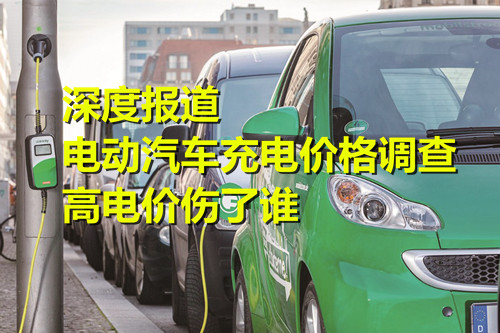
“the country's electricity resources are very rich and civil electricity prices are not high, but the charging price of new energy vehicles is prohibitively high, generally at 1. 6~2 yuan/degree, without reflecting the economic nature of new energy vehicles and limiting the development of industry.” in recent days, yoon yoon, chairman of the board of directors of chiri motors ltd., made a speech about the price of electric cars, which resonated with some car businesses。
In fact, not only new energy car companies and consumers are bearing high electricity prices, but the country's early advance in the new energy car rental industry, the grouping company, has already pioneered car leasing operations, and its president recently stated: “although electricity prices vary from place to place, they are generally too high, so our time-leased businesses are in loss because of high electricity prices.”
An important factor in attracting consumers to new energy vehicles has been the cheap charging of electricity, which has a clear economic advantage over fuel cars. Today, there are many companies that reflect excessive charging prices. What is the real picture? The chinese automotive, combined with the china energy journal, spent half a month interviewing representatives of the industrial chain up and down of the new energy car, listening to the voices of consumers, time-lease companies, charging stakes, car companies and national electricity-related administrations, with a view to ascertaining the situation and clarifying the situation。
Reality
1. 8 yuan/degree
Mr. Zhou, who had been in beijing for more than two years, had been the owner of a biadie6 car and had been deeply concerned about the charge price, since he had used three different charges for two years。
“when the sub-districts were not equipped with chargers, i used the nearby national network public chargers, which were at a preferential price of 1. 2 yuan/degree (based on grain price plus service charges), which, although more expensive than electricity, i found acceptable and less expensive than the odyssey at home.” according to mr. Zhou, “from 15 june 2016 onward, the public charging facility for electric vehicles belonging to the beijing city electricity company of the national network implemented a peak hourly charge at a price adjustment of us$ 1. 0044 per degree at peak (us$ 1. 0044), at normal times (us$ 0. 6950 per degree), at valley hours (us$ 0. 3946 per degree), plus a charge of us$ 0. 8 per degree for charging services at a charge of us$ 1. 2 ~ 1. 8 per degree, which is a very expensive price.”
The reporter asked if it would be cheap to charge in the valley. Mr. Zhou responded that the overall price was still high because of the irregular timing of charging cars and, in most cases, at peaks and at peace. Mr. Zhou had to seek to install his own charger in the district. "it's too cheap for me to get electricity from my house's meter, to use electricity at a price of 0. 5 yuan/degree."
However, not all owners are as fortunate as mr. Zhou, and another ms. U. U. 260, a new source of northern gas, told reporters that although she had installed charging stakes in the district, she could only use electricity from the community property industry at a cost of 0. 8 yuan/degree, close to twice the cost of electricity to the population. Why can't people use electricity? A tesla owner told the journalist why: “if the garage is for industrial electricity coverage, it is subject to industrial electricity charges. If the conditions and location permit the direct lifting of electrical cables from the home, there is no industrial charge, provided the capacity is sufficient.”
In fact, in large cities in the north and above, many of the owners are not in a position to install private charging stakes and use only public charging stakes. Mr. Lee, the owner of the electric car in beijing, was an early buyer of electric cars and, owing to the lack of a fixed space, he had to go to a nearby charging station to recharging. In his words, the cost of charging a public charger is at least three times more than the cost of charging a household。
The chairman of the board of directors of electric-rich technology, pongley, also told journalists that “in places such as malls, supermarkets and so on, charging stakes are for consumers, which would have been consistent with the reduction and reduction of parking fees, but according to my calculations, when parking costs exceed $5/hour, charging is not allowed, and if charged for two hours, it would have cost an extra $10 to charge”
In communication with new energy drivers, journalists found that the majority of consumers were located in small areas of old age, with limited capacity, and that it was no longer easy to install recharge poles, and that a few had access to electricity. In response to this phenomenon, liu kim liang, vice-president of zhejili holdings, inc., said in an interview with the press: “the price of electricity directly affects the power of electric car consumption. The use of electric cars by ordinary people is a private consumption and has nothing to do with industrial, physical and public electricity, of course. Punray also stated: “as a matter of course, most electric cars are used by consumers and should theoretically be paid for civilian rather than industrial electricity.”
High aggregate prices and lower prices for commercial users
In fact, in addition to ordinary consumers, the volume of vehicles owned by an electric car rental company cannot be underestimated, and is the question of the price of electricity genuine? Journalists visited several of the country's major electric car rental businesses to find out the truth。
President wang yang told reporters: “generally, the price of a public charger is approximately $1. 2 to $1. 5 per degree, plus a service fee of 0. 8, and the final price is about $2~2. 3 per degree. Thus, as an operator, the price of electricity is an important factor in our consideration when working with the stakes. From the point of view of the operating costs of the enterprise, i believe that the charging price is indeed high and, if it can be reduced, at least one third of the cost of operating the vehicle.”
Wong chunhua, chief market officer of universal car leasing limited, told journalists that, as a result of the self-charged stake model, the charge would only cover the cost of industrial electricity of 1. 2 to 1. 5 yuan/degree and would not require additional service charges of 0. 8 yuan/degree, which would not be too high compared to the operating costs of other leasing companies. “if the industrial electricity price plus the cost of services were to be calculated at 2. 3 yuan/degree, a vehicle would need 25 degrees of electricity to be filled and about 60 yuan to reach full power. In general, 25 degrees of electricity can run more than 100 kilometres, and this and the cost of the economy-type fuel truck is almost equal.” according to huang chunhua, if prices could be reduced, the operating costs of time-leased enterprises could be reduced and the promotion of time-leased leases could be facilitated。
In addition to time-lease enterprises, there is a group of new energy vehicles that cannot be ignored: electric car drivers who work in taxis and internet traffic. Mr. Meng, a drip driver, told reporters that his car required 22-25 degrees of electric power, usually close to 70 minutes, and that if it was charged in normal and peak hours, plus parking fees, it would cost approximately $45, or around $25. “two years later, battery performance was much lower than before, with air conditioning for guests in winter and summer, requiring frequent recharge of electricity, so that in most cases only the average and peak rates are used. This is not the case when it is thought that electric cars are used at low cost and make more money. I know that this is the price of industrial electricity and i want to use it, but conditions are not allowed.” when he said that, mr. Meng was helpless。
Confused
Can the price of electricity go down? The government says it's a discount
It's not hard to find that there are two things directly related to the charge price, the electricity price and the service fee. So, is the price of electricity and service really high
In 2014, the national commission issued a circular on issues relating to electricity price policies for electric automobiles (hereinafter referred to as " the circular " ), which explicitly provides for an enabling electricity price policy for electric vehicle recharge facilities, in which the cost of electricity for operational centralized power exchange facilities, which are directly charged to the power grid operators, is enforced in large industries. Until 2020, basic electricity charges were waived. Household homes, residential neighbourhoods, and non-resident users of electric charge installed by users of residential electricity prices, as well as the metering of electricity in residential electricity prices; the charging of electricity in government agencies, business enterprises and social public parking spaces, and the “general business and other types” of electricity prices. “this is already a relatively large benefit under the current overall electricity price system in the country.” hobo, a senior engineer at the national network energy institute, indicated。
A reporter from the chinese automotive newspaper interviewed the relevant departments of the national commission for development and reform in this regard and received a response: “with regard to the preferential policy of charging electricity, as far back as 2014, the circular on issues related to the price policy for electricity use in electric motor vehicles has no intention of developing further preferential policies.”
Journalists also noted that, according to the circular, by 2020, government-directed price management had been applied to the charge for electric car recharge services. The cap on the standard fee for charging electricity is set and adjusted by the provincial people's government price authorities or their authorized units. This means that different places have their own pricing rights in charging prices。
The city of beijing is known to have set a ceiling rate of 15 per cent of the maximum retail price per litre of petrol 92 in japan; until 2020, shanghai city will implement a government-directed fee for electric vehicle charging services, tentatively not exceeding $1. 6 per litre; jiangxi will have the highest charge for charging services, plus a charge of 2. 36 yuan/degree; and xi'an city will have the lowest charge for charging services at 0. 40 yuan/degree。
Chen baojiang, deputy director-general of the north gas new energy recharge sector, stated that there was a real difference in stakes or geography and in electricity prices. In general, electricity and service charges for charging facilities operated by the network in different regions are uniform and are implemented according to local standards. Other operators are generally charged the cost of electricity to the property owner at the site where the charging facility is located, and the service fee does not exceed the ceiling rate established in the area。
Can service costs be reduced? The stakes say they're alive
In response to the question about the high charge price, one of the unnamed battery operators argued: “in fact, the charge price is not very high, it is higher than the charge surcharge, such as high parking fees and charging services, and these prices can well be reduced.” on this issue, the chinese automobile journalist interviewed the directors of several charge-point operators, and the answer was not the same。
“we do not have the power pricing rights in charge, but rather in the hands of the relevant government authorities, and the service charges charged by the stakes are to cover the cost of the prior site, the worker's salary, the incremental costs, etc.” ceo jia, the pv technology, told reporters that “service fees are the driving force of investment, but the profits are very low. Moreover, the stakes are not allowed to raise the service fee even if they wish to do so, as the policy sets a ceiling on the service fee.”
In the view of charging stakes, their profit margins are small and survival is at risk if services are not charged. It also argued that electric cars already cost about one third of fuel vehicles, and that the central issue at the moment was not the excessive price of electricity, but the quality of electric cars (renewing mileage and battery life) and the improvement of recharge grids. In addition, the location of charging stakes has a significant impact on consumer use compared to electricity prices。
It is understood that, at present, the vast majority of charging companies still have long-term profits, even if they charge service fees. As li ping, co-chairman of the ninde-era new energy technology co. Ltd., said at a recent international summit forum on lithium industry: “we have investigated a number of charging companies and found that the purely market-based charging stake operators are currently in serious losses. I personally believe that liberalizing the charging network would result in a premium on charging services. It may be considered that the entire national grid is being built, thereby reducing the cost of using electric vehicles.”
After the deputy secretary-general of the chinese union of electric motor charged technology and industry, tehu objected: “this perception is not desirable, the construction of electric vehicle charging facilities must be marketed, and if all of the national grids are built, there is a lack of market competition, which is unhealthy for industry development.”
What do we do
Time price, technology breakthrough is the key
Journalists noted that the circular clearly stated that the establishment of a charge rate for charging electricity should be based on the principle of “soft, preferential” to ensure that the cost of using electric vehicles is significantly lower than that of fuel (or less than gas) and to enhance the competitiveness of electric vehicles in the terminal market, on the basis of lower operating costs for the construction of charging facilities by national and local governments, including through financial subsidies and the free allocation of recharging facilities。
It is clear that the real paradox is that users want to charge lower prices, while management and operators show no space to fall. In addition, the ndc's policy of enabling electricity prices for electric car recharge facilities has a clear exit time, and there is a high risk that basic electricity charges will no longer be exempted from 2020. Thus, charging prices not only present real difficulties in terms of falling but also are subject to rising pressures in the long run。
An expert who had left the national grid had made a proposal to reduce charging prices under the current pattern, arguing that many enterprises now did not receive a premium on basic electricity charges for large industrial power, that local governments should further refine their electricity pricing policies for charging facilities and that they should develop power-based subsidies in conjunction with monitoring platforms, so that the fiscal pressure on local governments in the coming years would not increase significantly。
More experts considered time-consuming electricity prices and technological advances to be fundamental ways of reducing electricity prices. According to pomley, “the european and american countries have more mature electricity systems, with industrial and civilian electricity prices not much different, but with large variations in the peak valleys, which can be drawn from the fact that only a few of our provinces and cities currently have time-consuming electricity prices.”
“in our study, the charge-backing of electric vehicles should be guided by time-priced electricity, which would, on the one hand, reduce the charge-back costs for users of electric vehicles and, on the other, increase the efficiency of the use of recharge facilities.” hobo said, “so our proposal is to promote time-price policy studies by provincial and municipal price authorities, led by the national price authorities, to develop a time-price policy for electric cars that is appropriate to local realities, based on resource endowments, power supply structure, industrial structure, etc., and needs to be further expanded”
With regard to technology applications, hobo suggested that charging prices could also be reduced in the future by improving renewable energy passivity or by providing ancillary services such as grid fm peaks through a wide range of "source-net-post-cars" smart interactions。
“the most important means of addressing this problem is technological innovation, which can significantly reduce parking costs if future recharge technologies are breakthroughs and the recharge time is significantly reduced.” in the view of an unnamed expert, breakthroughs in technologies such as high power speed could play a role in reducing parking costs。